


In Part 7 of Guardians of Kikurungo, we left behind the Kingdom of Paws. Now, we enter another kingdom — Kinyamugara, the Kingdom of Millet.
Part Eight
Kinyamugara: Where Millet Grows All Year Round
Long before imported grains arrived on our tables, millet carried the taste, rituals and identity of our people. But as traditional foods disappear, a question remains: what happens when a society forgets the seeds that fed its ancestors?
By Rogers Atukunda
*
Some memories do not return through photographs.
They return through taste.
A smell.
A sound.
A familiar preparation of food.
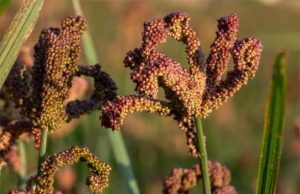
For me, one of those memories is finger millet.
Long before I understood agriculture, culture or heritage, I understood millet as part of life.
It was not just something grown in the garden.
It was part of who we were.
It was a connection between people and the land.
It was a conversation between generations.
Millet was more than food.
It was history.
The Food of the Hills
My grandmother’s generation understood food differently.
Today, food is often discussed in terms of price, availability and convenience.
But in the world I grew up in, food carried meaning.
Some foods were connected to ceremonies.
Some were connected to identity.
Some represented the wisdom of ancestors.
Millet belonged to that category.
It was a royal food.
It carried dignity.
It carried tradition.
It carried the memory of people who understood how to survive with what the land provided.
A millet field was not simply a place where crops grew.
It was a classroom.
A farmer learned patience.
A child learned seasons.
A family learned cooperation.
The entire process — preparing the land, planting, harvesting, drying and grinding — connected people.
The Hands That Carried Knowledge
One of the things I admire most about older generations is that they possessed knowledge without needing to call themselves experts.
A grandmother who planted millet was a scientist.
A farmer who understood the seasons was a climate observer.
A person who selected the best seeds was a conservationist.
They did not use modern terminology.
They simply lived the knowledge.
They knew which seeds survived.
They knew when the rains would come.
They knew how to protect the harvest.
They knew that a seed was not just a seed.
It was a promise.
The Kingdom of Millet
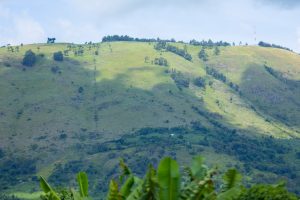
Kinyamugara is the summit of Kikurungo Hill.
This is where millet is grown all year round.
Blessed with fertile soil, and unlike the lowlands where people often harvested twice a year, Kinyamugara allowed a continuous cycle of cultivation.
The gardens were never truly silent.
When one field was ripening, another was being weeded.
When one harvest was being gathered, another garden was being prepared.
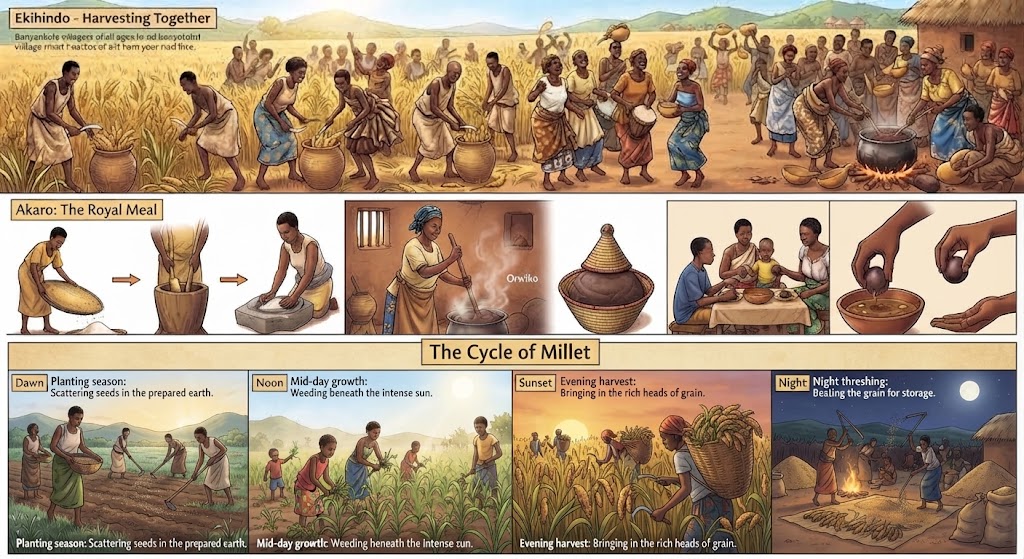
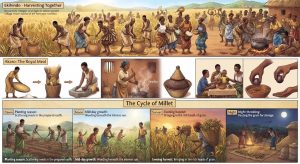
The first season ran from January to April.
January started with land preparation and sowing.
February to March were for active growth and weeding.
Harvesting, drying, and threshing happened in April.
The second season ran from May to August.
May kicked off with immediate land preparation and sowing for the next cycle.
Flowering and grain development ran from June to July.
August was for harvesting the second crop.
The final season ran from September to December.
September involved sowing the final crop of the year.
From October to November, growth and maturation occurred during the final months of the calendar.
December was the final harvest of the year, closing out the cycle.
The hill never rested.
The women of the hill understood time differently.
They did not see a field as empty land waiting to be used.
They saw a conversation between the earth and the people.
My aunts moved through those gardens with the confidence of people who knew they belonged there.
They understood the soil.
They understood rain.
They understood seeds.
And they understood something modern agriculture often forgets:
A seed is not only a beginning.
It is a promise.
Ekyihindo – Harvesting Together
As a child, I believed food simply appeared.
Only much later did I realise every meal had travelled an impossibly long road before reaching our hands.
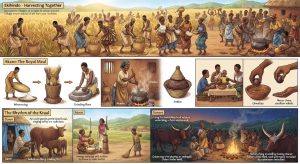
Nothing arrived quickly in my grandmother’s house.
Not milk.
Not meat.
Not millet.
Especially not millet.
Every evening we ate akaro (millet bread or millet paste).
As children, we thought it came from the kitchen.
But supper actually began months before.
It began when my aunts climbed Kinyamugara carrying hoes across their shoulders.
It began when they scattered tiny millet seeds into dark soil.
When they weeded beneath the hot sun.
When neighbours gathered to harvest together until laughter travelled farther than the sound of their curved knives slicing heavy heads of grain.
Millet harvesting itself was not an individual achievement.
It was a community event.
Entire villages gathered to harvest one family’s garden before moving to another.
Harvest season transformed the entire hill.
When one family’s millet ripened, the village came.
Not because they had been hired.
Because next week another family’s millet would be ready.
Then another.
Then another.
Labour moved across the hill like rain clouds.
By sunrise the hills echoed with laughter.
This communal labour was called Ekyihindo.
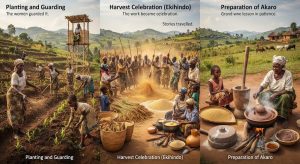
Women bent gracefully through the fields, cutting heavy millet heads with short curved knives and dropping them into woven baskets hanging from their waists.
But ekyihindo was more than work.
It was celebration.
Children chased one another between the stubble (the short, stiff stalks left in the ground after the grain has been harvested).
Old men sharpened blades beneath the shade.
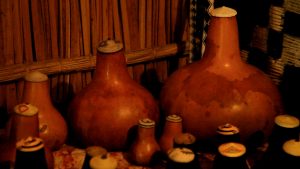
Fermented millet porridge was passed around in orugunda, the long-necked calabash.
The drink was known as obushera bw’enteere or obushera bw’enteezo.
The process began with the grain.
Millet or sorghum was first allowed to sprout and ferment. The grains were partially germinated, sometimes wrapped in banana leaves, placed in calabashes or even buried in pots underground. Once the grains had sprouted, they were dried in the sun and ground into flour.
This flour was different from ordinary millet flour. It carried the fermentation that would transform the porridge.
Normal millet flour was cooked into a thick porridge in blackened pots. Then the enteere better known as amamya — the fermented, sprouted grain flour — was added as a starter.
Left overnight, it worked its way through the thick porridge, thinning it and giving it the sweet, slightly tangy taste of obushera.
It was not the thick porridge we had started with. By morning, it had become a thin, fermented drink that could be gulped down in a few swallows.
Other neighbours arrived carrying calabashes filled with ensande, the fresh banana juice.
There was singing.
There was laughter.
And there was tonto (local brew).
The Making of Tonto
Tonto began its journey as ensande or eshande, the fresh, sweet juice extracted from ripe brewing bananas.
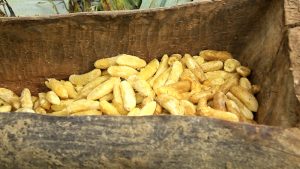
Only special sweet-and-sour bananas were selected.
They were wrapped carefully inside fresh banana leaves and buried in shallow pits beneath the plantation until they ripened in darkness.
When they emerged days later, their sweetness filled the air long before the leaves were opened.
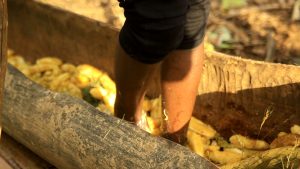
The bananas were peeled into a long wooden trough.
Then came my favourite part.
Feet.
Adults climbed into the trough laughing as they squeezed the fruit beneath their heels, mixing in fragrant lemongrass until thick golden juice flowed like honey.
The first juice was rich and sweet.
It was called Kyihotore.
It was served fresh inside enkyeka, the drinking calabash or orushare, the shallow bowl-like calabash that had been split into two, top to bottom.
The second juice was lighter and thinner, after water was added.
It was called Kiizi.
To make tonto, roasted sorghum flour was added to the banana juice.
Time transformed sweetness into sourness.
The mixture fermented into a sour alcoholic drink.
As children, we waited impatiently.
We hoped to drink it.
Sometimes we succeeded.
Other times, the adults laughed and chased us away.
At one ekyihindo party in Kashangura, my younger brother Simon Ahabwe aka Sai discovered a rather unconventional way of drinking tonto.
The elders had emptied their jerrycans and left them around the compound. Ahabwe went from one to another, tilting each one and gathering whatever drops remained. Drop by drop, he emptied what the elders had left behind.
By the time he had made his way through perhaps a dozen jerrycans, he was completely drunk.
He wandered around the compound, wobbling from side to side, crying and asking everyone he met:
“Do you have more tonto at your home?”
Instead of being punished for daring to drink alcohol, Sai became the entertainment of the afternoon.
Everyone laughed as he staggered around the compound, crying and begging for more tonto.
The making of Enguli
Some families went further, transforming tonto into enguli (a homemade spirit).
Enguli, or crude waragi, was a result of careful distillation.
Tonto was poured into an airtight container, like a pot or aluminium drum.
It was boiled until alcohol vapour separated from water at a lower temperature. The vapour rose through a cooling pipe and condensed into enguli, a much stronger distillate.
Typically ranging from 40% to 50% or up to 80% alcohol by volume (ABV), enguli was so powerful that the adults treated it with the respect one gives both medicine and danger.
It was capable of intoxicating even the strongest men. Some people even died from drinking too much of it.
But if Sai’s drinking was amusing, another incident involving enguli was anything but.
I witnessed it myself.
The village griot, whom we called Katemurura, was famous for his skill on the endingiri, the one-stringed tube fiddle. He could play for hours, until the cows returned to their kraals.
It was even exaggerated that Katemurura could lull a forest to slumber with his music.
That day, he took sip after sip of enguli as he played.
Then, suddenly, he collapsed.
The women screamed and scattered.
As children, we edged closer, frightened but desperate to see what had happened.
The dancing stopped. The singing stopped. Men rushed forward, fanning him with their shirts and pouring cold water over him.
We thought he was dead.
Then, after what seemed like an eternity, he stirred.
He opened one eye.
Then his hand reached for the endingiri.
A familiar tune rang out.
We all breathed again.
And just like that, the dancing and singing resumed.
*
Yet for most families, tonto and enguli symbolised celebration, hospitality and communal harvest.
As children, we watched every stage with wide eyes.
What fascinated me was not the drink itself.
It was the process.
Nothing simply became.
Everything became through care.
Looking back now, I realise my grandmother’s home had no word for “curriculum.”
Yet every season had one.
The rains taught planting.
The dry months taught harvesting.
Morning taught milking.
Evening taught stories.
Every task prepared you for another.
Every responsibility grew naturally from the one before it.
No examination announced your progress.
One day you simply noticed that the adults had begun trusting you with work they once did themselves.
That was how you graduated.
The Grandmother Who Fed a Village
Drinks aside, the biggest part of ekyihindo was the feast.
What is a celebration without food?
In those days, wealth was displayed by elaborate feasts that one family could prepare on special occasions.
My grandmother did not keep cattle alone.
Her homestead was a small kingdom of animals.
There were chickens, goats and sheep, each occupying its own place in the life of the household.
But the animals served different purposes, and my grandmother seemed to understand that instinctively.
The chickens were especially for us grandchildren.
Women of my grandmother’s generation did not always eat the delicacies that we children coveted.
Fish, grasshoppers, eggs and chicken meat were often things they could go without.
They had grown up in a world where adults sacrificed so that children could enjoy what was available.
So when we visited, my grandmother made sure we ate.
She kept chickens partly for that purpose.
If we stayed longer, she might slaughter a goat for us.
The killing of an animal was never treated casually, but neither was food allowed to go to waste. Every part had its place.
And when a cow was slaughtered, the occasion became larger than the family.
People from the village would come.
My grandmother would share the meat.
What could not be immediately eaten was cooked, roasted or smoked and preserved for later.
In those days, preserving food was not a fashionable idea. It was simply how people survived and how generosity worked. A cow could feed a household, but it could also feed a community.
That is one of the things I remember most about her.
She did not seem to understand wealth as something that became smaller when shared.
It became larger.
On occasions like millet harvesting, this ideal was demonstrated.
Harvest days were unlike ordinary days.
No one hurried home.
Women prepared food enough for an army.
Smoke rose from cooking fires long before midday.
Huge clay pots simmered with beans and meat.
Men drank tonto while old songs drifted through the gardens.
Children stole roasted sweet potatoes from the cooking fires and disappeared before anyone could scold them.
Work and celebration belonged together.
The harvest was not only about collecting grain.
It was about renewing relationships.
The grain brought people together before it fed them.
People ate and ate and ate again.
What remained was packed for them to carry home.
Nothing Was Wasted
In my grandmother’s world, an animal rarely became waste.
When a goat or cow was slaughtered, almost everything had a purpose.
The meat was shared, cooked, roasted or preserved.
Even the hide and skin were saved.
They became mats to sit on.
They became bedding.
They were used to make traditional drums.
A hide was dried, then beaten and worked until it softened. Eventually it became a mat on which someone could sit or sleep.
Sometimes the skins were soaked in salty water and later cooked until they became soft. The resulting food was called emihote. It was sometimes fed to the dogs, although some people ate it too.
At other times, the skin was dried, but before it became completely hard, the remaining pieces of meat and tissue were carefully scraped away with special knives. What remained was called enkuru. It could then be cooked with groundnut sauce into a delicacy.
Nothing about the process felt wasteful.
The animal had given its life, and the people made sure that life continued to serve them in as many ways as possible.
I did not know the word sustainability then.
I simply knew that throwing away something useful was foolish.
The cow gave us milk.
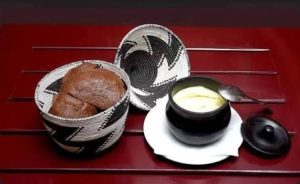
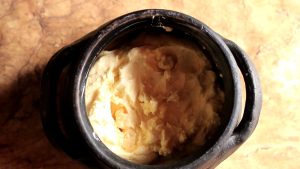
We drank it fresh, sometimes still warm from the udder. It could also be processed into butter, and the butter could be turned into eshabwe, the rich ghee that we ate with akaro, which was a staple of our meals.
The horns had other lives. Hunters and warriors could turn them into ornaments and communication devices.
A part of the animal that might appear useless to someone else could become a tool, a symbol or a means of sending a message across the landscape.
Even the urine had a purpose.
It was used to wash milk gourds, helping keep the containers clean for the milk that sustained the household.
And then there was the dung.
Nothing illustrates the completeness of that old system better than cow dung.
Fresh dung could be used in construction, mixed into the material used to smear the walls of mud-and-wattle houses and semi-permanent homes.
It could be taken to the banana plantation and used as manure.
And when it dried, it became fuel.
I remember the dried cow dung being burned in the kraal. It was particularly useful because a dung fire could remain alive for a long time.
So the cow fed us.
It clothed us.
It furnished our homes.
It helped build our houses.
It cleaned the containers in which its milk was kept.
It fertilised the gardens.
And even after its dung had dried, it could keep a fire burning.
The more I think about it now, the more extraordinary it seems.
We speak today about circular economies, recycling and zero waste as though these are entirely new ideas.
In my grandmother’s world, they were not theories. They were necessities that had become habits, and habits that had become knowledge.
The cow was part of a cycle.
Nothing was simply taken.
Everything was transformed.
And perhaps that was one of the first lessons I learned about guardianship: to guard something is not merely to keep it alive. It is to understand its value deeply enough that nothing it gives you is treated carelessly.
That is a lesson I did not learn from a textbook.
The Stone That Taught Me Pain
One of my lessons in guardianship came through a stone.
I was still a child.
Too young to understand responsibility.
One day, while following the goats and sheep, a snake almost taught me my first lesson about danger.
This was in a small valley near the summit of Kikurungo Hill.
The place was called Omuryamizi (a place of water) since it was the source of the stream that flowed downhill.
I watched something that looked like a stick rise as the goats passed.
It waited.
Then lowered itself.
Then rose again.
It had been waiting for me.
By the time I understood what was happening, it was too close.
I ran.
Fear carried me faster than my little legs ever could.
Then, halfway down the hill, I found what looked like the perfect grinding stone.
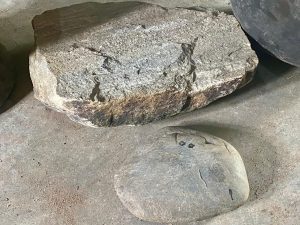
It was flat.
Smooth.
Dark grey.
I imagined grandmother smiling when she saw it.
Perhaps she would use it to grind millet.
Perhaps she would even tell everyone that I had found it.
There was only one problem.
The stone was far too heavy.
I tried lifting it.
It refused to move.
So I rolled it instead.
Step by step.
Slowly.
I would raise the left side of the stone, push forward, then run to the right side and push forward.
The hill became a battle between a child and a piece of the earth itself.
A little at a time.
Down the hill.
Rest.
Push.
Rest again.
Push.
It took what felt like the whole afternoon.
I refused to abandon it.
Then it happened.
The stone slipped.
My finger was caught beneath it.
Pain arrived before the tears.
I looked down and saw blood.
My middle finger was crushed badly.
I cried.
But I did not leave the stone.
Somewhere inside that small injured child was already the understanding that things worth carrying are rarely carried without sacrifice.
I rolled it home.
When my aunts saw my bleeding hand, they were furious.
“What have you done?”
One reached for my arm.
Another reached for the stick she intended to discipline me with.
Before either could touch me, grandmother appeared.
The woman who always embarrassed me by calling me her ‘little husband’, protected me with the same intensity.
Who would touch me in her presence?
She lifted her orubango.
The argument ended.
She did not ask why I had done something foolish.
She took my hand first.
Her hands smelled of smoke, fresh milk and ground millet.
She washed the wound.
Wrapped it carefully in clean cloth.
Then she stroked my head until my sobbing became little hiccups.
Only then did she turn to look at the stone.
“So,” she said quietly, “this is what kept you so busy.”
The anger had already left the compound.
She smiled—not because I had been foolish, but because she understood why I had tried.
She turned my enemy into my inheritance.
The stone that had hurt me became my little grinding stone.
When my finger healed, grandmother let me put my stone to use.
She gave me my own little pile of grain and showed me how it’s done.
I ground beside her.
Slowly.
Clumsily.
Proudly.
It was the first tool that was truly mine.
She had taken the thing that wounded me…
and turned it into a lesson.
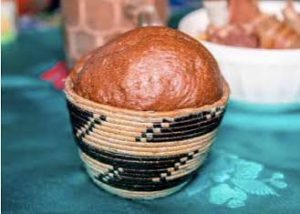
The millet ground on my special stone soon became a paste.
It was served in my own special endiro, a small round basket.
Akaro: The Royal Meal
Preparing akaro, the millet paste, was an art.
Fresh grains were first dried under the open sky in the courtyard.
They were stored carefully in baskets made with crossing patterns of plant materials, sometimes sealed with cow dung to protect them.
Then they were placed inside round and conical-shaped grass-thatched granaries.
Those granaries were not simply storage structures.
They were insurance against uncertainty.
They were promises that tomorrow would not be empty.
Preparing akaro started with drying the millet.
When the grain was ready, it was beaten with omuhini (a special stick) until it separated from its outer covering.
It was cleaned.
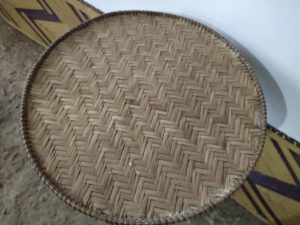
Sorted and winnowed on a wide, flat tray-like basket called orugari.
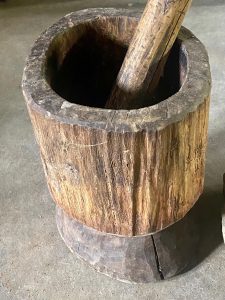
It was pounded inside wooden mortars using a pestle.
It was ground on the grinding stone.
Every stage required patience.
The grinding stone was one of the most important tools in the household.
A heavy stone that had witnessed countless generations of hands.
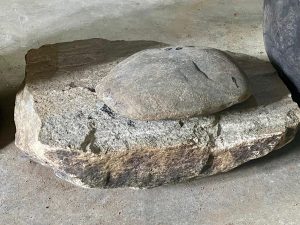
The grain was transformed slowly.
Not by machines.
By rhythm.
By effort.
By relationship.
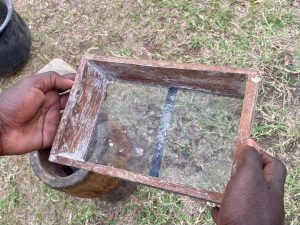
Eventually, the grain turned into flour.
It was sieved with a handmade wire mesh (akakyenkyuzo) to produce fine flour, free of other impurities.
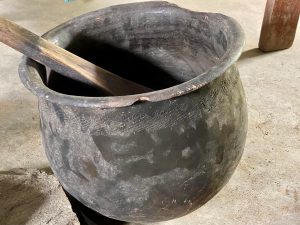
Water was heated in a cooking pot (enyungu) placed upon three stones.
The millet flour was added slowly.
Then came the work of orwiko, the mingling stick.
The flour and water resisted each other at first.
The women then stirred.
Through patience and strength, the flour and water became one.
A heavy, sticky mass.
The finished paste was placed inside endiro, the small conical basket.
Then it was served.
No evening meal was complete without akaro.
How We Ate Akaro
Akaro was more than food; it was something to be respected.
Even the way we ate it reflected that respect — no forks, no spoons, only akaro in a basket and soup in orwabya, the earthen soup bowl.
Eating akaro was itself a ritual.
You did not simply eat.
You participated.
You washed your hands.
You pulled off a portion with your fingers.
You rolled a portion in your palm.
You created a small hollow with your thumb.
Then you dipped it into soup served inside the clay bowl, orwabya.
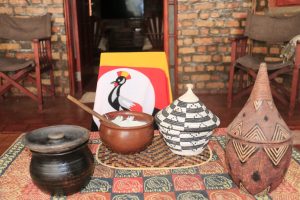
The clay bowl kept the sauce warm.
You then filled the hollow with soup.
Then the whole ball went into your mouth.
We were taught never to chew akaro.
You swallowed it whole.
The Grain of the Kings
Millet was so precious that it was served as a royal meal in ancient kingdoms.
Before I understood that food could carry history, I thought millet was simply what appeared on our plates.
A golden mound of akaro.
A familiar taste.
A meal waiting at the end of the day.
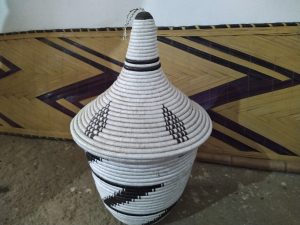
Only later did I understand that every spoonful carried a story older than any person sitting around the table.
Millet was not just a crop.
It was memory planted into the soil.
Because millet was once royal food.
In Bunyoro, Buganda and Ankole traditions, millet was not an ordinary grain.
It carried dignity.
It carried ceremony.
It carried history.
It was a meal fit for a king and queen.
The hands carried the food.
The food carried the memory.
The meal connected the living to those who had eaten before them.
Today, when I see millet losing its place on many tables, I do not only see a changing diet.
I see a conversation being interrupted.
When a grain disappears, a chapter disappears with it.
Because food is never only food.
It is a record of who we were.
And perhaps, if we are careful, it can still guide who we become.
The Disappearing Seed
But today, something is changing.
The fields are changing.
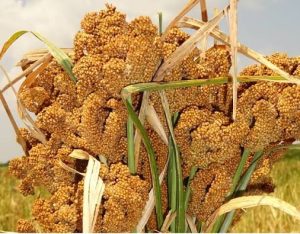
The foods on our tables are changing.
The relationship between people and traditional crops is changing.
Imported grains and new eating habits are gradually replacing foods that once carried generations of meaning.
This change is not only about agriculture.
It is about memory.
Because when a traditional crop disappears, the knowledge surrounding it disappears too.
The songs connected to it.
The preparation methods.
The stories.
The celebrations.
The identity.
A seed carries more than nutrition.
It carries a civilisation.
The Modern Question
I understand that societies change.
No culture remains frozen.
People adopt new foods.
Farmers respond to markets.
Communities adapt.
Change itself is not the enemy.
The danger is forgetting.
The danger is reaching a point where we no longer know why something mattered.
A child should be free to eat modern foods.
But that child should also know the story of the traditional foods that came before.
A farmer should be free to grow crops for income.
But they should also understand the value of preserving indigenous varieties.
Progress should not require amnesia.
The Wisdom of the Old Granaries
The old granaries represented more than storage.
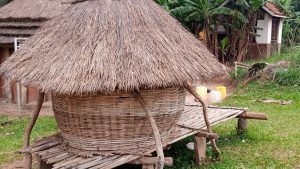
They represented preparation.
They represented independence.
They represented respect for the future.
A family that stored grain understood that tomorrow mattered.
They understood seasons.
They understood uncertainty.
They understood that survival depended on preparation.
Modern society has gained many things.
Technology.
Speed.
Convenience.
But sometimes, in gaining new things, we forget old wisdom.
*
Next Tuesday in The Guardians of Kikurungo
Part Nine: The Guardians We Become — From Kikurungo to the World