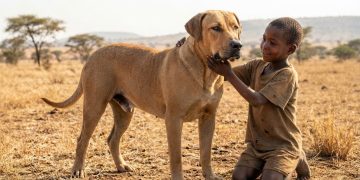



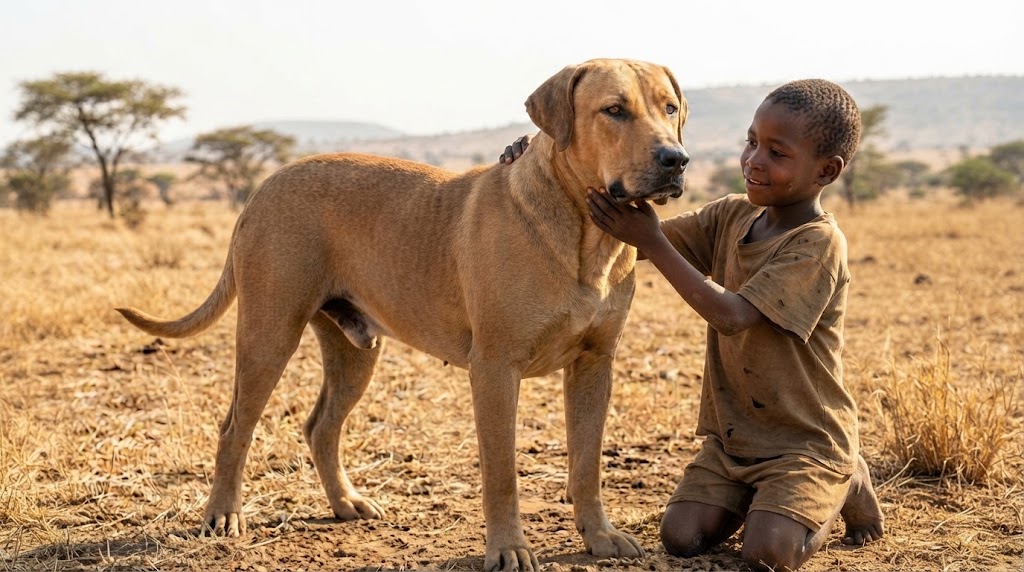
In Part 6 of Guardians of Kikurungo, we entered the Kingdom of Paws and met two legendary dogs — Champion and Kadoma — the guardians who watched over our home and cattle. Now we meet Simba, the King of Dogs.
Part Seven
Simba: The Power of Quiet Authority
Simba taught me that true strength rarely needs to fight at all. He ruled without violence, protected without fear and carried the authority of a king in the body of a dog.
By Rogers Atukunda
*
Every kingdom has a ruler.
Some rulers sit on thrones.
Some rule through armies.
Some rule through fear.
But the greatest rulers do something different.
They create order simply by being present.
In my childhood kingdom of dogs, there was one whose authority was unquestioned.
His name was Simba.
The name itself meant lion.
And in many ways, he lived up to it.
He was not a lion.
He did not need to be.
He carried the spirit of one.
The Power Who Did Not Need to Roar
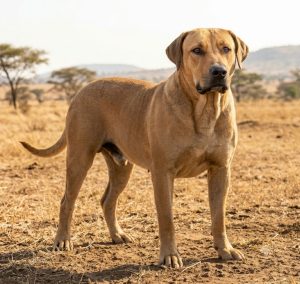
Simba was not a giant, but he sat squarely in that imposing space between an ordinary big dog and a legend.
When he stood, he seemed larger than a dog should be—massive, heavy-set, and impossible to ignore.
His coat was light brown — almost the colour of dry grass after the long dry season.
Everything about him suggested strength.
His body.
His size.
His movement.
Yet Simba taught me that true strength rarely needs to fight.
His greatest weapon was never his teeth; it was his presence.
He did not need to roar.
What made Simba remarkable was not his physical power.
It was his discipline.
He was powerful but controlled.
He was feared but gentle.
He was capable of violence but rarely needed it.
Unlike Champion, who announced danger with action, Simba announced authority through presence.
He almost never barked.
He growled.
A deep, powerful sound that seemed to rise from somewhere beneath the earth.
A sound that did not need repetition.
One growl was enough.
People understood.
Animals understood.
Danger understood.
The Dog Who Ruled Without Fighting
There are creatures that constantly prove their strength.
They challenge.
They attack.
They make noise.
But Simba belonged to another category.
He did not need to prove anything.
His reputation arrived before he did.
Other dogs knew.
Strangers knew.
Even thieves knew.
A person approaching our home understood that crossing Simba was not a simple decision.
His authority created boundaries.
He protected without needing constant confrontation.
This was a lesson I only understood later:
Real strength does not always announce itself.
Sometimes the strongest person in the room is the quietest.
The Kitchen Without Locks
One of my favourite memories of Simba was the trust we had in him.
Our kitchen did not need locks.
It did not need guards.
It had Simba.
When milk simmered over firestones or meat roasted above glowing embers, everyone knew the rule.
Nobody entered without permission.
Not because Simba was cruel.
Because Simba understood his responsibility.
Even Tiger — the female dog who belonged to our home — respected him.
Tiger was the opposite of Simba.
She was small.
Short.
But dangerous.
She had a reputation for biting people, including those who owned her.
She was also a thief.
If nobody was watching, Tiger would take anything she could find.
But when Simba was around, everything changed.
He did not need to chase her.
He did not need to fight.
A single growl was enough.
The king had spoken.
Simba and the Midnight Milk Journey
Some memories reveal the character of animals better than any description.
One night, my sister, Grace, woke up confused by the brightness of the moon.
The light was so strong that she thought morning had arrived.
She went to the kraal to milk the cows.
It was around 3 a.m.
The world was completely quiet.
Most people were asleep.
But Simba was awake.
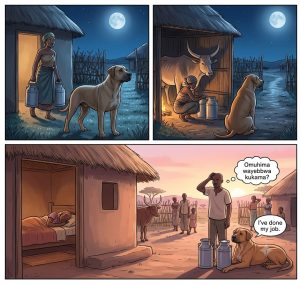
The moment she opened the door carrying milk containers, Simba moved in front of her.
Not behind.
Not beside.
In front.
He became her shield.
After finishing milking, she returned home.
Suddenly, sleep overcame her.
She went back to bed.
Our father was used to hearing her leave for milking at around 6 a.m.
But that morning, he heard nothing.
No footsteps.
No movement.
No doors opening.
Confused, he came looking for her.
He asked: “Omuhima wayebwa kukama?”
(A muhima—cowgirl in this sense—did you forget to milk the cows?)
Then he discovered the milk containers already filled.
The work had been done.
The journey had happened.
Yet nobody had heard her leave.
Only later did he realise what had happened.
She had gone much earlier than usual.
And Simba had guarded her.
*
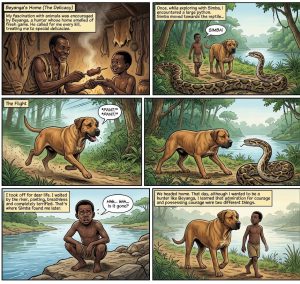
My fascination with animals was encouraged by neighbours like Beyanga, a hunter whose home always carried the smell of fresh game meat.
Every time there was a fresh kill, he called for me. He then treated me to special delicacies.
One morning, my excitement made me run from home without washing my face, earning me a nickname that followed me for life: Katebe.
Beyanga’s sister gave me one look and burst into laughter.
“Look at this one, he looks like Katebe,” she stated.
I don’t know what that meant, but the nickname stuck.
Katebe and the Python
Inspired by Beyanga, I also wanted to become a hunter.
Once, while exploring with Simba, I encountered a large python.
Simba moved towards the reptile while I took off for dear life.
I don’t know what transpired between Simba and the python.
I waited by Omukabare River, panting, breathless and completely terrified.
That’s where Simba found me later, and we immediately headed home.
Although I wanted to be a hunter like Beyanga, that day I learned that admiration for courage and possessing courage were two different things.
The Boys of Kashangura
Like the animals around us, we children also carried names.
I was Katebe.
My friend Dickson Atwine was Izeyi.
Then there was Fula (Francis), whom we called Kanyankore. We lost him a few years ago.
Fula was the son of Maleju, the man we called Kanywani (friend).
His family were hunters and butchers, and there was almost always meat at their home.
Fula had endless stories about hunting with his father and brothers: the places they went, the animals they pursued, the things they saw in the bush.
I could listen to those stories for hours.
Before Fula became my friend, however, he had another role in my life.
He was my tormentor.
Whenever he saw me, he would beat me and harass me. I endured it until one day I decided I had had enough.
I fought back.
For a few glorious seconds, I became Jet Li.
One kick.
Then another.
And another.
Fula did not seem to understand what had happened.
Before he could recover, he was on the ground, clutching his stomach and groaning.
Then came the reinforcements.
He called the cavalry (his older brothers).
I ran.
Fula chased me, but by the time he got anywhere near me, all he could catch was the dust I had left behind.
Something changed after that.
The next time we met, we became friends.
Not ordinary friends.
Best friends.
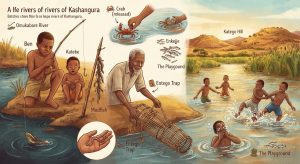
Fula’s older brother, Ben — I have forgotten his nickname — was an expert fisherman. I often followed him to the swamps and wetlands around the Omukabare and Omukafunzo rivers, the latter running below Katego Hill.
Ben knew where the mudfish hid.
He would dig into the soft mud on the riverbed and pull out earthworms. Then he would find a hooked stick, tie a thin, strong thread to it and attach a small metal hook. He would thread the worm onto the hook, from the bottom up to the head, then search for a nook or hole in the riverbed where the water formed a dark pool.
Then came the call.
Ben would make a peculiar sound, calling his prey to the bait. We would wait.
After a while, the line would begin to shake violently.
Ben would pull in one sharp heave.
Up came a mudfish, the hook buried in its mouth.
He would throw it onto the riverbank, then grab it quickly before it could wriggle its way back into the water. He would stick the fish onto a long, straight, sharpened stick and return to the river to repeat the process.
Sometimes we caught crabs — red crustaceans with two arms that looked almost like the blades of a road grader. We threw them back. We did not eat them.
Sometimes we caught small fish called enkejje. I remember these fish for another reason. They were boiled and the soup given to children suffering from measles. That was how I understood them then: not simply as fish, but as something that could help make a sick child well.
The more experienced elders had another method. They would weave a long, narrow basket with a wide bottom and a small opening at the top, tie a rope to it and place it in the river with pieces of food or worms as bait. The mudfish would enter but could not find its way back out.
Mudfish was a local delicacy. It could be cooked as soup, like other fish, or roasted directly over the fire. And whenever the rains came, the rivers seemed to fill with them.
For us, the rivers were another world to explore and a playground for bathing, swimming, and splashing one another. We held competitions to see who could paddle the fastest and who could hold their breath the longest completely submerged.
Izeyi, on the other hand, was not simply my childhood friend.
Somewhere along those hills, he became my sworn brother for life.
The two of us were almost always together, and that was enough to make adults nervous.
Whenever people saw Katebe and Izeyi walking together, they did not wonder where we were going.
They wondered: What are these two going to spoil this time?
Or: What kind of trouble are they brewing now?
And causing trouble seemed to be part of our DNA.
The Mystery of Abwooli
One Saturday, while playing with Izeyi, we spotted our family cat.
She was called Abwooli.
Abwooli was going about her business when, without thinking, we ordered Simba to attack her.
Normally, Simba protected everything around the home.
Even cats.
He was not known for attacking animals without reason.
But what happened afterwards remains one of my most confusing childhood memories.
I remember Simba grabbing the cat and swinging it repeatedly.
Fur flying.
Movement everywhere.
And then silence.
A dead cat.
And the consequences were immediate.
My mother locked me in a goat shed and beat me senseless.
As I lay there crying and groaning with pain, I wondered what had exactly happened.
Even today, I struggle to explain it.
Why did it happen?
What changed?
Why did the dog who protected everything become the cause of destruction?
Perhaps that is another lesson from animals.
They are not symbols.
They are living beings.
They carry instincts.
They carry contradictions.
Just like humans.
The Fruits of the Wild
The elders’ fears almost always came true when they saw Katebe and Izeyi on the move.
Those who owned fruit trees had to stay on high alert.
Those who owned sugarcane plantations kept a close watch.
The grazing hills were our supermarket long before we knew the word.
We survived on wild berries, guavas, mangoes, jackfruits, passion fruits and sugarcane.
Many tasted wonderfully sweet, especially when they belonged to someone else.
Our greatest temptation belonged to a man everyone called Damazo.
He owned magnificent fruit trees.
He also possessed a legendary reputation for miserliness.
Damazo would rather watch ripe mangoes fall to the ground and rot than allow neighbourhood children to eat them.
To us, this created a moral dilemma with a surprisingly simple solution.
If the owner would not save the fruit, perhaps we were merely rescuing it.
At least that was the argument we used to quiet our consciences as we climbed his trees.
Of course, if caught, Damazo would come at us with everything he got — stones, sticks, insults and last warnings.
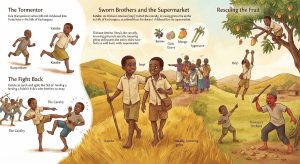
To mitigate this risk, we always left one child down as a lookout while we climbed the trees.
The child would alert us on sighting Damazo, and then we would run for dear life.
The hills were teaching us the generosity — and occasional selfishness — of village life.
The Local Toy Factory
When we were not causing trouble, we put our hands to work.
The wild classroom of Kashangura had its own manufacturing industry.
We had no toy shops.
We had something better: a local factory, open every day, with unlimited raw materials and no adults telling us what we were supposed to make.
We made almost everything.
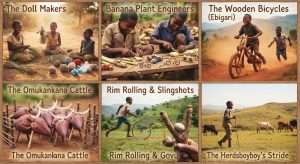
The girls made dolls from dry grass and banana fibres.
They made small balls from pieces of old cloth, banana fibre and sometimes polythene bags. Their balls were usually smaller than the footballs we made from the same materials.
Then there were our ‘machines’.
We used the soft tubes and stalks of banana plants to make cars, bicycles and sometimes what we imagined to be radios.
We cut and shaped the material with small knives, improvising as we went.
Sometimes we found discarded bicycle spokes and used them to make more elaborate contraptions.
Then came the wooden bicycles: ebigari.
We used a special tree called omuko to make the wheels and sometimes the entire structure. They were not toys you simply pushed around. We climbed onto them and rode them.
I still carry scars from endless falls while riding ekigari.
We fell.
We got up.
We rode again.
When we did not have time to build anything elaborate, we simply found an old bicycle or car tyre or rims, rolled it along with a stick and ran after it.
Sometimes we made wheels from leaves, attaching them to sticks and running with them so that the wind spun the leaves.
The materials changed.
The principle did not.
Find something. Imagine something. Make something.
But my favourite creations were our artificial cows.
Perhaps that should not surprise anyone who knew me as a child.
We made artificial cattle from the banana heart or male inflorescence. We called it omukankana — the large, purple-red teardrop-shaped bud at the end of the banana flower cluster.
We collected these from the plantation.
Then we transformed them.
Four small sticks became the legs.
For horns, we searched for curved white fish bones left over from meals. We fixed them onto the front of the omukankana, pointing them upwards.
And suddenly, we had cattle.
Magnificent cattle.
I kept a whole herd.
I even built a kraal for them.
The best-looking cows were always placed at the front, where visiting childhood friends could see them.
I took pride in my breeding stock even though none of them could eat grass, produce milk or run away.
They were dead plant material.
Yet in my imagination, they were alive.
And perhaps this was the strangest lesson of all.
We looked after two kinds of cattle: the living ones grazing across the hills and the imaginary ones we manufactured with sticks, banana plants and fish bones.
The real cattle taught us observation.
The artificial cattle taught us creation.
Then there was govu, our slingshot.
We found a V-shaped stick, attached a piece of rubber or a rubber-like belt to its two ends, placed a stone in the middle, pulled it backwards, aimed at a target and released it.
The stone flew.
There was another version that needed no V-shaped stick. We held the rubber in a semicircle, placed the stone in the middle, swung it around with the arm and then released one side.
The stone flew too.
We used these to shoot birds.
And then there was orubango.
Unlike the other things we made, this was not a toy.
It was a walking stick.
A grazing stick.
A herdsboy’s stick.
And in our hands, even that became a weapon, a hunting spear, a tool of discipline and, sometimes, a form of protection.
Because while we played, the cattle were still grazing.
And someone had to guard them.
These were not toys bought from a shop.
We made them.
That was the important part.
Even our military games were manufactured from whatever the landscape offered us.
We used stems of yam plants to make toy guns.
We tied a rope from the front to the back so the gun could hang across our shoulders. Small reeds held the pieces together; they became our nails.
Those same reeds had another job.
We used them to join the parts of the cars and bicycles we made from banana stems. The inedible lower parts of yam plants became wheels. Long sorghum stems became the rods connecting the wheels.
We were children, but we were also engineers of a sort.
We had no workshop.
We had no instructions.
We had no adult standing over us explaining how machines worked.
We simply looked at things, took them apart in our imagination and tried to make them into something else.
And somewhere between the two, without a classroom, a blackboard or a teacher standing over us, we were learning how to turn the things around us into something else.
We did not know the word engineering.
We were engineering.
We did not know the word manufacturing.
We were manufacturing.
We did not know the word design.
We were designing.
We only knew that the world around us was full of things waiting to become something.
And we had all afternoon to find out what.
The Guardian of Boundaries
Aside from the toys, we also had our own miniature animal husbandry.
Our parents kept cattle, goats and chickens.
We, on the other hand, reared rabbits.
Rabbits were difficult to manage because they could dig holes under their small houses and escape.
They could also roam the compound and end up in the neighbour’s banana plantation.
Unlike goats or cows, you couldn’t control rabbits.
This is where Simba comes in.
Simba did not only protect people.
He protected everything entrusted to him.
He guarded our rabbits.
He watched over the edges of our banana plantation.
He understood the limits of our compound.
Other dogs from the village knew his territory.
They did not simply wander into it.
Simba was not a roaming dog looking for fights.
He stayed home.
He knew his kingdom.
And he protected it.
My sister Grace described him perfectly:
“Simba was Rwabambari in a dog.”
A protector.
A guardian.
A force that stood between danger and those under his care.
The Rival From the Adjacent Hill
But even kings have rivals.
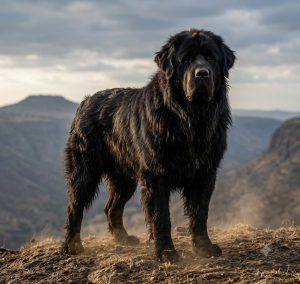
On the neighbouring hill lived another legendary dog.
His name was Rucuncu — meaning lion.
He was owned by my friend Fula’s family.
Rucuncu belonged to Simba’s own lineage.
Simba himself was born from that line.
My brother Jonan remembered Rucuncu as: “The black giant. The dog could rumble like thunder, standing almost a metre tall.”
He was specifically bred for hunting.
Rucuncu was not an ordinary dog.
He was a giant.
Powerful.
Fearsome.
A dog whose size and presence made people stop and look.
The rivalry between Simba and Rucuncu was not about fighting.
It was a recognition of greatness.
Two giants from the same bloodline.
Two guardians.
Two legends.
One on one hill.
One on another.
The Day the King Was Wounded
The hardest memories are often the ones we try to avoid.
One day, I returned from school and greeted everyone as usual.
But something was wrong.
I could not see Simba.
I asked where he was.
My mother told me he was somewhere in the bush, badly injured.
Someone had struck him with a hoe, breaking his back.
I cannot describe the feeling.
Some of my siblings could not gather the courage to go and see him.
I did. I wish I hadn’t.
I still struggle with the way Simba died.
He chose not to die at home.
I have sometimes wondered whether, even in his final hours, he was protecting us from the pain of watching him slowly wither away.
Perhaps he chose the bush because kings have always known when to leave their kingdoms.
Perhaps he wanted us to remember him as he was: massive, strong, light-brown, silent, feared by thieves and obeyed by every creature that knew his name.
Simba did not let us watch him die. He left us with the memory of the king.
The King Remains
When I think about Simba today, I do not first remember his strength.
I remember his discipline.
I remember his loyalty.
I remember a dog who understood responsibility.
A dog who could have dominated through violence but chose restraint.
Champion taught me that courage may require sacrifice.
Kadoma taught me that loyalty is service.
Simba taught me something even deeper:
Leadership is not always about power.
Sometimes leadership is simply the confidence that others feel when you are present.
*
And somewhere in the memories of Kashangura, beneath the same hills that raised us, the footsteps of that giant light-brown dog still seem to echo.
I dread the possibility of losing these memories.
I dread not passing these memories onto my children.
The same fear extends beyond dogs.
It extends to cattle.
It extends to food.
To crops like millet.
*
Next Tuesday in The Guardians of Kikurungo
Part Eight: Kinyamugara: The Kingdom of Millet