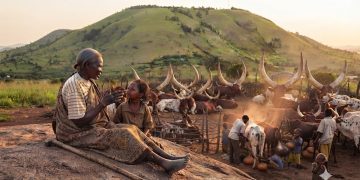



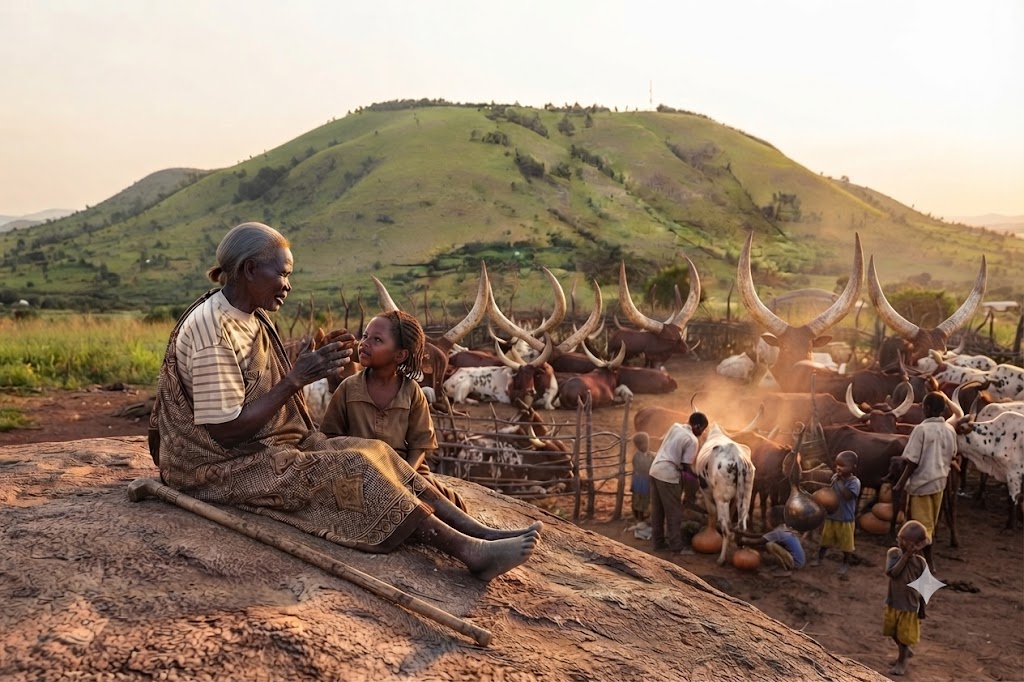
In Part One of Guardians of Kikurungo, I began with the hills, cattle and memories that shaped my childhood. At the centre of those memories was my grandmother, Zeluya Kantooma—the woman whose life would become my first education in land, cattle, family and responsibility.
Part Two
Zeluya: My Grandmother, a Living Archive
She carried an orubango (walking stick), commanded respect without raising her voice, and measured wealth not by what she owned but by how many people found warmth beneath her roof.
By Rogers Atukunda
*
There are people whose presence becomes a place.
Even after they leave, you still feel like you can return to them.
For me, that person was my grandmother, Zeluya.
When I think about Kikurungo, I do not first remember the hills.
I remember her.
I remember the sound of her voice.
I remember the movement of her walking stick.
I remember the way people changed their behaviour when she entered a conversation.
I remember that she could command respect without demanding it.
She was not a woman who needed to announce her importance.
The land already knew.
The people already knew.
The cattle already knew.
A Name That Remembered
My grandmother was called Zeluya Kantooma, Muhara wa Karamagyi ka Butaaho.
To someone unfamiliar with our traditions, it may sound like an unusually long name.
But in the Africa of my grandmother’s generation, names were never accidental. They were deliberate. They carried memory.
She was Zeluya Kantooma, muhara wa Karamagyi ka Butaaho—the daughter of Karamagyi, who was the son of Butaaho.
With a single introduction, three generations stood before you.
Her name was not merely an identifier. It was an oral family tree.
Long before governments issued identity cards or computers stored genealogies, our ancestors carried their lineage in their names.
Every introduction quietly answered the question, “Whose child are you?” It located a person within a family, a clan and a history.
A name carried responsibility as much as identity.
To speak it was to remember those who had come before you and to acknowledge that you were never an isolated individual. You belonged to a people, and your conduct reflected not only on yourself but also on the generations whose names you carried.
Today, we often think of ancestry as something hidden in archives, certificates or digital databases.
My grandmother’s generation carried theirs on their tongues. Every time they introduced themselves, they kept their history alive.
Perhaps that is why forgetting names was never a small thing. To lose a name was to lose a story. To lose enough stories was to lose a people.
When I say, “My grandmother was Zeluya Kantooma, Muhara wa (daughter of) Karamagyi ka (son of) Butaaho,” I am not introducing one person.
I am introducing a lineage.
A Woman of the Hills
My grandmother belonged to a generation that understood responsibility differently.
Today, we often measure success through what a person owns.
A house.
A vehicle.
Money.
Land.
Titles.
But my grandmother lived in a world where a person’s true wealth was measured by something deeper.
How many people could depend on you?
How many hungry people could sit at your table?
How many children could find a home in your compound?
How many families could call upon you during difficult times?
By that measure, my grandmother was one of the richest people I knew.
She owned land.
She owned cattle.
She commanded respect.
But her greatest possession was not what belonged to her.
It was what she gave away: knowledge, stories, cattle wisdom, values and memory.
In a world where wealth was measured by cattle, land and influence, my grandmother taught me another definition of richness: how many people found shelter, food and kindness under your roof.
The Woman Who Shared Her World
She owned half of Kikurungo Hill but shared it with everyone.
Other families could grow crops, especially millet, just beside my grandmother’s gardens.
Other families could rear their livestock in my grandmother’s grazing lands.
As I grew older, I began to understand that Kikurungo was not only teaching me about survival.
It was teaching me about sharing.
It was teaching me about belonging.
A person is shaped by the places that hold their earliest memories.
Before we know the names of countries, before we understand politics, before we learn the language of the wider world, we first understand a smaller universe.
For me, that universe was the hills.
The hills taught me that nothing exists alone.
The cattle depended on the grass.
The grass depended on the rain.
The rain depended on the forests and the seasons.
The people depended on the land.
And the land depended on people who cared enough to protect it.
This was the first lesson of guardianship.
Everything is connected.
The Woman with the Orubango
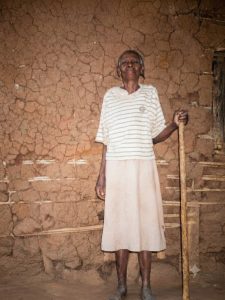
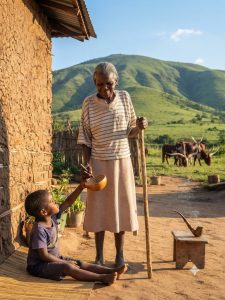
My grandmother walked with orubango, the traditional walking stick carried by elders.
To a stranger, it may have looked like an ordinary stick.
But to us, it represented something else.
It represented experience.
Authority.
Age.
Wisdom.
It was not simply something she used to support herself while walking.
It was almost an extension of her identity.
When she walked across the compound, the movement itself carried meaning.
She was not rushing.
She was not trying to prove anything.
She moved with the confidence of someone who understood exactly where she belonged.
The hills had shaped her.
And she had shaped the people around her.
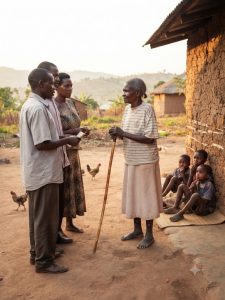
On Kikurungo Hill, even grown men watched their steps when Zeluya appeared carrying her famous orubango.
The grandmother everyone called sister, aunt, or grandmother was not a village official.
She held no government position. Yet disputes from surrounding homes found their way to her compound, and her decisions carried the weight of a court judgment.
Whenever she made a judgment, the case was considered closed.
No one added a single word.
To us kids, that orubango held a very different meaning:
It was a menacing symbol of discipline.
We had repeatedly seen my grandmother use it on her own grown-up children—our aunts and uncles—and even on errant adult relatives whenever they misbehaved.
She never hit us, her favourite grandchildren, but the mere sight of her walking stick was more than enough.
In my grandmother’s presence, good behaviour was automatic.
The First Teacher of Generosity
Children learn many things from adults.
Sometimes they learn from what adults say.
But often, they learn more from what adults do.
My grandmother taught through action.
She showed that food was not only something to consume.
It was something to share.
She showed that land was not only property.
It was responsibility.
She showed that a home was not only a building.
It was a place where people found belonging.
In her world, a visitor was not an interruption.
A visitor was a blessing.
A neighbour’s child could eat.
A relative could stay.
A person passing by could rest.
The door was never simply a door.
It was an invitation.
A Childhood Under Her Shadow
As children, we did not fully understand the significance of the world around us.
Children rarely do.
We simply lived.
We chased goats.
We followed cattle.
We played around homesteads.
We listened to stories.
We moved through a world that felt permanent.
We assumed our elders would always be there.
We assumed the hills would always look the same.
We assumed the traditions would continue forever.
Only later do we understand that childhood is often a journey through a world that is already disappearing.
*
Like Camara Laye’s mother in The African Child, my grandmother Zeluya belonged to a generation whose knowledge was not written in books but carried in their hands, voices and daily actions.
She was not a teacher by profession, yet she educated those around her.
Camara Laye’s mother guarded the spiritual memory of her people (in Guinea).
My grandmother guarded the living memory of ours—the cattle, the land, the seasons and the responsibilities that connected one generation to another.
Both women belonged to a disappearing Africa…
An Africa where wisdom was not something one searched for in libraries; it was something one inherited through living.
The Lessons Hidden in Ordinary Days
My grandmother did not sit me down for formal lessons.
She did not say:
“Today I will teach you about leadership.”
She simply lived.
And by watching her, we learned.
We learned that strength could be gentle.
We learned that authority did not require cruelty.
We learned that generosity was not weakness.
We learned that a person could own much and remain humble.
Those lessons became the foundation of how I understood guardianship.
A guardian is not the person with the most power.
A guardian is the person who uses whatever power they have to protect others.
The Woman Behind the Stories
Many years later, when I began writing about my childhood, I realised something.
My grandmother was not only part of my past.
She represented an entire generation.
A generation that carried knowledge without writing it down.
A generation that understood seasons.
A generation that understood animals.
A generation that understood community.
They were walking libraries.
But unlike books, their pages disappeared when they left this world.
That is why remembering them matters.
Because when we lose these stories, we lose more than memories.
We lose instructions for living.
Creating for Ourselves First
One of the deepest challenges we face as Africans is not a lack of creativity, intelligence or imagination. It is that we have often learned to look outward before looking inward.
Before we ask, “Will our own people understand this?” we ask, “Will the world accept this?”
Before we tell our stories, we imagine the foreign viewer.
Before we write our books, we imagine the international publisher.
Before we make our films, we imagine the festival jury sitting somewhere far away deciding whether our stories are worthy.
Somewhere along the way, we began creating with an invisible audience standing over our shoulders.
The argument is always the same: validation and money. “Will it make money?”
We are told that if we want recognition, funding and success, we must first make ourselves understandable to others. We must package our cultures in ways that are familiar to people outside our communities. We must explain ourselves before we celebrate ourselves.
But perhaps this is where we have misunderstood the purpose of creation.
A people should first tell stories because those stories matter to them.
A people should first preserve knowledge because that knowledge serves their children.
A people should first create art because their own communities deserve to see themselves reflected.
The rest of the world can come afterwards.
This challenge is not limited to storytelling. It exists even in our education systems.
Many of our brightest scholars spend years researching questions that are shaped by priorities outside their communities. A PhD student may spend years studying a subject because it attracts international funding, while the urgent questions surrounding their own villages, cultures and societies remain unanswered.
The knowledge produced may be academically impressive, yet disconnected from the people who need it most.
Imagine if more of our universities asked different questions.
What knowledge can transform our farming communities?
What histories are disappearing because nobody has documented them?
What indigenous technologies can solve modern challenges?
What wisdom exists among our elders that can guide future generations?
What stories have our people carried for centuries that deserve to be preserved?
The purpose of knowledge should not only be to impress the world.
It should also be to serve the people who created it.
This is the philosophy I want to carry into my own work.
When I write stories, I want to begin with my own people.
When I make films, I want the first person who watches them to be someone from the community that inspired them.
I want a child in Uganda to see themselves as the hero of the story.
I want an elder to recognise their memories.
I want families to sit together and say, “This is our story.”
If the world appreciates it afterwards, that is a blessing.
But the first responsibility of an African storyteller is not to seek permission from the world to exist.
It is to remind Africa that it has always had something worth saying.
A tree does not grow by first asking whether another forest will admire its roots.
It grows by feeding from the soil beneath it.
Only then can its branches reach the sky.
The First Guardian I Knew
Before I knew the word “guardian,” I knew my grandmother.
Before I understood leadership, I watched her.
Before I understood culture, I lived inside hers.
She taught me that guardianship begins with care.
Not with authority.
Not with recognition.
Not with reward.
It begins with a simple question:
What has been placed in my hands, and what will I do with it?
That question would follow me throughout my life.
It would appear again in the cattle kraal.
It would appear again among the dogs that guarded our home.
It would appear again when I saw traditions disappearing.
But before I learned to protect animals, landscapes and memories, I first learned from the woman who protected everyone around her.
The Disappearing Classroom
Today, many children grow up surrounded by different realities.
The classroom has become the main place where knowledge is recognised.
And formal education is important.
But I worry that we sometimes forget the other classrooms that shaped generations before us.
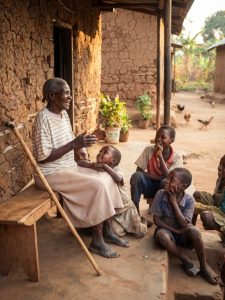
The garden was a classroom.
The cattle trail was a classroom.
The kitchen fire was a classroom.
The evening conversations of elders were classrooms.
The hills themselves were classrooms.
A generation learned how to survive without calling it “survival training”.
They learned leadership without calling it leadership.
They learned conservation without calling it conservation.
They learned responsibility without needing certificates to prove it.
The knowledge was simply part of life.
The Responsibility of Remembering
Years later, when I began documenting stories as a journalist and filmmaker, I realised something.
Many of the stories we consider ordinary are actually treasures.
A grandmother’s advice.
A farmer’s knowledge.
A cattle keeper’s relationship with animals.
A child’s memory of a legendary dog.
A community’s relationship with a hill.
These are not small things.
They are pieces of a civilisation.
The danger is that when the people carrying these memories disappear, the knowledge can disappear with them.
That is why memory matters.
Remembering is a form of guardianship.
Writing is a form of protection.
Telling a story is a way of saying:
“This mattered.”
The Fear of Forgetting
Among all the memories I carry from Kikurungo, there is one fear that has grown stronger with time.
I fear that some of the things that shaped us may disappear before future generations understand their value.
I fear that the Ankole longhorn cattle — animals that carried beauty, identity and history — may one day become memories told by old people.
I fear that millet, once a royal food and a symbol of tradition, will lose its place as imported grains replace the crops that connected generations.
I fear that children may grow up knowing the price of food but not the story behind it.
Already, I have heard some Gen Zs—and even a few millennials—confidently answer “the fridge” or “the supermarket” when asked where milk comes from.
Perhaps it is funny at first. But beneath the laughter is a more troubling question: how far have we travelled from the hands, animals and land that produce the food we consume?
Knowing the market value of cattle but not the cultural value.
Knowing the name of a place but not the meaning behind it.
A society does not lose its heritage in one dramatic moment.
Sometimes it disappears quietly.
One forgotten seed.
One abandoned tradition.
One untold story at a time.
Passing on Responsibility
My grandmother rested in 2003 at the remarkable age of 97.
Time had whitened her hair, but it never bowed her spirit.
Even in her final years, she walked with a straight back and quiet dignity. Age never stooped her frame.
Tall and brown-skinned, she carried herself with the grace of someone who had lived in harmony with the land and with herself.
When she died, we did not remember only her passing. We celebrated her life.
Her funeral was not merely an occasion for grief. It was a gathering of gratitude—a celebration of ninety-seven years filled with purpose, wisdom and service.
We mourned her absence, but we also rejoiced that we had known a woman whose life had touched generations and whose legacy would continue long after her voice had fallen silent.
Although her memory had begun to fade with age, the wisdom she had spent nearly a century gathering had not.
Long before her voice grew quiet, she had entrusted her life’s lessons to another guardian.
That guardian was her only son, my uncle, Ishaka Nterwa.
*
Next Tuesday in The Guardians of Kikurungo
Part Three: Ishaka Nterwa — The Last Stories of a Human Guardian