



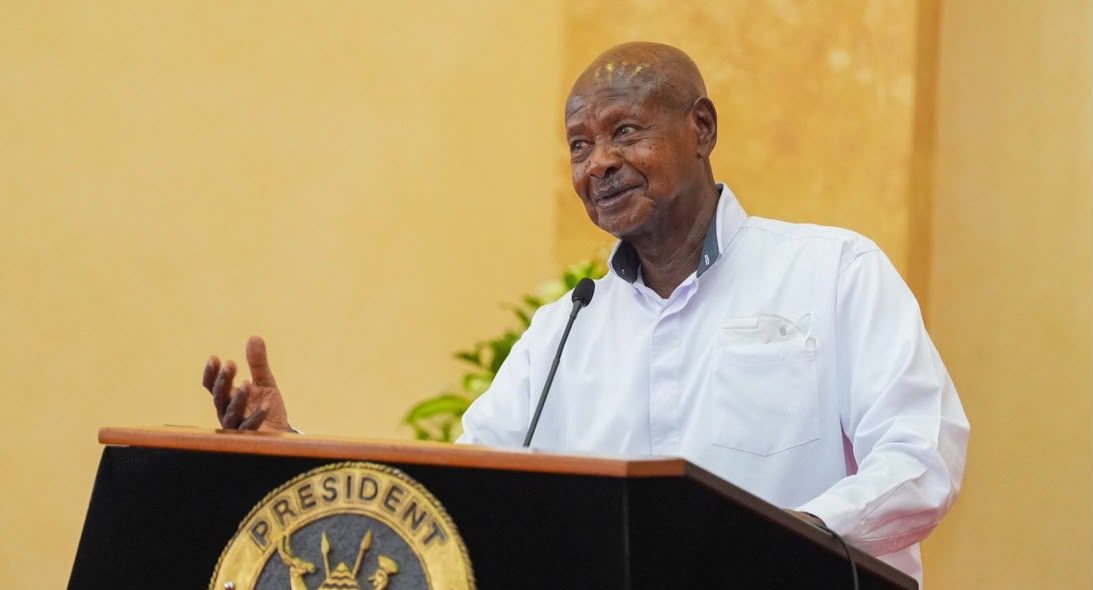
President Yoweri Kaguta Museveni has rejected proposals to sell dollars from Uganda’s foreign exchange reserves to stabilise the shilling, instead urging Ugandans to reduce imports and the country to increase its earnings from exports and tourism.
Museveni said the weakening shilling reflected a shortage of foreign currency relative to demand, warning that using reserves to lower the dollar’s price would deplete resources while financing imports of non-essential goods.
The President made the remarks on Friday, October 9, 2026, during Uganda’s 64th Independence Day celebrations at State House Entebbe, as the shilling traded above Shs4,000 against the US dollar.
“The real solution is to increase our dollar inflows,” Museveni said, attributing the shortage partly to the effects of drought and Ebola on tourism, alongside other factors affecting foreign currency inflows.
He opposed a proposal he attributed to the Governor of the Bank of Uganda to sell dollars to bring down the exchange rate, arguing that the country should preserve its reserves instead.
“I do not agree with that. It is not correct, because you would be squandering our dollars,” he said.
Museveni estimated Uganda’s foreign exchange reserves at about $6 billion and questioned why the country should use them to finance imports of goods such as perfumes and wigs.
“We have a big balance in the bank. I think the reserves are now about $6 billion. But it is not correct to sell them to people who want to import perfumes, or dead people’s hair,” he said.
“Could you stop? Minimise the imports. This is the answer. Import less.”
The President argued that currency depreciation benefits exporters because they receive more shillings when they convert their dollar earnings, although importers face higher costs when purchasing foreign currency.
Using coffee as an example, Museveni said an exporter receiving $2 would earn Shs7,400 when the dollar trades at Shs3,700, compared with Shs8,000 when it trades at Shs4,000, assuming the dollar earnings remain unchanged.
“When the price of the dollar is Shs3,700, I get fewer shillings. When it is Shs4,000, I get more shillings,” he said.
He noted that importers face the opposite effect because they must spend more shillings to purchase the same amount of dollars needed to pay foreign suppliers.
Dollar trades above Shs4,000
The Bank of Uganda’s opening foreign exchange rates on Thursday, October 8, placed the US dollar at Shs4,045 for buying and Shs4,055 for selling.
The central bank’s published rates also placed the British pound at Shs5,336.97 for buying and Shs5,351.38 for selling, while the euro traded at Shs4,526.75 for buying and Shs4,538.76 for selling.
The rates are indicative and may differ from the prices offered by commercial banks and foreign exchange bureaus to individual customers.
The shilling’s depreciation has been driven by strong demand for foreign currency from importers, energy companies and telecommunications firms, among other market participants.
Reuters reported on October 8 that commercial banks were quoting the shilling at between Shs4,090 and Shs4,100 per dollar, compared with Shs3,960 to Shs3,970 a week earlier. The currency had lost more than 11 per cent against the dollar since the beginning of 2026, according to the report.
The Bank of Uganda has said the shilling operates under a market-determined exchange rate, with its value influenced by the supply and demand for foreign currency. The central bank has indicated that it does not intend to defend a specific exchange-rate level, although it has tools to manage excessive volatility.
Museveni links inflation to drought
Museveni also addressed inflation, saying price increases should be understood in the context of economic disruptions, including drought.
“Fortunately, the inflation rate is not so high. It is still about 4%,” he said.
Annual headline inflation stood at 4.6 per cent in September 2026, according to the figures provided by the Uganda Bureau of Statistics (UBOS).
The President argued that increasing foreign currency earnings, reducing dependence on imported goods and strengthening domestic production would help Uganda respond to external economic pressures.
His position contrasts with calls for the central bank to intervene more directly in the foreign exchange market to ease pressure on the shilling. The debate has intensified as the currency’s depreciation raises the cost of imported goods and fuel, while increasing the shilling value of export earnings.
Museveni maintained that Uganda should prioritise earning more dollars rather than spending its reserves to make foreign currency cheaper.