



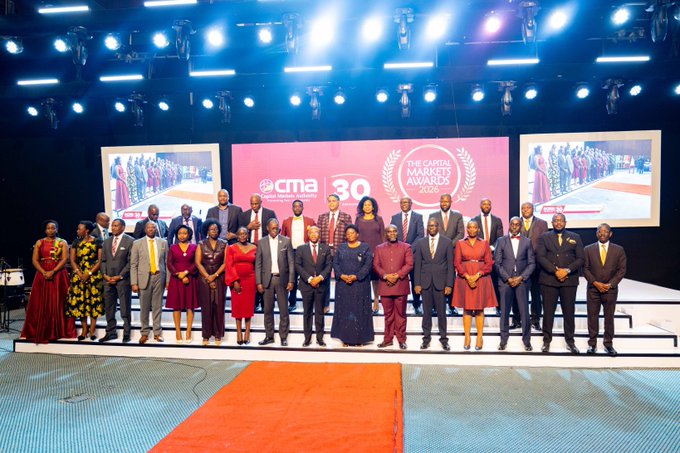
The Capital Markets Authority (CMA) has honoured institutions and individuals for their contribution to Uganda’s capital markets over the past 30 years, as Deputy Speaker of Parliament Thomas Tayebwa called for greater public participation in stock market investment, saying only about 0.5% of Ugandans currently participate in the market.
Speaking at the CMA’s 30th anniversary awards dinner at Kampala Serena Hotel on October 8, 2026, Tayebwa said the regulator should focus on expanding access to investment opportunities beyond the relatively small number of Ugandans currently participating in the stock market.
“I would like to see a future where a teacher in Mitooma can invest part of their salary in a listed company and benefit from its growth.”
He pledged Parliament’s support for reforms that would make it less costly for companies to list on the Uganda Securities Exchange while maintaining investor confidence and market integrity.
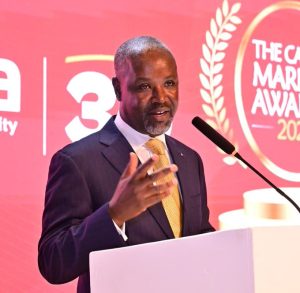
Tayebwa said the country’s ambition to build a $500 billion economy required patient, long-term capital to finance businesses, value addition, industrialisation and job creation.
The awards dinner marked three decades since the establishment of the CMA in 1996 and recognised institutions and individuals who have contributed to the development of Uganda’s capital markets.
CMA targets one million investment accounts
CMA chief executive officer Josephine Okui Ossiya said the capital market must connect Ugandans’ savings to businesses and projects requiring long-term financing.
“Thirty years ago, a small team began building that possibility. Today, as we mark thirty years of the Capital Markets Authority, we honour the founders and every Board, staff member, market participant and partner who helped turn that vision into an institution,” Ossiya said.

She said long-term savings held by pension funds, insurance companies and collective investment schemes exceeded Shs45 trillion, but a significant share remained concentrated in short-term deposits and government securities.
“We must therefore do more to connect Uganda’s own savings to Uganda’s long-term development,” she said.
Ossiya announced that the authority was targeting one million funded collective investment scheme accounts within five years, supported by simpler digital registration, affordable products and access beyond Kampala.
“A Ugandan should be able to explore a regulated investment opportunity from Arua, Kabale or Soroti as readily as from the capital,” she said.
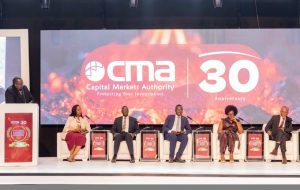
She also outlined plans to attract more public and private companies to the market, expand financing instruments such as infrastructure and green bonds, strengthen real estate investment trusts and develop private equity and venture capital frameworks.
The authority is also participating in government efforts towards Uganda’s first sovereign sukuk, an Islamic finance instrument that could broaden the range of investment products available to the market.
Nuwagaba cites growth from two desks
Bank of Uganda Deputy Governor Prof. Augustus Nuwagaba reflected on the CMA’s development from a small operation housed in the central bank’s headquarters to a regulator overseeing a market with domestic capitalisation exceeding Shs15 trillion.
Nuwagaba recalled that the authority operated from a basement office known as “Floor Zero” when it was starting out.

“Thirty years ago, this market was almost all maroon: Sweat, Commitment and Patience. Tonight, at last, we can all see the Gold,” Nuwagaba said, using the event’s maroon-and-gold dress code to illustrate the market’s progress.
He said the authority had helped build a market that now includes securities brokers, fund managers, collective investment schemes and hundreds of thousands of investor accounts.
Nuwagaba said the Uganda Securities Exchange was licensed in 1997, with its first product being a bond issued by the East African Development Bank. Uganda Clays became the first company to conduct an initial public offering on the exchange in March 2000.
He cited the listings of MTN Uganda in 2021 and Airtel Uganda in 2023 among the milestones in the market’s development.
However, Nuwagaba warned that Uganda still faced challenges including limited trading liquidity, too few listed domestic companies and competition from government securities for investors’ funds.
“Listings are a means, not the measure. The purpose of a capital market is to finance the growth of real enterprises,” he said.
He called for more companies to raise capital through the market, greater investment in long-term assets and stronger regional integration to expand opportunities for investors and businesses.
Nuwagaba also urged fund managers to take investment products to ordinary citizens through mobile phones and other accessible channels, while strengthening public confidence in regulated investment opportunities.
Old Mutual, Pearl Capital among award winners
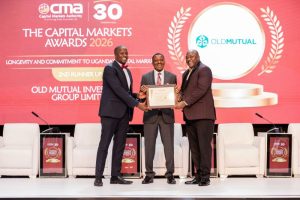
Old Mutual Investment Group Limited received two awards: the Market Development Excellence Award for Collective Investment Schemes and the Longevity and Commitment to Uganda’s Capital Market Award.
The company, which has operated as a licensed stockbroker since 1999, was recognised for its sustained presence in the market and the scale of its collective investment scheme business.
As of June 30, 2026, Old Mutual had Shs4.1 trillion in assets under management, representing approximately 58% of the collective investment schemes market, according to the award citation.

Pearl Capital Partners Uganda Limited won the National Economic Impact Award in the market intermediaries category for its management of the Yield Uganda Investment Fund.
The fund had secured commitments of €16 million across 15 agricultural small and medium-sized enterprises and disbursed €13.77 million. Its investments supported businesses in sectors including coffee, livestock, dairy, seeds, organic farming and agro-processing.
According to the award citation, portfolio companies supported 6,691 certified smallholder farmers and generated employment for 1,317 permanent workers and 3,772 casual labourers.
In the same category, Inua Capital Uganda Limited was first runner-up, while the Uganda Securities Exchange was second runner-up.
The National Economic Impact recognition for listed companies highlighted the contribution of businesses trading on the Uganda Securities Exchange. The award citation said listed companies had collectively raised Shs2.3 trillion through the exchange.
NIC Holdings and NIC General Insurance, represented at the event by managing director Dan Musiime, also received a National Economic Impact Award recognising their contribution to Uganda’s economic development.
In the Market Development Excellence category for equity and fixed income, the Uganda Securities Exchange was the overall winner, followed by Crested Stocks and Securities Limited and Dyer & Blair Uganda Limited.
The exchange was recognised for facilitating more than Shs1.84 trillion worth of stock trading over the preceding decade.
Sanlam Allianz Investments Limited won the Capital Markets Digital Transformation Award for initiatives that allow Ugandans to invest through mobile platforms, including Yinvesta, developed in partnership with MTN MoMo.
Cornerstone Asset Managers Limited received the Outstanding New Entrant Award after mobilising Shs250 billion in collective investment scheme assets and Shs557 billion in segregated assets by June 2026, following its licensing in December 2024.
The awards also recognised institutions supporting the wider development of Uganda’s capital markets, including the National Social Security Fund, the Ministry of Finance, Planning and Economic Development, the Bank of Uganda and the Nairobi Securities Exchange.
Finance Minister Henry Musasizi said Uganda’s capital markets will be critical to financing the government’s ambition to grow the economy from about US$70 billion in the 2025/2026 financial year to US$500 billion by 2040.

In remarks delivered for him earlier, Musasizi said the national budget and bank lending alone could not meet the country’s long-term financing needs.
“Power stations, roads, dams, and processing plants earn returns over long periods and require long-term, patient capital—which is the specific function of capital markets,” Musasizi said.
He outlined five government commitments, including encouraging public enterprises to raise long-term financing through bonds and partial listings, using capital markets to finance infrastructure, reviewing tax and regulatory measures to lower the cost of capital, and enabling pension funds to invest more in long-dated Ugandan securities within prudent limits.
Leaders honoured for building the market
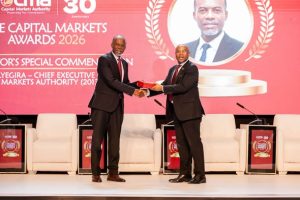
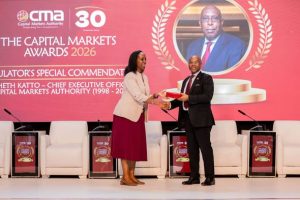
The CMA’s special commendations recognised former chief executives Japheth Katto and Keith Kalyegira, current chief executive Ossiya, past board chairpersons and other individuals credited with establishing and developing the authority.

Nuwagaba praised Katto, the authority’s founding chief executive, for helping establish the regulatory framework and introducing investment education initiatives. He also recognised Kalyegira’s leadership during major listings, including MTN Uganda, Airtel Uganda and Cipla Quality Chemical Industries.
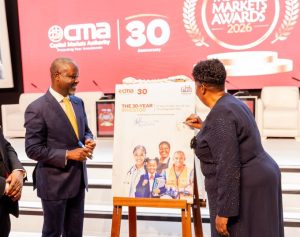
The anniversary celebrations also featured the launch of the 30-Year Investor Campaign, a public awareness initiative developed by the CMA in collaboration with the Uganda Institute of Banking and Financial Services to encourage more Ugandans to embrace long-term investing.