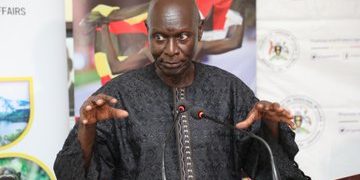



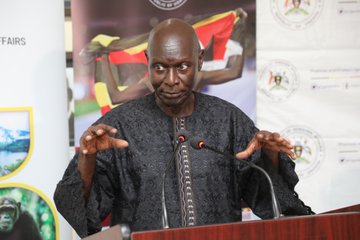
KAMPALA — As Ambassador Olara Otunnu campaigns to become the next Secretary-General of the United Nations, his candidacy carries a remarkable historical connection to the very process that determines who leads the world’s largest international organisation.
More than four decades ago, the Ugandan diplomat introduced a confidential voting system that helped end a deadlock in the United Nations Security Council. The method, now widely known as the “Otunnu Formula,” has since become a key part of how the Security Council builds consensus before recommending a candidate for the world’s top diplomatic post.
Today, as Uganda seeks to secure international backing for Otunnu’s candidacy, the diplomatic innovation he introduced in 1981 has returned to the spotlight.
What Is the Otunnu Formula?
The Otunnu Formula refers to a system of confidential straw polls first introduced in December 1981 when Olara Otunnu was serving as President of the United Nations Security Council.
At the time, the Council faced one of its toughest political challenges. Member states were deeply divided over who should succeed Secretary-General Kurt Waldheim. The Cold War rivalry between the United States and the Soviet Union had turned the selection process into a diplomatic stalemate, with repeated rounds of voting failing to produce a consensus candidate.
As President of the Council, Otunnu proposed a simple but innovative solution.
Instead of forcing countries into public votes that could expose political divisions and trigger vetoes, he introduced confidential, informal ballots. Council members could privately indicate whether they encouraged, discouraged, or had no opinion on each candidate.
The confidential process allowed diplomats to test support, identify candidates who could command broad acceptance and quietly eliminate those likely to face a veto from one of the Council’s five permanent members.
The approach broke the deadlock and paved the way for the selection of Javier Pérez de Cuéllar of Peru, who was later recommended by the Security Council and appointed by the UN General Assembly as Secretary-General.
Over time, the procedure evolved into the standard method used during every subsequent selection of a UN Secretary-General.
How the UN Chooses Its Secretary-General
Although all 193 UN member states participate in the appointment process, the decisive stage takes place inside the 15-member Security Council.
The selection follows several steps.
First, member states nominate candidates for the position.
The candidates then present their vision for the United Nations through informal dialogues with member states and engage in diplomatic outreach to build international support.
The Security Council subsequently conducts a series of confidential straw polls to assess each candidate’s chances of securing consensus.
These informal votes—based on the Otunnu Formula—allow Council members to measure support before any formal decision is made.
The process is especially important because the five permanent members of the Security Council—China, France, Russia, the United Kingdom and the United States—each hold veto power. A candidate who faces opposition from any one of these countries is unlikely to advance.
Once the Council agrees on a candidate, it formally recommends that person to the UN General Assembly.
The 193-member Assembly then appoints the Secretary-General, usually by consensus.
Why the Formula Changed UN Diplomacy
Before the introduction of confidential straw polls, selecting a Secretary-General often involved open political confrontation, making it difficult for governments to change positions without losing face.
The Otunnu Formula created space for quiet diplomacy.
Countries could express their true preferences without public pressure, while candidates gained a clearer understanding of their level of support before formal voting began.
In later years, the system was refined further through colour-coded ballots that allowed diplomats to determine whether opposition came from one of the Security Council’s permanent members or from its elected members.
Although the procedure has evolved, the principle introduced by Otunnu—building consensus through confidential consultations—remains at the heart of the Security Council’s selection process.
The Ugandan Diplomat Behind the Formula
Olara Otunnu served as Uganda’s Permanent Representative to the United Nations before later becoming UN Under-Secretary-General and the first Special Representative of the Secretary-General for Children and Armed Conflict.
Throughout his diplomatic career, he earned a reputation as a consensus builder, often working to bridge divisions during periods of international tension.
His curriculum vitae also credits him with helping broker another diplomatic compromise in 1983 during tensions surrounding the Grenada crisis while serving as Chairman of the UN General Assembly Credentials Committee.
These achievements have become central to Uganda’s argument that Otunnu possesses the diplomatic experience needed to lead the United Nations at a time of growing geopolitical divisions.
Why the Formula Matters Today
The United Nations is once again preparing to choose its next Secretary-General as António Guterres approaches the end of his second term.
Uganda has nominated Olara Otunnu for the position, placing him in the unusual position of seeking an office whose selection process he helped reshape more than 40 years ago.
Supporters argue that his role in creating the confidential straw-poll system demonstrates the kind of patient diplomacy and consensus-building that the United Nations needs as it confronts wars, humanitarian crises, climate change and increasing divisions among major powers.
Whether or not Otunnu ultimately secures the organisation’s highest office, the diplomatic innovation that bears his name has already secured him a lasting place in United Nations history.
Today, every race for Secretary-General begins with a process that traces its origins to a Ugandan diplomat determined to find common ground when the world’s most powerful nations could not.