


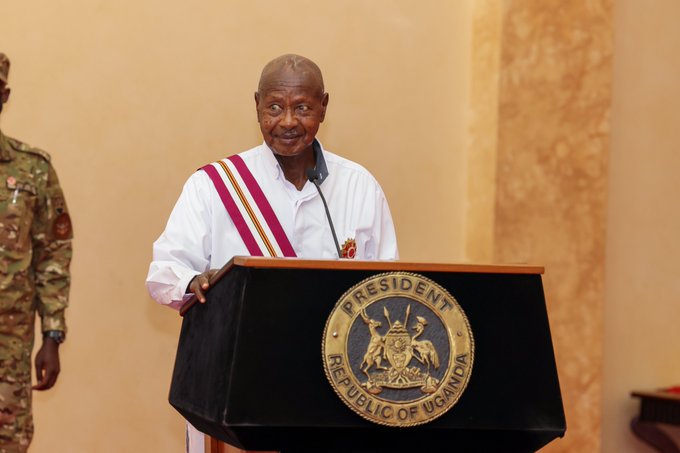
President Yoweri Kaguta Museveni has projected that Uganda’s economy will grow to nearly US$74 billion by June 2027, calling for increased industrialisation, value addition, improved transport infrastructure and greater participation of households in commercial economic activity.
Addressing Uganda’s 64th Independence Day celebrations on Friday, October 9, 2026, from State House Entebbe, President Museveni said the economy had grown from approximately US$3.9 billion in 1986 to US$69.3 billion, while identifying wealth creation and the development of a knowledge-based economy as priorities for the next phase of transformation.
The celebrations were held under the theme, “Embracing Our Sovereignty with Hope and Visionary Leadership.”
President Museveni said Uganda had lost 24 years between independence in 1962 and the National Resistance Movement (NRM) government’s rise to power in 1986 because of conflict, political instability and economic decline.
“First of all, I congratulate all Ugandans on this occasion of 64 years of Independence. Those 64 years, some of the years were wasted between 1962 and 1986. We had 24 years of conflict and decline, and fighting,” he said.
Five phases of economic transformation
President Museveni said the government had pursued five phases of economic transformation: minimum recovery, expansion, diversification, value addition and the development of a knowledge-based economy.
He said the colonial economy had relied heavily on a narrow range of commodities, leaving much of the population outside the money economy. The regime of former President Idi Amin, he added, further weakened several productive sectors.
“The British left a small cash economy of 3Ts and 3Cs, including copper, cotton and coffee, tobacco, tourism and tea,” he said.
President Museveni said the government first focused on reviving collapsed sectors before expanding production and introducing new sources of income.
He cited the recovery of tea production, which he said had risen from three million kilogrammes to 60 million kilogrammes, and an increase in coffee production from approximately three million bags to nine million bags.
He also called for greater commercialisation of agricultural products, including milk, fruits, maize, beans, bananas, millet and fish, saying they could generate more income for households and supply local industries.
Recalling his experience as a milk producer, he said: “I was a milkman, but my milk wasn’t in the shops under the colonial system.”
Value addition and knowledge economy
The President identified value addition as a central priority, arguing that processing locally produced raw materials would enable Ugandans to earn more from their products and create jobs.
“When you add value, you get much more money than when you sell raw materials,” he said.
Using coffee as an example, President Museveni said raw coffee could fetch about US$2 per kilogramme, while processed products could command higher prices depending on the product and market. “This is the battle we are engaged in, value addition,” he said.
He urged manufacturers and entrepreneurs to expand local processing instead of relying primarily on exports of unprocessed commodities.
President Museveni also identified science, technology and innovation as increasingly important sources of economic growth, citing electric vehicles, pharmaceuticals and computers as examples of knowledge-intensive products.
“There are products which are products of knowledge, science, and that’s where we have started moving. Uganda is making electric vehicles. We are now using knowledge to produce wealth,” he said.
He said the development of local technological capacity, skilled workers and industries producing higher-value goods would be important to Uganda’s long-term economic prospects.
Transport infrastructure
President Museveni identified transport infrastructure as another priority, citing traffic congestion and the heavy reliance on roads to transport cargo and petroleum products.
“One of the gaps we shall have to deal with is the transport system, now it’s akatogo, the traffic jam,” he said.
He said the government was pursuing petroleum pipeline infrastructure with Kenya to reduce the movement of fuel tankers on roads. Plans to rehabilitate the metre-gauge railway, develop the Standard Gauge Railway (SGR) and improve water transport were also part of efforts to ease pressure on the road network.
The President highlighted proposed railway connections to western Uganda and Karamoja, which he said had deposits of minerals including marble, limestone and gold.
He estimated that inefficiencies in the transport system cost Uganda approximately US$1 billion annually, arguing that improved infrastructure would reduce logistics costs and improve the competitiveness of locally produced goods.
Households urged to join money economy
The President also called for more households to engage in commercial production and enterprise, saying national economic growth must be accompanied by increased household incomes and productive assets.
He said Operation Wealth Creation had increased the proportion of Ugandans participating in the money economy from 32 per cent to 61 per cent, while the Parish Development Model (PDM) had raised the figure to 67 per cent.
He challenged political, religious and cultural leaders to identify households in their communities that remained outside commercial economic activity and help them establish sustainable sources of income.
President Museveni cited Kisozi, where he said approximately 90 per cent of households were now participating in the money economy, compared with widespread poverty when he visited the area in 1990.
He also recounted the experience of a woman identified as Deziranta Tumusiime from Rubirizi, who he said had not owned productive assets before benefiting from the PDM.
The President said the government would continue supporting households through coffee and fruit seedlings, dairy farming, pasture development, piggery, poultry and fish farming.
He said the objective was to bring the remaining 33 per cent of households outside the money economy into productive commercial activity.
Progress, Peace and Stability
Vice President Jessica Alupo congratulated Ugandans on the 64th anniversary of independence, citing progress in peace, stability, unity and development. “I congratulate you and all the people of Uganda upon reaching 64 years of Independence,” she said.
Alupo also highlighted women’s empowerment and the government’s 10-fold growth strategy, pledging continued support from women leaders for the country’s development agenda.
Minister for the Presidency Milly Babirye Babalanda said the Independence Day theme called on Ugandans to reflect on the country’s history, honour those who fought for freedom and recognise the responsibilities associated with sovereignty.
She paid tribute to historical figures, including Omukama Kabalega of Bunyoro and Kabaka Mwanga, alongside other patriots who contributed to the struggle for independence.
“Uganda’s Independence wasn’t achieved on a silver plate,” Babalanda said.
She said political independence was only the first stage of liberation, adding that economic independence remained a key development objective.
“President Museveni has consistently emphasised that economic Independence is the way to go,” she said.