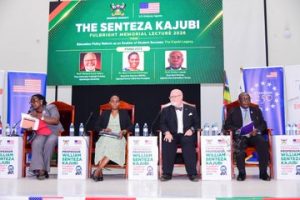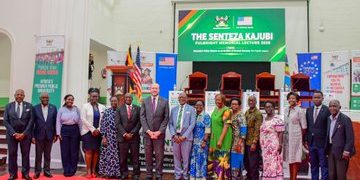



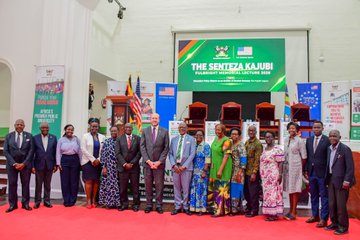
Kampala — Transforming Uganda’s education system into a high-performance engine for student achievement took centre stage as stakeholders gathered to honour the nation’s most influential educationalist.
At the 6th Annual Professor Senteza Kajubi Fulbright Memorial Lecture 2026 held at Makerere University, policymakers, scholars, and international partners explored how deep-rooted policy reforms can move beyond simple classroom access to ensure genuine, lifelong learner success.
Prof Kajubi’s legacy in education reform
Opening the lecture, Prof. Anthony M. Mugagga, Principal of the College of Education and External Studies (MakCEES), described Prof. Kajubi as central to Uganda’s education transformation.
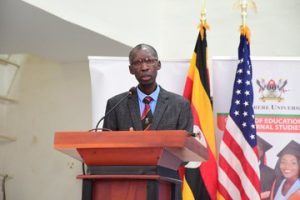
“It is very hard to talk about education reforms in Uganda without mentioning the name William Kajubi,” Prof. Mugagga said. “For over thirty years, Uganda’s education system has had as its fulcrum the Kajubi Report (1989) and the resultant Uganda Government White Paper on Education for National Development (1992).”
He emphasised Kajubi’s academic excellence and enduring influence on Makerere University and the national education systems.
“Professor William Senteza Kajubi was a beacon of academic excellence and a passionate advocate for the transformative power of education,” he said. “His leadership… serves as a testament to his unwavering commitment to fostering a higher education system rooted in responsibility, ethics, and civic engagement.”
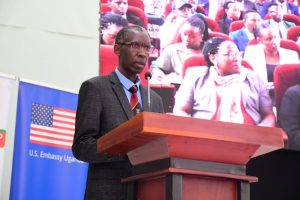
Prof. Mugagga also linked Kajubi’s vision to current reforms: “The only way the College of Education and External Studies can justify its existence is by engaging in meaningful dialogue about education policy reforms from pre-school to university level.”
Kajubi was an intellectual pioneer
Makerere University Vice Chancellor Prof. Barnabas Nawangwe paid tribute to Kajubi’s intellectual legacy and international influence. “Prof. Kajubi was an exceptional intellectual. I had the opportunity to travel with him for two weeks—witnessing his depth of intelligence, clarity of thought, and remarkable generosity in sharing knowledge.”

He also highlighted Kajubi’s policy impact: “Prof. Kajubi authored the 1989 Education Policy Review Commission Report—still one of the most comprehensive analyses of Uganda’s education system. Many reforms today echo his forward-looking recommendations.”
Education as a bridge between nations
The U.S. Ambassador to Uganda, H.E. William Popp, emphasised Kajubi’s role in advancing international education exchange and the continued importance of the Fulbright Program. “Education is one of the most powerful instruments for promoting relations between people and building bridges across cultures,” he said.
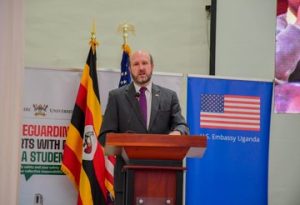
He praised Kajubi’s role as a pioneer: “Professor Kajubi was the first Fulbright scholar from Africa. He bridged two worlds and returned not only with knowledge, but with a vision for what Ugandan education could become.”
Ambassador Popp stressed education policy relevance: “Education policy must serve students—the young people whose families and nations depend on them.” “Students must be prepared not only for today’s jobs, but for careers that do not yet exist.”

Calling for accountability in education systems, he said: “We must connect education to the needs of the future workforce while preserving critical thinking, problem-solving, and adaptability.”
“A policy is as good as its implementation”
Delivering the keynote address, Dr Mary Goretti Nakabugo, Executive Director of Uwezo Uganda, underscored Kajubi’s 1989 policy framework as foundational to Uganda’s education system. “A policy is as good as its implementation,” she said.

She highlighted Kajubi’s core principles: “Education is for everyone… and education should produce responsible citizens.”
Dr Nakabugo noted that the Kajubi Commission prioritised universal access, inclusion, teacher training, and foundational learning. “It would have been easy to simply expand access, but without quality, expansion would not deliver real learning,” she said.
She warned of current system gaps: “We are seeing a shift in investment away from primary education, yet strong foundations are essential for long-term success.”
She also raised concerns about learning outcomes: “Even at Primary Seven, a significant number of learners cannot read basic texts.”
Her recommendations included strengthening school management, expanding pre-primary education, and prioritising learning outcomes over enrolment figures.

Kajubi’s vision of the learner
Prof. Eriabu Lugujjo, Executive Director of the Uganda Vice Chancellors’ Forum (UVCF), traced Kajubi’s educational philosophy to five key pillars: learning to be, learning to know, learning to do, learning to learn, and learning to live together.
“He wanted students to be confident, to know what they want, and to express themselves clearly,” he said.
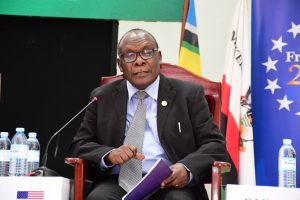
He criticised passive learning methods: “I am disappointed by the current trend of PowerPoint presentations where students do not engage deeply with knowledge.”
He stressed the need for lifelong learning: “Learning should never stop, especially in developing countries where skills must continuously evolve.”

On vocational education, he said: “Knowledge must be applied. A graduate should be able to adapt and contribute in different ways.” “Education should produce confident, knowledgeable, skilled, adaptable, and socially responsible individuals.”
Technology must serve humans, not replace them
Keynote speaker Dr Richard Scott Nokes, Professor of English at Troy University and currently a Fulbright Scholar in Uganda, placed education policy within the context of historical technological change, from the printing press to artificial intelligence.
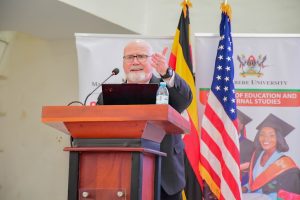
“Technology must serve the human. The human must never serve the technology,” he said.
He noted that the printing press expanded literacy but created new inequalities: “We gained a great deal, but literacy became a requirement and a new form of exclusion.”
On online education, he observed both gains and losses: “Students can now learn across continents without travelling, but the sense of classroom community has weakened.”
Regarding artificial intelligence, he warned: “Banning AI is ineffective. It does not remove the technology; it only removes guidance on how to use it responsibly.”
He emphasised balance in AI development: “The ideal is not an AI that knows only Uganda, but one that knows Uganda and the world.” “None of these technologies teach by themselves. They are tools we use to teach one another.”
Family tribute highlights Kajubi’s personal legacy
Representing the Kajubi family, Beverley Nambozo Nsengiyunva, his eldest granddaughter, reflected on his life and influence. “Professor Kajubi was a gentleman who carried much of the legacy of Africa’s Fulbright experience on his shoulders during the 1950s,” she said.

She recalled his support for education and the arts: “Every time I published a new book, he would buy at least five copies.”
She also highlighted his inclusive philosophy: “He would speak to casual labourers, gardeners, and household workers, asking them for their views on higher education.” “In the words of Professor Senteza Kajubi: ‘Time stays and we go, but time cannot erase the legacy we create.’ Today, what legacy are we creating?”
The 2026 Senteza Kajubi Fulbright Memorial Lecture reaffirmed Prof. Kajubi’s enduring influence on Uganda’s education system, particularly through the 1989 Education Policy Review Commission and the 1992 White Paper.