



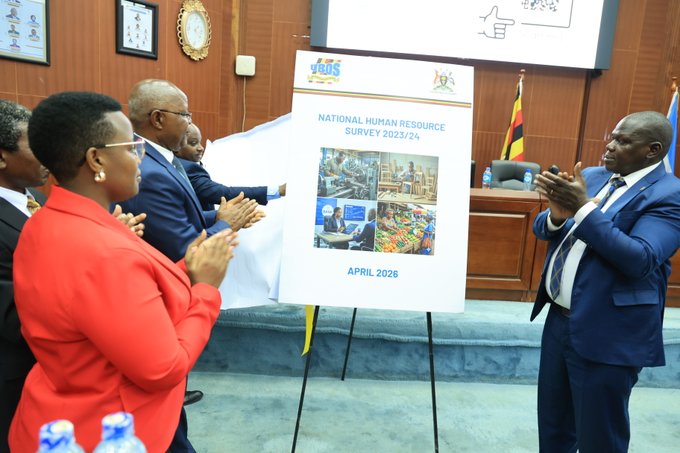
KAMPALA — Uganda’s total workforce has reached approximately 9.3 million people, with the vast majority employed in the informal sector, according to the newly released National Human Resource Survey 2023/24 by the Uganda Bureau of Statistics (UBOS).
The report was officially launched on April 23 at Statistics House in Kampala by Stephen Mukitale, Deputy Chairperson of the Executive Board of the National Planning Authority and MP for Buliisa County.
Mukitale used the occasion to call for stronger support for the private sector, warning that the government alone cannot absorb the country’s growing labour force.
“We must empower private sector businesses and improve the working environment to enable them to create more jobs, since government jobs are limited,” he said.
Private sector dominates employment
According to the survey, Uganda has 2.14 million employees in formal establishments, with 1.63 million working in the private sector compared to 505,141 in the public sector.
UBOS data further shows that fixed-term employment dominates the formal sector, accounting for 1.19 million workers, followed by 939,259 permanent employees and 73,282 casual workers.
“Males still dominate across all employment categories compared to females,” the report notes, adding that young people aged 18–30 make up the largest share of the workforce.
Beyond the formal sector, the informal economy remains the biggest employer, with over 7.1 million Ugandans engaged in informal non-household businesses—bringing the total workforce to about 9.3 million.

Education, trade lead employment sectors
The findings indicate that the education sector employs the largest share of workers in formal establishments, followed by trade, manufacturing, and financial and insurance services.
The report also highlights gender disparities, showing that men dominate employment across most sectors, while women slightly outnumber men in the informal economy.
Data key for planning
Speaking at the launch, UBOS Executive Director Chris N. Mukiza emphasised the importance of the survey in shaping national development policies.
“The data being released is what government and other stakeholders use for evidence-based planning and policy formulation,” Mukiza said.
He added: “I encourage all stakeholders to make full use of this report, and many others that UBOS has released and is yet to publish, for societal development.”
Skills gaps and workplace improvements
The survey identifies critical skills gaps in areas such as information technology, communication, customer care, and innovation—particularly among managers and professionals.
At the same time, it notes improvements in workplace standards, with the proportion of institutions implementing Occupational Safety and Health policies rising from 19 percent in 2016/17 to 53 percent in 2024.
Call for alignment between education and jobs
The report also assessed the link between education and employment, raising concerns about mismatches between workers’ qualifications and their current jobs—an issue experts say could affect productivity and competitiveness.
UBOS said the findings will guide future labour market planning and hinted at plans to conduct additional surveys targeting smaller enterprises not fully covered in the current report.
The National Human Resource Survey is Uganda’s second comprehensive assessment of its labour force, following the 2016/17 edition, and is expected to play a key role in shaping employment policies amid a rapidly growing population.