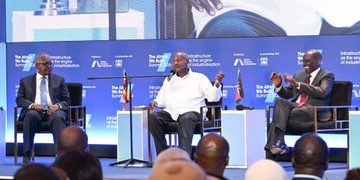



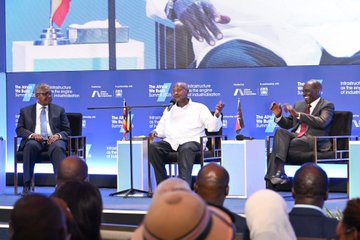
Nairobi, Kenya – President Yoweri Kaguta Museveni has called for a coordinated and strategic approach to infrastructure development across Africa, urging leaders to prioritise investments that directly support industrialisation and economic transformation.
The President made the remarks during the opening of the Africa We Build Summit 2026 held at the JW Marriott Hotel Nairobi, where he joined regional and global leaders to discuss accelerating infrastructure development on the continent.
The two-day summit, hosted by the Africa Finance Corporation in collaboration with the Government of Kenya, has brought together Heads of State, policymakers, and private sector leaders to explore practical pathways for unlocking Africa’s economic potential through large-scale projects.
President Museveni commended his Kenyan counterpart, William Ruto, for convening the summit. “I thank H.E President William Ruto and Africa Finance Corporation for organising the Africa We Build Summit,” he said.
He emphasised that infrastructure must be developed within an integrated framework that links key sectors of the economy. “The transformation of Africa requires moving priority infrastructure projects from conception to implementation through coordinated planning and regional cooperation,” President Museveni said.
He added that infrastructure should not be treated as a standalone asset but must connect transport, energy, and digital systems with productive sectors such as agriculture, tourism, and small and medium enterprises.
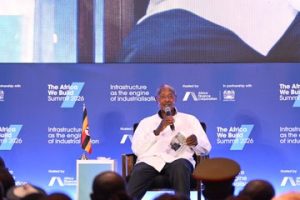
The President noted that Africa’s economic performance has yet to match its vast natural resources and demographic potential, citing structural bottlenecks and governance challenges as key constraints.
He warned that instability driven by sectarian politics and weak state institutions continues to undermine development efforts, calling for stronger governance, national unity, and security as foundations for sustainable growth.
President Museveni also stressed the importance of value addition, urging African countries to move away from exporting raw materials.
He said processing commodities such as cotton, coffee, minerals, and petroleum locally would significantly boost revenues and create jobs.
“Infrastructure must strengthen what I call the bone marrow of the economy, the core systems that support industrialisation and long-term growth,” he said.
He further called for prudent use of borrowed funds, emphasising investment in productive sectors such as electricity, railways, pipelines, and manufacturing rather than recurrent expenditure.
The President reaffirmed Uganda’s commitment to regional integration through infrastructure connectivity, industrial development, and expansion of local manufacturing capacity, including in vaccines, steel, and petroleum refining.
He also highlighted the importance of the African Continental Free Trade Area in expanding intra-African trade and supporting large-scale production.
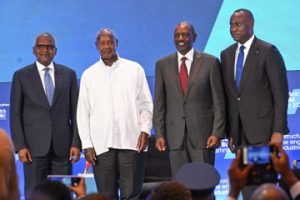
President Ruto, who delivered the keynote address, underscored the urgency of accelerating industrialisation across the continent.
“We must also acknowledge that other regions have faced such challenges but overcome them. Africa’s place in the global trade requires urgency; manufacturing has been stagnant at 10%. We need a way forward in terms of manufacturing and value addition,” President Ruto said.
He emphasised the need for stronger political commitment to infrastructure connectivity across the region. “Mzee, the same way you invested in the pipeline is the same way we are always ready to work together,” he added, thanking President Museveni for Uganda’s role in regional energy projects.
Meanwhile, Nigerian industrialist Aliko Dangote praised Uganda’s policy direction on value addition. “I also want to commit to the two Presidents here that with their support for the refinery, we will build a similar one in East Africa, like the one in Nigeria,” Dangote said.
The summit continues to explore financing models, regional cooperation, and investment strategies aimed at positioning infrastructure as a key driver of Africa’s industrial transformation.