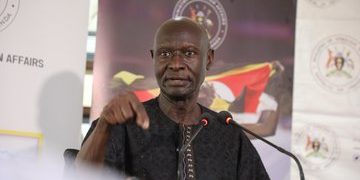



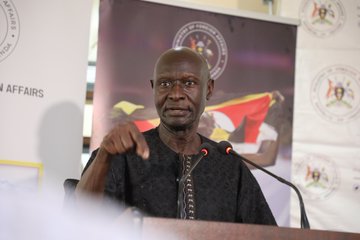
KAMPALA — Few Ugandans have served at the highest levels of international diplomacy quite like Ambassador Olara Otunnu.
A lawyer, diplomat, peacebuilder and former United Nations Under-Secretary-General, Otunnu has spent more than four decades at the forefront of international conflict resolution, human rights advocacy and multilateral diplomacy. His career has taken him from Uganda’s Ministry of Foreign Affairs to the corridors of the United Nations, where he helped shape global policy on the protection of children caught up in armed conflict.
Now, the veteran diplomat is seeking one of the world’s most influential positions — Secretary-General of the United Nations — promising reforms aimed at strengthening the organisation’s credibility, effectiveness and ability to respond to global crises.
Born on September 6, 1950, Otunnu studied at Makerere University before leaving Uganda due to his opposition to the Idi Amin regime. He later earned a Bachelor of Arts in Jurisprudence from Oxford University as an Overseas Scholar before obtaining a Master of Laws degree from Harvard Law School as a Fulbright Scholar.
His diplomatic career accelerated in the early 1980s when he served as Uganda’s Ambassador and Permanent Representative to the United Nations. During that period, he chaired the UN Commission on Human Rights, served as President of the UN Security Council in December 1981, and later became Vice-President of the UN General Assembly.
Perhaps his most internationally recognised role came in 1998 when he was appointed the United Nations Under-Secretary-General and the organisation’s first Special Representative for Children and Armed Conflict.
In that capacity, Otunnu successfully persuaded the UN Security Council to recognise the protection of children affected by war as a matter of international peace and security. He also helped establish the monitoring and reporting mechanism under Security Council Resolution 1612, which publicly identifies parties responsible for grave violations against children during armed conflicts.
His work extended beyond the United Nations. Otunnu previously served as President of the International Peace Academy, now known as the International Peace Institute, and has participated in numerous international commissions on conflict prevention, global governance and UN reform.
Within Uganda, he served as Minister of Foreign Affairs between 1985 and 1986 and later led the Uganda People’s Congress as party president from 2010 to 2015. More recently, he has co-chaired the Rocco Paco community peacebuilding initiative, which focuses on reconciliation and post-conflict healing in northern Uganda.
Throughout his career, Otunnu has received numerous international honours, including the Sydney Peace Prize, the German Africa Prize and the Harvard Law School Alumni Association Award in recognition of his contributions to peace, diplomacy and human rights.
Fluent in Luo, English and French, Otunnu has also authored and co-authored publications on peacekeeping, governance, international security and customary law.
Should he secure the support of UN member states, Otunnu would become the first Ugandan to serve as Secretary-General of the United Nations.
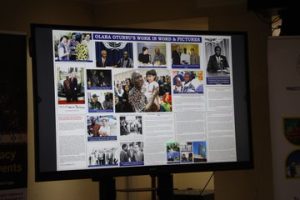
Timeline: Olara Otunnu’s Career
1950 — Born in northern Uganda.
1972–1973 — Elected President of the Makerere University Students’ Guild, where he led student opposition to the Idi Amin regime.
1978 — Earned a Master of Laws (LLM) from Harvard Law School as a Fulbright Scholar, after earlier studies at Makerere University and Oxford University.
1980–1985 — Served as Uganda’s Ambassador and Permanent Representative to the United Nations while holding several senior UN leadership positions, including President of the Security Council, Chairman of the UN Commission on Human Rights and Vice-President of the General Assembly.
1981 — Introduced the Security Council’s informal straw-balloting procedure for selecting the Secretary-General—later known as the “Otunnu Formula”—which remains standard practice today.
1985–1986 — Served as Uganda’s Minister of Foreign Affairs and helped shape the Nairobi Peace Agreement.
1990–1998 — President of the International Peace Academy (now the International Peace Institute), focusing on conflict prevention and peacebuilding.
1998–2005 — Served as United Nations Under-Secretary-General and Special Representative for Children and Armed Conflict, leading reforms that established international mechanisms to monitor and respond to grave violations against children in war.
2010–2015 — President of the Uganda People’s Congress (UPC).
2023–Present — Co-Chair of the Rocco Paco peacebuilding initiative supporting reconciliation in northern Uganda.
2026 — Nominated by Uganda as its candidate for United Nations Secretary-General.