




Mpigi – Hope Vocational and Technical Institute (HVTI), a training institution under Watoto Church Ministries, has graduated 164 students, with leaders urging them to use their vocational skills to create employment, serve their communities and contribute to Uganda’s development.
The graduates, who completed the 2024–2025 training cycle, received qualifications in more than 10 vocational and technical fields, including electrical installation, construction, plumbing, automotive mechanics, carpentry, catering and hotel management, fashion and design, cosmetology, information and communication technology (ICT), and journalism and media studies.
Raymond Fred Buyinza, the institute’s principal, said the graduates had acquired practical skills through a training model that combines classroom instruction with workplace experience.

“Our learners spend three days studying at the institute and another two to three days undertaking practical work with our work-placement partners. This allows them to apply the knowledge and skills they acquire in the classroom to real working environments,” Buyinza said.
He said the institute primarily serves young people from disadvantaged backgrounds, many of whom are orphans, but seeks to ensure that their circumstances do not determine their future opportunities.
“When they join us, their previous circumstances no longer define their opportunities. We ensure they have access to everything they need, just like any other child growing up in a family or home,” he said.

Buyinza urged the graduates to begin their careers within their communities instead of waiting for ideal employment opportunities.
Josephine Oboth, Acting Team Leader for Education and Sports at Watoto Church Ministries, said the training had equipped the students with more than technical abilities, pointing to the importance of discipline and confidence in applying their knowledge.
“Across the 11 technical and business courses, you have done more than acquire vocational skills. You have developed practical abilities, discipline and the confidence to turn knowledge into work that serves others,” Oboth said.

She noted that some graduates were already applying their training within the organisation, particularly those in journalism, information technology, and fashion and design.
Oboth challenged the graduates to regard graduation as the beginning of another phase of their lives, whether through employment, entrepreneurship or further studies.
“Whether you start a business, join an established team or continue your studies by pursuing a diploma, carry with you the values you have learnt here,” she said. “Do your work as unto the Lord, and let your skills open doors that your character will keep open.”

Rebecca Natukunda, who represented the Executive Director of the Technical and Vocational Education and Training (TVET) Council, said vocational training was an important part of national development and should not be regarded as an inferior alternative to university education.
“Skilling is part of God’s agenda,” Natukunda said, citing biblical accounts of skilled artisans Bezalel and Oholiab, who were given the responsibility of carrying out technical work during the construction of the tabernacle.
She said vocational institutions had a role to play in preparing young people to respond to opportunities in agriculture, tourism, mineral development, and science, technology and innovation — areas she identified as government priorities.

In agriculture, she called for technical training institutions to develop affordable technologies, including solar-powered irrigation systems, to help farmers respond to changing weather patterns.
She also urged young people to explore opportunities in value addition, particularly in the processing and marketing of agricultural products.
“Our future does not lie only in what we produce; it also lies in the value we add to what we produce,” she said.

Natukunda challenged graduates in media, journalism and information technology to use digital platforms to promote Uganda’s tourism attractions, arguing that local young people should take advantage of opportunities that foreigners were already exploiting.
She also pointed to opportunities in mineral processing and manufacturing, saying Uganda needed technical professionals who could help develop local industries and reduce reliance on imported products.
Beyond technical competence, Natukunda emphasised attitude and personal responsibility as important factors in career advancement.

“Every day you report to your workplace, you are effectively earning a vote. Every time you show up, interact with others and perform your responsibilities, people are forming an opinion about you,” she said. “Attitude and responsibility are what open doors.”
She urged young women in particular not to compromise their character to fit into social or professional groups, saying personal choices had consequences for their future.
Pastor Edward Mwesigye, the institute’s chancellor and Pastoral Team Leader at Watoto Church, similarly challenged graduates to pursue excellence and use their skills to create opportunities rather than wait for others to provide them.

“Do not wait for someone else to create opportunities for you. Every problem presents an opportunity,” Mwesigye said.
He cited agriculture as one of the sectors offering opportunities for young entrepreneurs, urging graduates to take advantage of initiatives such as Watoto’s Bobi Agribusiness Institute (BAI).
He also encouraged them to build relationships through the Watoto alumni association, saying graduates could benefit from the experience of those already working in different sectors. “Do not strive only to make a living; strive to make a difference,” he said.
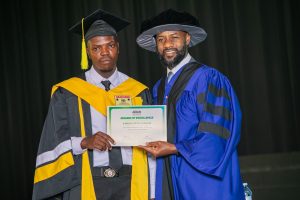
Mwesigye added that vocational training should not be a source of shame, arguing that professional competence was not determined solely by possession of a university degree.
“Do not look at TVET as something to be ashamed of. TVET is an opportunity; it is a vehicle God has allowed you to use in this season as He shapes you into godly transformational leaders,” he said.
Sandra Amodot Opio, Watoto Church Ministries’ Executive Director for Community Care, delivered a message on behalf of the ministry team leaders, Pastors Julius and Vanita Rwotlwonyo, who were unable to attend.

In their message, the pastors urged graduates to demonstrate integrity, diligence, humility and compassion as they entered the world of work.
“The knowledge and skills you have acquired are gifts from God, entrusted to you for a greater purpose. We encourage you to pursue excellence, demonstrate integrity, work diligently and serve others with humility and compassion,” the message read.
The pastors also thanked parents, guardians, local and international partners, instructors and staff for supporting the students throughout their training.

Opio, in her own remarks, said HVTI remained committed to improving the quality and relevance of its programmes in collaboration with regulatory bodies.
She said the institute was working towards expansion under its next five-year strategic plan, with the ambition of producing graduates equipped for employment, entrepreneurship and service to society.
“Your success will depend not only on your qualifications, but also on your character, integrity, diligence and willingness to keep learning,” she told the graduates.

One of the graduates, Nakate Winnie Mary, who received a certificate in Hotel Management and Catering, said the training had equipped her with practical skills in food preparation and hospitality.
“I have learned many skills, including juice-making. I have learned how to handle fruits, achieve the right consistency and combine different ingredients to produce quality products,” she said.
She added that the course had also taught her how to welcome guests, maintain a clean environment, present food properly and clear tables.

“I have also learned how to handle guests whenever I receive them at an establishment. This includes welcoming guests, ensuring they have a conducive environment, presenting food properly, clearing tables and keeping the area clean,” she said.
The fourth graduation ceremony was held on October 30, 2026, at the institute, with representatives of the Technical and Vocational Education and Training (TVET) Council, Uganda Vocational and Technical Assessment Board (UVTAB), Watoto Church leadership, parents and other stakeholders in attendance.