


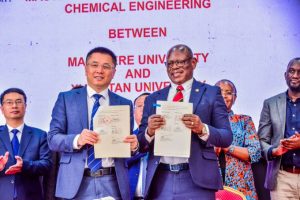
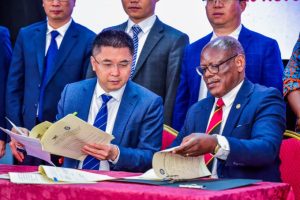
KAMPALA — Makerere University and China’s Xiangtan University have signed an agreement to jointly teach a master’s degree programme in Materials and Chemical Engineering, as the two institutions seek to strengthen academic cooperation and support skills development.
The agreement, signed on Friday, November 20, 2026, provides for a “1+2” Joint Master’s Degree programme, under which the universities will collaborate in postgraduate training.
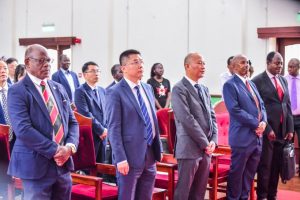
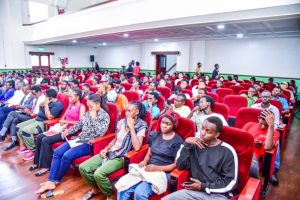
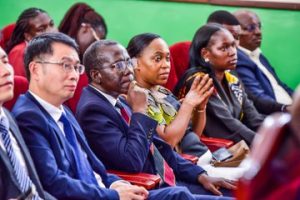
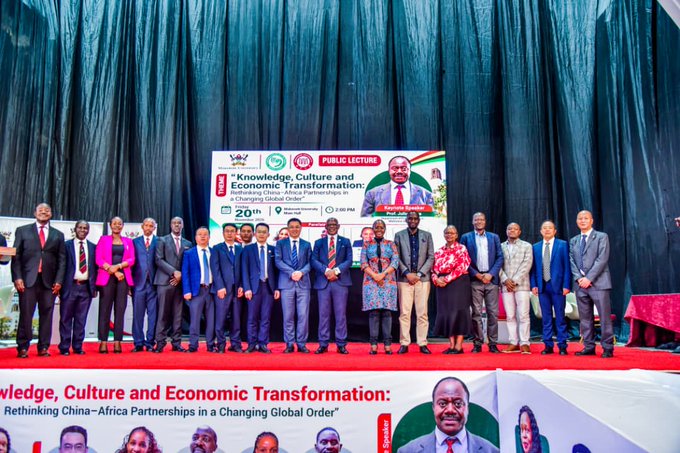
The signing took place at Makerere University’s Main Hall during a public lecture organised under the theme, Knowledge, Culture and Economic Transformation: Rethinking China–Africa Partnerships in a Changing Global Order.
The lecture sought to stimulate academic and policy debate on the changing nature of China-Africa relations and their implications for Africa’s development agenda.
Prof. Lin Jingang, Deputy Secretary General of the Communist Party of China (CPC) at Xiangtan University, described the agreement as part of growing cooperation between the two institutions.
He commended Makerere Vice Chancellor Prof. Barnabas Nawangwe for his leadership and support, saying the partnership had produced practical results.
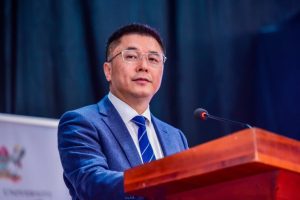
“It is this sincere spirit of partnership that has enabled our cooperation to deepen and yield practical results step by step,” Prof. Lin said.
He also highlighted the contribution of Makerere University’s Confucius Institute in expanding Chinese language education and training local Chinese language teachers.
Prof. Lin noted that interest in learning Chinese among Ugandan young people had grown, particularly following the introduction of Chinese as a subject in Uganda’s secondary school examinations in 2022.
Makerere Vice Chancellor Prof. Barnabas Nawangwe said the university intended to expand its engagement with China beyond language teaching.
“Apart from the teaching of the Chinese language, we have decided that we are going to establish a centre for Chinese studies,” Prof. Nawangwe said.
He also pointed to China’s economic transformation as a subject from which African countries could draw lessons, particularly in addressing poverty.
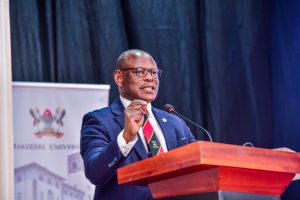
Prof. Nawangwe recalled China’s history of foreign invasions and exploitation, drawing parallels with Africa’s colonial experience.
“China, in 30 years, managed to move 400 million people out of poverty,” he said, citing the country’s poverty reduction experience as an example of the scale of transformation that African countries could study.
The keynote address was delivered by Makerere political scientist Prof. Julius Kiiza, who challenged participants to examine whether China-Africa relations genuinely reflected equality between partners or concealed differences in economic and political power.
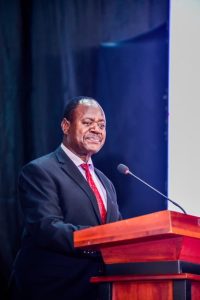
He questioned the framing of the relationship as a partnership, arguing that the language used in international relations could sometimes obscure unequal power dynamics.
“When you begin with China, then bring Africa, and then say it’s a partnership, you are making a very clear proposition, namely that whereas we are using the word partnership officially, we may be talking about asymmetrical power relations,” Prof. Kiiza said.
He defined asymmetrical relations as unequal power relations and urged Africans to distinguish between official diplomatic language and the actual interests driving international cooperation.
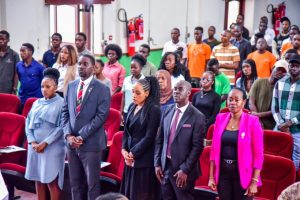
Prof. Kiiza also compared Western and Chinese development assistance, noting that Western aid often comes with governance conditions relating to electoral democracy, press freedom and political competition.
“China says, ‘Sorry, we are here to partner’. We are not here to interfere with your internal affairs,” he said.
However, he cautioned against viewing Chinese assistance as entirely detached from geopolitical interests.

“My central argument is a modification of the reality we seem to see. I argue that China is definitely Africa’s ally with a strong history of partnership with Africa. But friends, China is a sovereign state, not a charity house. China is not an NGO,” Prof. Kiiza said.
He argued that China’s engagement with Africa was also driven by its ambition to project influence globally, urging Ugandans and other Africans to examine the interests underpinning international partnerships.
Speaking during the panel discussion, Prof. Wang Weiyan, Director of the International Exchange Centre at Xiangtan University and a professor of Chemical Engineering, said China’s development experience could offer lessons for African countries, provided they adapted them to their own circumstances.
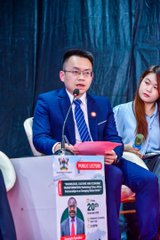
He said Chinese development assistance followed approaches suited to the needs of recipient countries.
“There are three areas where our universities can work together to support African economic transformation. These are education, science, technology, and talent development,” Prof. Wang said.
“I am confident that African countries, including Uganda, can draw on China’s development model and find paths to economic transformation and development that suit their own circumstances.”
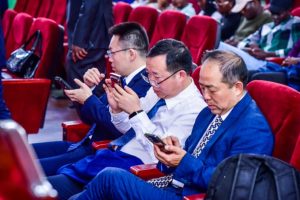
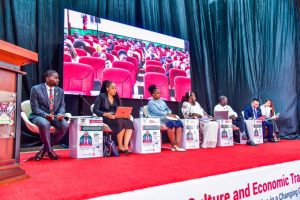
The panel discussion was moderated by Dr Eunice Akulo, a lecturer in Political Science and International Relations at Makerere University.
Other panellists included Chris Mukama, a Mandarin language educator; Sarah Mirembe, a political science lecturer at Nkumba University and PhD candidate at Makerere; Godfrey Muhairwe, a PhD candidate at Makerere and director of Dollar Travel Services; and Hilda Ayebare, a Chinese language translation specialist working with the National Curriculum Development Centre.
The discussions examined the role of language, education, technology, cybersecurity and cultural exchange in shaping China-Africa relations.
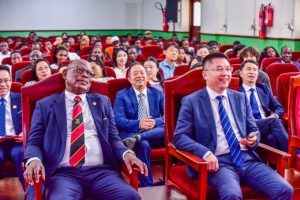
The agreement between Makerere and Xiangtan University adds postgraduate engineering education to the areas of cooperation between the institutions, as debate continues over how African countries can engage international partners while protecting their development priorities and economic interests.