



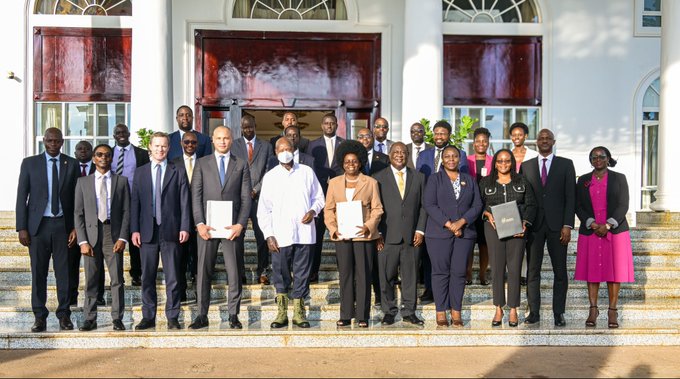
Uganda has signed a 10-year crude oil marketing agreement with international energy trader Vitol, paving the way for the country to sell its first commercial oil production on the international market.
The agreement, signed at State House, Entebbe, on Friday, November 20, 2026, involves the Uganda National Oil Company (UNOC), the Ministry of Energy and Mineral Development and Vitol, which will market Uganda’s Pearl Sweet crude oil and identify international buyers offering competitive prices.
President Yoweri Kaguta Museveni, who witnessed the signing, described the agreement as a new phase in Uganda’s relationship with Vitol, which initially supplied refined petroleum products to the country.
President Museveni said his initial engagement with the company followed concerns about Uganda’s reliance on intermediaries when importing petroleum products, which he said increased the country’s costs.
He recalled that Uganda was purchasing approximately one billion litres of petroleum products annually through middlemen operating in Kenya.
“When I got that information some years ago, I told the then Minister of Energy, Hon. Irene Muloni, to sort it out. Later, I heard about this group, Vitol. I said a whole country should not be buying from middlemen. It is a big shame. I have always told you to buy directly from the factories,” President Museveni said.
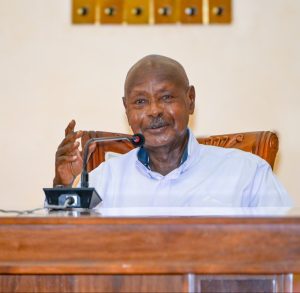
He explained that Vitol’s ability to source petroleum products directly from refineries and supply them in bulk helped Uganda negotiate better prices.
According to the President, diesel prices dropped from $118 to $83 per metric tonne under the arrangement, while petrol declined from $97.50 to $61.50. Jet fuel prices also fell from $114.25 to $79.25.
Under the new agreement, Vitol will market Uganda’s crude oil internationally, while UNOC will retain oversight of the transactions and buyers.
“Under this agreement, they will hawk our petroleum products and sell to the highest bidder. Whoever they sell to must be known to UNOC. UNOC must be satisfied with who has bought the oil and why,” he said.
The Minister of Energy and Mineral Development, Dr Monica Musenero, described the agreement as a critical step in preparing Uganda to enter the international crude oil market.
She said the country needed to put in place commercial arrangements and establish market readiness before its crude oil could be sold internationally.
“Many Ugandans have been waiting for first oil, but we cannot take the oil to the market until we are prepared for the market. Today’s agreement is very fundamental, and it is the last step now leading us to the next announcement we shall be making about first oil,” Dr Musenero said.
She explained that Vitol would initially work alongside UNOC to provide technical guidance, training and access to international buyers as the national oil company develops its capacity to independently market Uganda’s crude oil.
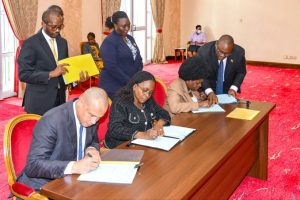
Under the initial arrangement, Uganda’s crude oil will be sold on a Free On Board (FOB) basis at Tanga in Tanzania, where the East African Crude Oil Pipeline (EACOP) terminates.
Dr Musenero said the government would later consider extending the arrangement to cover transportation of the crude oil to its final destinations, depending on UNOC’s experience and capacity.
“Vitol is going to walk side by side with UNOC, training and teaching us how to enter the market and introducing us to the market. Later, when UNOC has mastered this game, we will decide whether we should work with the crude oil to the final destinations. Vitol will continue guiding us until we have the capacity to do this ourselves,” she said.
Vitol Regional Head Michael Balint commended President Museveni for his guidance during the negotiations and praised the teams from UNOC and the Ministry of Energy for their work in concluding the agreement.
“Thank you, Your Excellency, for the guidance you have provided throughout this process. It has been a long journey, and this signing marks the next chapter in our relationship with Uganda. You have a strong team at UNOC and the Ministry of Energy, and I commend them for their efforts,” Mr Balint said.
He described the agreement as a natural progression of Vitol’s relationship with Uganda and said the company was pleased to support the country’s entry into the international petroleum market.
He added that the partnership would also help strengthen UNOC’s institutional capacity by exposing its staff to international crude oil trading operations.
“We believe this is the next step in our relationship with Uganda. It is a natural growth, and we are happy to be part of that growth,” he said.
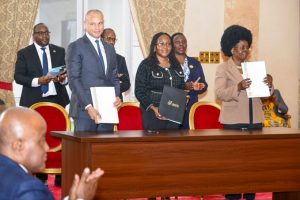
Mr Balint thanked President Museveni for the decisions taken to advance the partnership and reaffirmed Vitol’s commitment to supporting Uganda’s petroleum sector.
Among the officials who attended the signing were Attorney General Dr Sam Mayanja, Permanent Secretary and Secretary to the Treasury at the Ministry of Finance, Planning and Economic Development, Ramathan Ggoobi, and Permanent Secretary of the Ministry of Energy and Mineral Development, Eng. Irene Batebe.
Background
Uganda’s crude oil was officially named Pearl Sweet by President Museveni in September 2026. It is produced from the Tilenga and Kingfisher oilfield developments in the Albertine Graben.
The name combines Uganda’s identity as the Pearl of Africa with the term “sweet”, which refers to the crude oil’s relatively low sulphur content of approximately 0.12%, making it attractive to refiners.
Pearl Sweet is classified as a medium-to-heavy, waxy crude oil. Its high wax content requires heating during transportation to maintain its flow.
The crude oil will be transported through the 1,443-kilometre East African Crude Oil Pipeline, from Kabaale in Hoima District to the export terminal at Tanga in Tanzania, where it will be loaded onto vessels for international markets.