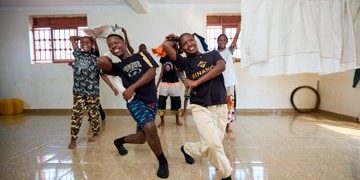



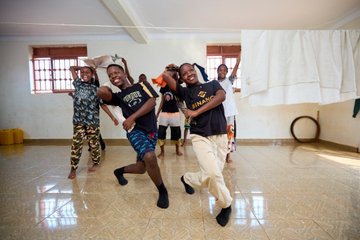
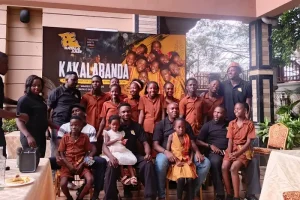
A childhood tale once used to frighten, discipline and shape the behaviour of children is being brought back to the stage through a new dance-theatre production featuring the Wakiso Dance Kids.
Kakalabanda Remake, produced by Batalo East, will explore the familiar Ugandan story through the eyes and movements of a younger generation, blending traditional dance with contemporary urban performance.
The production will be staged at the National Theatre in Kampala on September 9 and at Kavumba Recreational Centre in Wakiso on September 12, with performances running from 7:30 pm to 8:40 pm.
Batalo East founder David Mubiru says the production is part of the organisation’s wider effort to reconnect young Ugandans with traditional performing arts while presenting them in forms that speak to contemporary audiences.
“Tradition Meets Urban” is at the heart of Batalo East’s approach, bringing techniques and movements from Uganda’s traditional dances into contemporary and urban choreography.
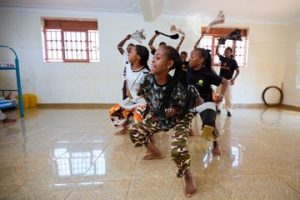
Mubiru says the idea emerged from concern that younger generations, particularly late millennials and Gen Z, are becoming increasingly disconnected from the history and cultural meaning embedded in traditional dance.
Uganda’s diversity of traditional dances provides a vast foundation for this work. Mubiru estimates that each of the country’s 52 tribes could have at least five different dance forms, demonstrating the depth of the country’s dance heritage.
Batalo East has therefore sought to work directly with cultural elders to recover the techniques and meanings behind traditional dances before integrating them with contemporary forms.
“If you know the proper technique of, say, Mabunju, and then infuse it with something like popping, you get a very different and unique artistic expression,” Mubiru explains.
For Batalo East, however, the objective is not simply to preserve dance movements. It is to use dance to tell stories about society.
Those stories can address health, politics, education, sadness and other social and economic experiences.
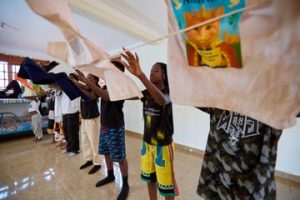
“We use our bodies to express and communicate how we feel about different social, economic and political factors in the world,” Mubiru says.
Giving an old story a new audience
Production Manager Albert Mubiru says Kakalabanda Remake is not intended to simply reproduce an earlier production.
Instead, the team is asking what the old story means to children growing up in a radically different environment.
“What we are trying to do with Kakaabanda is not necessarily to remake what we did ten years ago. We are trying to tell the same story differently — in a different timeline, for a different generation,” he says.
The original story, he explains, belonged to a tradition of oral storytelling in which frightening or mysterious characters were used to teach children discipline and appropriate behaviour.
For many Ugandans, particularly those who experienced boarding-school life, Kakalabanda evokes stories of a mysterious presence that would supposedly visit dormitories at night.
The cultural memory of the character is well established. Literature on Ugandan theatre and poetry has documented Kakalabanda as part of the country’s storytelling tradition, while earlier Ugandan creative works have also drawn on the boarding-school myth.
The new production asks how such stories can be used to address challenges facing children today.
Mubiru says the team is researching the experiences of young people to understand how older generations can help create environments that foster positive behaviour while remaining relevant to contemporary children.
“We are also trying to close the intergenerational gap,” he says.
He argues that young people are increasingly growing up with influences from the internet and other modern technologies, sometimes with less connection to the cultural systems that shaped previous generations.
The production therefore becomes a meeting point between generations.
“We want them to come back into this process and understand how we became who we are today,” Mubiru says.
Children at the centre
The decision to put children at the centre of the production is deliberate.

Batalo East says working with young performers provides an opportunity not only to tell the story differently but also to pass artistic knowledge to the next generation.
The production team says the young performers have been receiving training in dance and performance, combining traditional movement with contemporary choreography.
Choreographer and visual artist Elvis Elasu describes the production as a collaborative process involving different artistic departments, with the choreography team working closely with the children to translate the ideas of the production into movement.
For Mubiru, that intergenerational transfer is critical to the survival of Uganda’s dance heritage. “We wanted to pass this element on to the next generation for the sustainability of this art,” he says.
He also wants audiences to recognise dance as a profession rather than simply entertainment.
“Dance is a serious profession,” Mubiru says, noting that artists have built livelihoods through dance after university.