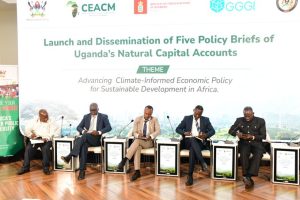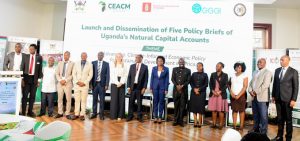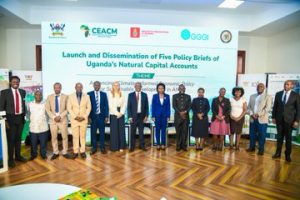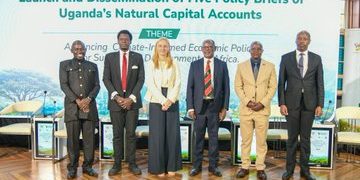



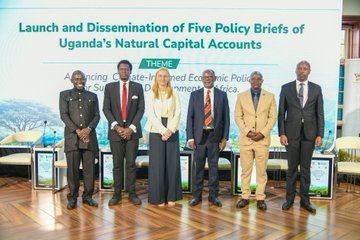
Uganda has launched five policy briefs on Natural Capital Accounts aimed at integrating the value of forests, wetlands, water resources, land, energy systems and ecosystems into national economic planning, budgeting and investment decisions.
The policy briefs, developed by the Centre of Excellence for Africa Climate-Sensitive Macroeconomic Modelling (CEACM) at Makerere University’s College of Business and Management Sciences (CoBAMS), were launched on Wednesday, July 15, 2026, bringing together government officials, academics and development partners to promote climate-informed economic policymaking.
The initiative comes as Uganda seeks to strengthen evidence-based planning while pursuing ambitious economic transformation targets, including the goal of growing the economy tenfold and achieving a USD 500 billion economy.
Speaking at the launch, Hon. Beatrice Anywar, Minister of State for Environment, who represented the Minister of Water and Environment, said Natural Capital Accounting provides Uganda with a new approach to valuing its environmental resources.
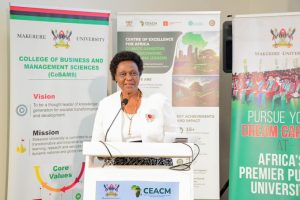
“Today, we are not just launching a report, but we are launching a new way of seeing, planning and managing Uganda’s development,” Anywar said.
She said traditional measures such as Gross Domestic Product (GDP) do not fully reflect the condition of natural resources that support the economy.
“But GDP does not tell us if our forests, water sources and wetlands are shrinking. It does not tell us if our forests can still hold our waters or whether our soils will still feed the next generation,” she said.
Anywar noted that Uganda’s natural capital, including forests, wetlands, water resources, biodiversity and fertile soils, supports livelihoods, tourism, hydropower generation and climate resilience.
“This natural capital supports over 70 percent of our population and powers our hydropower. It feeds into tourism and buffers us against droughts and threatening floods,” she said.
She warned that environmental degradation represents a loss of national wealth. “When natural capital is degraded, we are not just losing trees, wetlands, water or soils. We are losing wealth. We are losing jobs for our children and future generations,” Anywar said.
She described Natural Capital Accounting as a system that places nature on Uganda’s economic balance sheet. “This is what natural capital accounting does. It puts nature on the balance sheet. I studied basic accounting, but I never imagined that natural resources could also be reflected on a balance sheet. Today, that is becoming a reality,” she said.
The minister also called for communities to play a central role in protecting natural resources, saying traditional knowledge should complement modern science. “Our ancestors protected the environment without maps, technology or scientific reports. They knew which areas were sacred, where water sources were protected and where forests should not be disturbed,” she said.
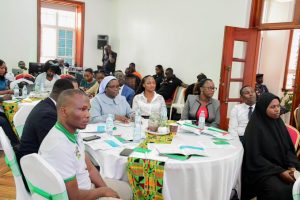
Makerere Positions Research at Centre of Policy
Prof. Edward Bbaale, Director of CEACM, said the centre was established to ensure climate considerations become part of national planning, budgeting and macroeconomic decision-making.
“Makerere University has consistently demonstrated a strong commitment to advancing research that informs policy and contributes to national development,” Prof. Bbaale said.
He said climate change could no longer be separated from economic planning. “It is very important that national planning, budgeting, macroeconomic frameworks and fiscal policies are not oblivious to climate change, but instead fully integrate climate-related considerations,” he said.
Prof. Bbaale added that Makerere University was committed to supporting government through evidence generation and capacity building. “We have to be part of this global effort and contribute the much-needed evidence, research and capacity building to support the Ministry of Finance in executing this important responsibility,” he said.
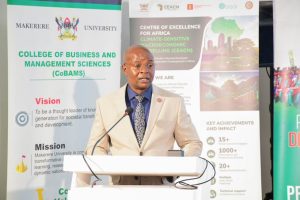
Makerere University Vice Chancellor Prof. Barnabas Nawangwe said the launch demonstrated the value of collaboration between academia, government and development partners.
“Today’s event demonstrates the power of collaboration between academia, government and development partners in generating knowledge that informs public policy and advances Uganda’s sustainable development agenda,” Prof. Nawangwe said.
He said the five policy briefs and updated Natural Capital Accounts would provide evidence needed for better planning. “Together, these accounts provide invaluable evidence for integrating natural capital into national planning, budgeting, investment decisions and sustainable development strategies,” he said.
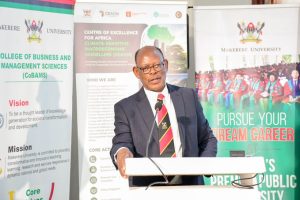
Finance Ministry Links Natural Capital to Economic Growth
Representing the Ministry of Finance, Planning and Economic Development, Davis Vuningoma, Acting Commissioner for Macroeconomic Policy, said climate risks could affect Uganda’s economic ambitions if not addressed.
“If we do not address these challenges, our fiscal space could shrink, and our ability to provide public services could be affected,” Vuningoma said.
He said Uganda’s natural resources had not always been fully captured in economic measurements. “Uganda is richly endowed with natural capital, including forests, wetlands and water resources. However, traditional measures of economic performance have often failed to fully capture the value of these assets,” he said.
Vuningoma said the policy briefs would support government decision-making as Uganda pursues economic transformation. “These briefs provide practical policy options that will help government make more informed decisions,” he said.
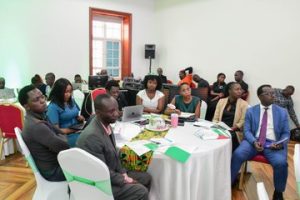
Partners Call for Action Beyond Research
Representing the Global Green Growth Institute (GGGI), Arthur Ssebbugga-Kimeze, Manager, Climate Finance, said natural capital must be recognised as an economic asset.
“Natural capital is far more than an environmental issue. Uganda’s forests, wetlands, water resources, land and biodiversity are productive economic assets that underpin agriculture, tourism, energy, livelihoods and ultimately the country’s long-term prosperity,” he said.
He said Uganda’s experience provides lessons for Africa. “Uganda continues to demonstrate regional leadership by showing how Ministries of Finance can use natural capital accounting to strengthen fiscal policy, improve public investment decisions and build resilience to climate change,” Ssebbugga-Kimeze said.
Representing the Embassy of Denmark, Nina Guldbæk van Leeuwen, Counsellor and Team Leader for Politics, Regional Affairs and Refugee Support, said natural capital accounts were essential for climate-responsive economic planning.
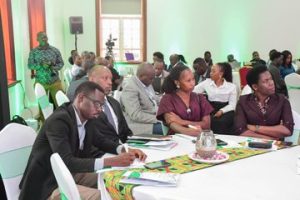
“These policy briefs are crucial in enhancing the role of economic, fiscal and financial policies in addressing climate change in Uganda and Africa as a whole,” she said.
She urged stakeholders to ensure the research informs decisions. “Let us ensure that these policy briefs do not remain on institutional shelves but are actively used to inform decisions and policies going forward,” she said.
Policy Briefs Reveal Growing Pressure on Natural Resources
Presenting the research outputs, Dr Peter Babyenda, Coordinator of CEACM, said the briefs were developed through collaboration between Makerere University, government institutions and development partners.
“The briefs were developed through collaborative efforts coordinated by the Centre of Excellence for Africa Climate-Sensitive Macroeconomic Modelling,” Babyenda said.
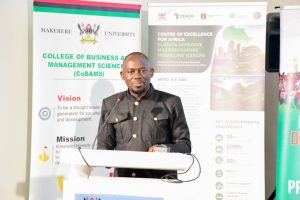
The five briefs focused on Uganda’s energy system, wood stocks, ecosystem services, land natural capital and water accounts.
The findings show that traditional biomass accounts for about 87 percent of Uganda’s final energy consumption, while national wood resources declined by 45 percent between 1990 and 2015.
The reports also found that unsustainable agricultural expansion, deforestation and urbanisation are major drivers of land degradation, while ecosystem value per capita declined by 17.7 percent despite growth in total ecosystem value.
The National Water Accounts further showed agriculture as the largest water user, accounting for 55.4 percent of total water abstraction in 2024, amid increasing climate-related risks.
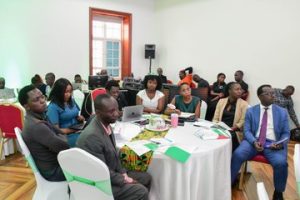
Babyenda said the process involved extensive research, data analysis and stakeholder consultations, adding that although the briefs were funded by the Gates Foundation, the findings represent the views of the authors.
“The findings, interpretations and conclusions presented in these briefs are those of the authors and do not necessarily reflect the position or policies of the Gates Foundation,” he said.
The launch marks a shift towards recognising Uganda’s natural resources not only as environmental assets, but as measurable components of national wealth and economic transformation.