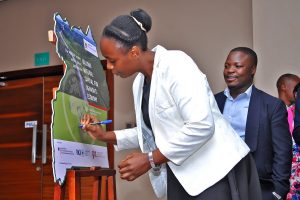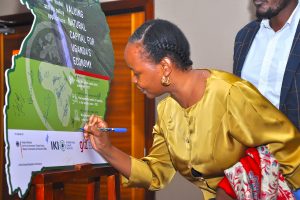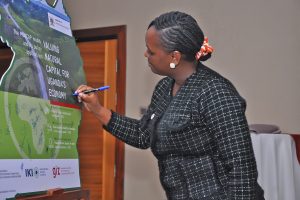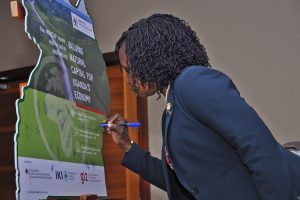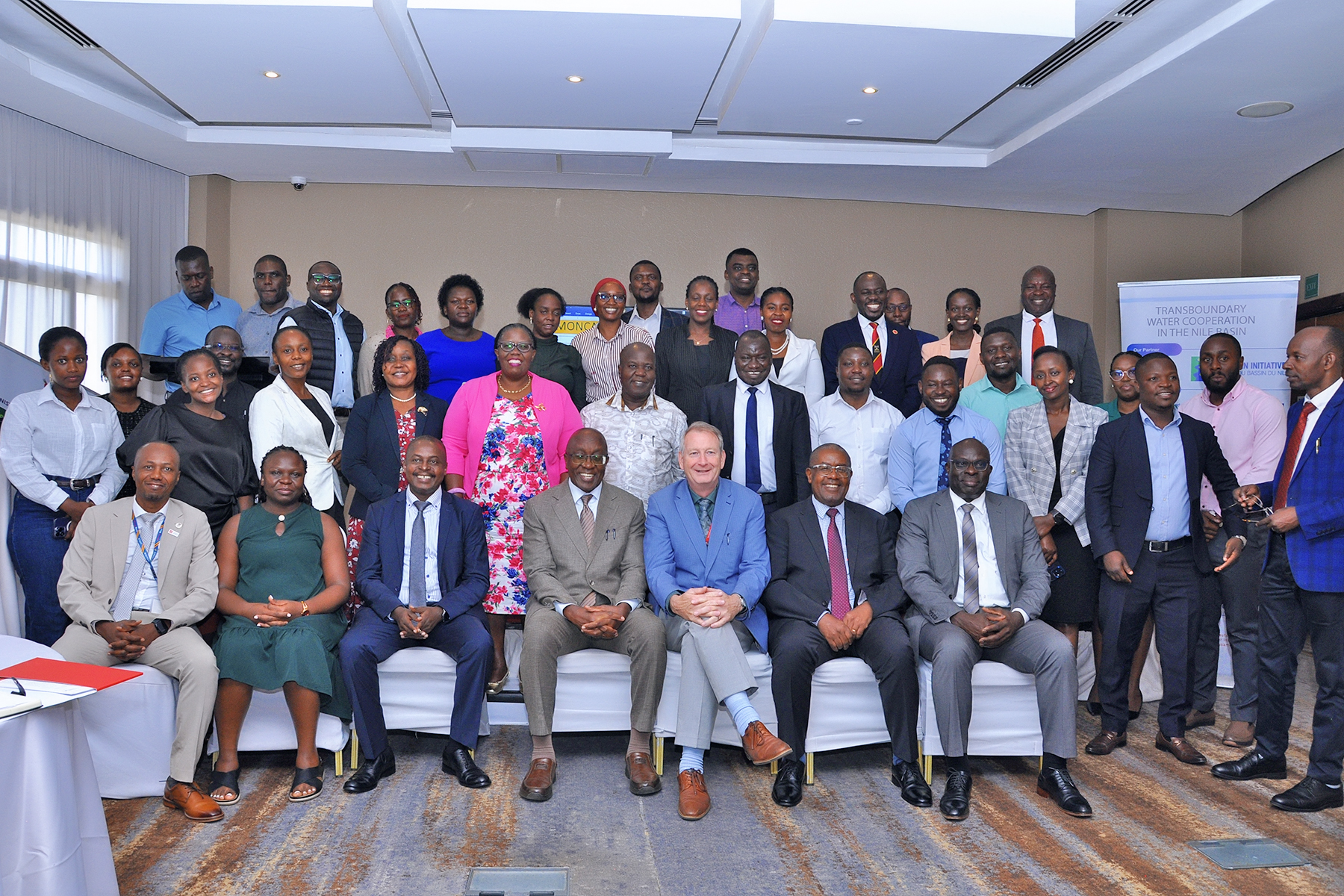
KAMPALA — Uganda has launched a new modelling tool designed to help government assess the economic consequences of investing in, or failing to protect, natural resources such as forests and water.
The Model for Natural Capital Policy Assessment (MONCAP) was launched on Friday at Golden Tulip Canaan Hotel in Kampala by the Permanent Secretary in the Ministry of Water and Environment, Dr Alfred Okot Okidi.
Makerere University has previously described MONCAP as a tool that integrates natural capital and climate variables into fiscal and macroeconomic planning, allowing policymakers to simulate policy options and assess their economic implications.
Speaking at the launch, Okidi said Uganda’s pursuit of the Tenfold Growth Strategy must be accompanied by measures to protect the natural resources underpinning economic activity.

“How do we achieve tenfold growth without degrading the natural resources upon which our economy and the world depend?” Okidi asked.
He said Uganda’s economy and livelihoods remain heavily dependent on water, forests and other ecosystems, making their protection an economic rather than merely environmental concern.
“It is an investment in economic productivity, water and food security, climate resilience and long-term national prosperity,” he said.
Okidi said the model would help government understand the implications of different policy and investment choices, including the economic consequences of failing to invest in natural capital.
The Permanent Secretary said the model should be integrated into national planning, budgeting and public investment decisions.
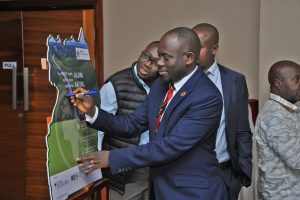
Okidi formally launched the MONCAP model and its accompanying policy assessments covering investment in water, forestry and government policies affecting the management and exploitation of natural capital.
GIZ calls for institutionalisation
GIZ Country Director James Macbeth described the initiative as the result of a long-standing partnership between Germany and Uganda.
He said Makerere University’s Environment for Development Centre had worked with government institutions to translate complex relationships between natural capital, climate change and the macroeconomy into a tool for policy analysis.
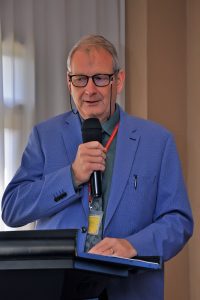
“You can see that it is a very sophisticated and very impressive model, with so much science behind it,” he said.
Macbeth said the model’s significance goes beyond environmental protection because water and forests constitute part of Uganda’s productive economic base.
“Natural capital, like water and forests, is increasingly viewed in Uganda not as an afterthought or an appendix—a separate environmental consideration—but as part and parcel of the capital base and productive infrastructure of this country,” he said.
He said GIZ would focus on three areas in the next phase: institutionalising the model across government, strengthening the evidence base through regular data updates and ensuring national ownership.
Model can improve investment decisions
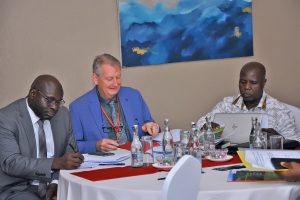
Eng. Gilbert Kimanzi, who represented the Permanent Secretary during the opening session, said MONCAP could help government quantify the economic costs of failing to invest in water, irrigation and other natural assets.
“There is an economic cost to not investing in water. There is an economic cost to not investing in irrigation. To what extent are those costs considered?” Kimanzi asked.
He said natural resources should be factored into budgeting and resource allocation decisions.
Forestry investment could create 3,663 jobs
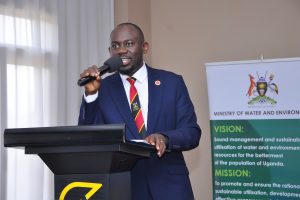
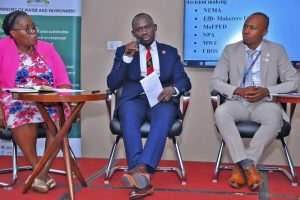
Presenting the policy briefs generated from MONCAP, Dr Peter Babyenda of Makerere University’s EfD-Mak Centre said the model was designed to move government from recommendations to evidence-based action.
“What the model does most is enable us to simulate—run the model and see what happens,” Babyenda said.
He said the forestry policy brief examined a scenario in which government invested Shs10 billion in afforestation and reforestation. “We saw that this would increase economic growth. It would increase Uganda’s growth by 0.02%,” he said.
According to the model scenario presented by Babyenda, the investment would generate 3,663 full-time equivalent jobs, increase household welfare by 0.02%, expand forest cover by an estimated 1,074 hectares and reduce carbon emissions.
He said the findings suggested that forestry should be considered part of Uganda’s economic growth and climate agenda rather than treated solely as an environmental concern.
The model’s simulations, he said, indicated that LPG could provide an alternative to biomass energy while helping reduce emissions.
Shs20 billion water investment scenario
Babyenda said a second policy brief examined the potential macroeconomic effects of investing Shs20 billion in the water sector.
“What we see here is that GDP would increase by 0.04%. We would create 4,215 jobs, and household welfare would also improve,” he said.
“Therefore, investments in natural capital are actually growth-enhancing. And not just growth-enhancing, but also welfare-improving and job-creating,” he added.
He said investment in water should be considered alongside investment in sectors such as agriculture, mining and industry because of their dependence on water resources.
The model also examined the implications of Uganda’s Tenfold Growth Strategy for emissions and possible mitigation measures.
Babyenda said the simulations indicated that economic expansion would increase emissions, but that energy transition, restoration, afforestation and cleaner cooking technologies could help reduce the impact.
“One of the recommendations that comes out of the simulation is that efforts in clean cooking, improved stoves and related measures will play a very big role in reducing emissions,” he said.
MoFPED wants evidence-based decisions
Dr Sam Mugume of the Ministry of Finance, Planning and Economic Development said the model comes at a time when government is seeking evidence to guide investment under the Tenfold Growth Strategy.
“There is now great appreciation within the Ministry of Finance, Planning and Economic Development of the need to invest in natural capital, biodiversity and nature,” Mugume said.
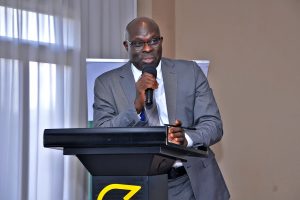
He said Uganda’s economy had recorded average growth of about 6–7 percent, with natural resources, agriculture, industrialisation and services playing a major role.
“The resources we have, as the Permanent Secretary said, our economy depends significantly on natural resources,” he said.
MONCAP designed to assess trade-offs
Wilson Asiimwe, a senior economic modeller at MoFPED, said MONCAP was developed to bridge a gap in conventional economic analysis, which has often failed to fully account for natural capital depletion.
“We have always known that economic growth depends on natural capital assets such as forests,” Asiimwe said. “But conventional analysis of economic growth has often sidelined natural capital assets because they have historically been viewed as a large stock that has always been available,” he added.
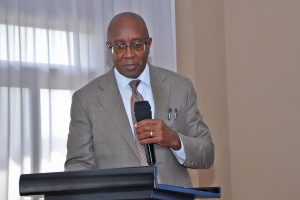
Asiimwe said MONCAP was designed to make the macroeconomic value of natural resources visible. “Nature is capital. MONCAP makes the macroeconomic value of natural capital visible,” he said.
The model can assess the implications of investment and non-investment in natural capital, analyse the effects of government policies on forests and water, examine energy transitions and assess climate-related policies, he said.
He said the model could support national and sector planning, budget formulation, public investment appraisal, climate policy and Nationally Determined Contribution assessments.
The MONCAP model and accompanying policy briefs and user manual were formally handed over to the Ministry of Water and Environment for adoption, use and institutionalisation.
The model was developed by the Ministry of Water and Environment in collaboration with the Ministry of Finance, Planning and Economic Development (MoFPED), Makerere University’s Environment for Development (EfD-Mak) Centre, the Uganda Bureau of Statistics (UBOS), the National Planning Authority and development partners, with support from the German development agency GIZ.