


LAMU, Kenya — President Yoweri Kaguta Museveni has welcomed the construction of a $16 billion oil refinery in Kenya, saying the project represents a shift from Africa’s long-standing dependence on exporting raw materials and importing finished products.
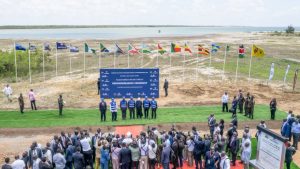
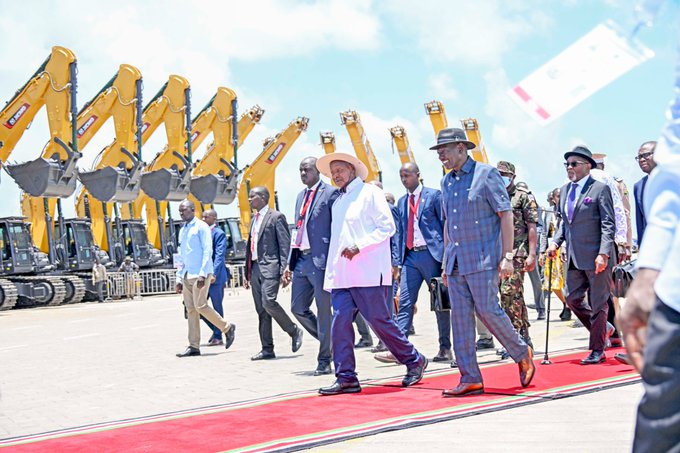
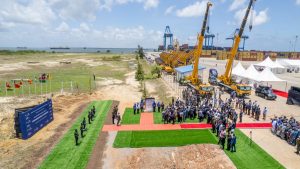
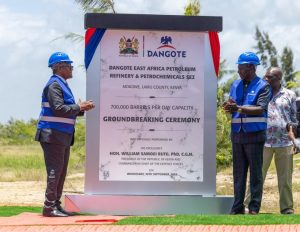
Museveni was speaking on Wednesday at the groundbreaking of the Dangote East Africa Petroleum Refinery in Mokowe, Lamu County, where he joined Kenyan President William Ruto, Nigerian industrialist Aliko Dangote and other African leaders.
“I am very happy to see Africa reimagining its future beyond this 70-year betrayal of exporting raw materials and importing finished products,” Museveni said.
The refinery is planned to process up to 700,000 barrels of crude oil per day and is expected to supply refined petroleum products to markets across East and Central Africa. The project is expected to be completed within about 40 months, according to Dangote.
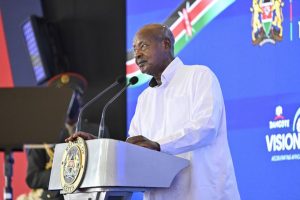
Museveni said the project demonstrated the importance of processing African resources within Africa, arguing that value addition would create jobs and retain more income on the continent.
“When we sell a bean of coffee, after the husking, removing the skin, you get $2 a kilo. When it is roasted, ground and packed, the one who did it gets $40,” he said.
He said the same principle applied to petroleum, minerals and agricultural commodities, arguing that African countries should not remain exporters of raw materials while importing products manufactured from those same resources.
Museveni backs Uganda refinery
Museveni said Uganda would continue with plans to establish its own refinery in Hoima despite the construction of the much larger facility in Lamu.
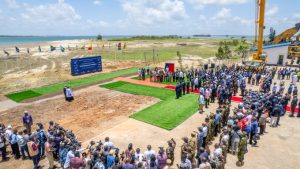
“In Uganda, we have some petroleum and had plans to build a small refinery in Hoima. I also discussed with Mr Dangote, President Ruto and President Samia the idea of building a refinery in Tanga. I support this project, but I will not invest yet,” he said.
He said Uganda’s refinery would serve the domestic market and other countries in the interior of Africa.
Museveni also said he intended to revisit discussions with Tanzanian President Samia Suluhu Hassan about the proposed refinery in Tanga.
He argued that several refineries could operate in the region if countries coordinated their investments and expanded regional markets.
“The refinery here in Lamu can be there. The one in Tanga can be there. The one in Uganda will be there. The one in Nigeria can also be there,” he said.
Uganda has previously pursued plans for a refinery at Kabaale in Hoima, alongside the East African Crude Oil Pipeline linking Uganda’s oil fields to the Tanzanian port of Tanga.
Calls for East African integration
Museveni also renewed his call for deeper political integration in East Africa, saying regional integration would make it easier for countries to share markets, jobs and industrial opportunities.
He cited Nigeria, where petroleum can move between states without international borders, contrasting it with the challenges faced by countries in East Africa operating separate national markets.
He questioned how Uganda and other countries would fully benefit from regional investments if workers and businesses could not move freely across borders.
“We need to look again at the political federation of East Africa. Our earlier leaders saw the need for it,” Museveni said.
He argued that a more integrated East African market would make large investments such as refineries more economically viable and allow citizens across the region to participate in the resulting opportunities.
Ruto credits Museveni
President Ruto described the Lamu refinery as a major regional industrial investment and credited Museveni with encouraging the project.
“Today we break ground in Lamu. We turn a proposal into an industry. We transform a long-held ambition into real opportunity for Kenya, for East Africa and for our continent, Africa,” Ruto said.
Ruto said the refinery would strengthen regional energy security and reduce reliance on imported petroleum products.
The Kenyan president said the $16 billion project would form part of a wider industrial complex incorporating a 1,000-megawatt power plant, plastics manufacturing and production of fertilisers and chemicals.
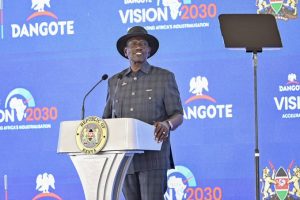
He said the project was expected to generate about 60,000 direct jobs during construction and contribute to the development of local technical skills and businesses.
Ruto also said the project could increase Kenya’s economic output by 12% and attract additional foreign investment during the construction period.
Ruto thanked Museveni for his role in encouraging regional cooperation around the investment.
“I want to thank our father, President Museveni. When we sat down with Aliko Dangote, it was your vision that brought us this far. Mzee, we don’t take your vision for granted. You are the one who pushed us,” Ruto said.
Africa must process what it produces
Dangote said the Lamu project was conceived as part of a broader effort to increase Africa’s industrial capacity and reduce dependence on imported finished products.
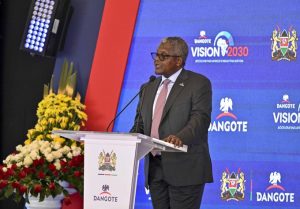
“Africa cannot build lasting prosperity by exporting what it has and importing what it needs. We must produce more of what we consume; we must process more of what we produce,” he said.
He said the refinery would serve markets across East Africa and could support industries in petrochemicals, manufacturing, logistics, engineering and other sectors.
Dangote said up to 30% of the refinery’s equity had been earmarked for East African countries, with participating governments able to take stakes in the project.
He also pledged to establish a training school in Lamu capable of training 1,000 local engineers and technicians.
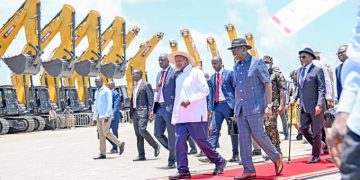
Dangote said more than 110 pieces of equipment were already on site, with hundreds more expected to arrive as construction progresses. He pledged to return to Lamu to commission the refinery within 40 months.
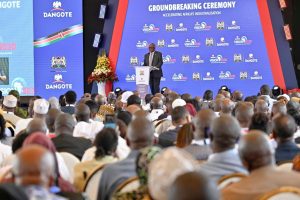
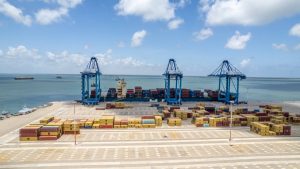
The refinery is planned along the Lamu Port-South Sudan-Ethiopia Transport (LAPSSET) Corridor and is expected to serve Kenya and other regional markets, including Uganda, Tanzania, Rwanda, Ethiopia, South Sudan and the Democratic Republic of Congo.
The project is being developed as East Africa seeks to expand its refining capacity, process more of its natural resources locally and reduce dependence on imported petroleum products.
The project also faces questions from local communities over land, employment, compensation and environmental concerns.
Ruto said residents had a right to ask how the refinery would affect land, water, fishing, jobs and local businesses, saying such questions should be addressed as part of responsible development.