



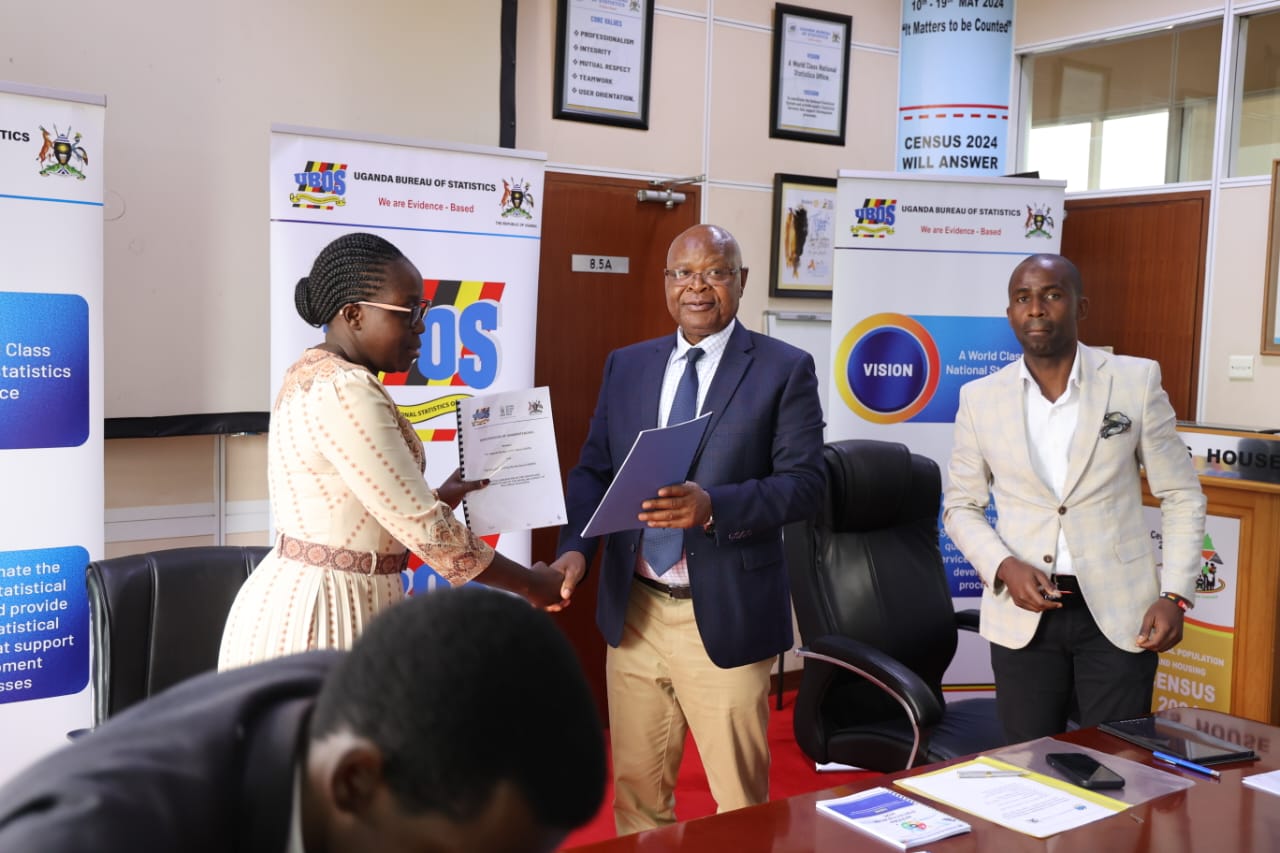
The Uganda Bureau of Statistics (UBOS) and the National Building Review Board (NBRB) have signed a Memorandum of Understanding (MoU) to conduct Uganda’s first-ever baseline survey of buildings, creating what officials say will be the country’s first comprehensive statistical inventory of its building stock.
The agreement was signed on August 7, 2026, at Statistics House in Kampala during a ceremony presided over by UBOS Executive Director Dr Chris Mukiza. The NBRB delegation was led by its Executive Secretary, Eng. Flavia Gutto Bwire.
The survey will generate nationwide data on the number and distribution of buildings, their characteristics and structural condition, ownership and occupancy, as well as compliance with building regulations and standards.
Officials said the data will provide the government with a clearer picture of Uganda’s building stock and help improve planning and regulation across the construction sector.
Speaking at the signing ceremony, Dr Mukiza said reliable official statistics are essential for effective national planning and policy-making.
He said the partnership demonstrates the importance of collaboration within Uganda’s National Statistical System and will help ensure that decisions affecting the building sector are based on credible and evidence-based information.
The survey is expected to establish a comprehensive inventory of buildings and produce statistics that can support infrastructure planning, construction regulation, disaster risk reduction, monitoring of building standards and policy formulation.
UBOS and NBRB will establish a Joint Technical Committee to oversee the exercise, including development of the survey methodology and questionnaires, pilot testing, field operations, data processing, validation and dissemination of the findings.

Under the agreement, UBOS will provide technical leadership in survey design, statistical methodology, quality assurance, data processing, analysis and dissemination.
NBRB will coordinate implementation, mobilise resources and provide technical expertise in building inspection, construction standards and regulatory compliance.
The institutions said the survey will provide government agencies, investors, development partners and other stakeholders with accurate and timely information about Uganda’s building sector.
The findings are expected to contribute to improved construction regulation, stronger enforcement of building standards, enhanced public safety and more sustainable urban development.
The exercise also comes as Uganda’s urban centres continue to expand, increasing the need for reliable information to guide infrastructure development, land-use planning and regulation of the construction industry.
Officials said the baseline data will ultimately support Uganda’s broader national development planning by providing an evidence base for decisions on the built environment.