


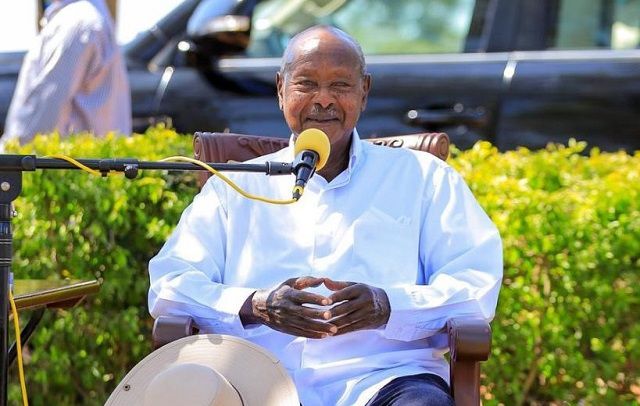
President Yoweri Kaguta Museveni has congratulated National Resistance Movement (NRM) Members of Parliament following the passage of the Protection of Sovereignty Bill, 2026, describing the legislation as essential in shielding Uganda from foreign interference.
In a statement shared on his official X account on Wednesday, the President defended the Bill and criticised opponents who questioned its intent.
“This is to congratulate the NRM MPs for passing the Sovereignty Bill, which simply means ‘mutuleke tukole ebyaffe ngamwe bwemukola ebyamwe wataliwo okubayingilila’ (let us do our things by ourselves just as you do your own things without anybody interfering with you),” President Museveni said.
“How shameful and disgusting to see people arguing otherwise!! Foreigners interfering in our internal issues is very dangerous,” he added.
The President cited historical examples to justify his position, accusing foreign actors of backing the 1971 coup that brought former President Idi Amin to power. “It is how the Israelis, led by one Barak, and the British supported Idi Amin’s coup in 1971 because Obote was vocal in opposing their policy on Rhodesia (Zimbabwe),” Museveni said.
He further argued that Uganda suffered years of instability as a result of external interference. “We had to spend 8 years and a lot of deaths to solve the problem created for us by others,” he said.
Parliament passed the Protection of Sovereignty Bill on Tuesday, 05 May 2026, after adopting a series of amendments that significantly narrowed the scope of the proposed law and removed several contentious provisions.
The legislation was debated during a plenary sitting chaired by Speaker Anita Among.
Minister of State for Internal Affairs, David Muhoozi, who moved the motion, said Uganda faces growing threats that undermine its ability to govern independently.
Presenting the committee report, Defence and Internal Affairs Committee Chairperson Wilson Kajwengye said lawmakers consulted more than 200 stakeholders, including government agencies, civil society organisations, private sector players, academics and members of the diaspora.
“The amendments are intended to harmonise the definitions with the scope of the Bill to limit the application of the law to only agents of foreigners and not any other person,” Kajwengye said.
Among the major changes adopted by Parliament was the restriction of the law to individuals or entities acting on behalf of foreign interests in influence-related activities, particularly in political processes and public decision-making.
Lawmakers also revised the definitions of “foreigner” and “agent of a foreigner,” excluding Ugandan citizens living abroad from the law’s application.
The House further removed provisions that would have granted sweeping powers to the minister, replacing them with more structured mechanisms. Parliament also replaced mandatory approval requirements for foreign funding with a declaration regime.
Clause 22 now requires agents of foreigners to declare funds received rather than seek prior approval.
Several sectors were exempted from the law, including financial institutions, academic and research bodies, health facilities, and individuals receiving funds for legitimate commercial or domestic purposes.
Diaspora remittances, foreign direct investment, trade and humanitarian assistance were also protected under the amendments.
The amended Bill, however, continued to attract criticism from opposition legislators.
Jonathan Odur tabled a dissenting report opposing the legislation and accused committee leadership of bias during deliberations.
Ndorwa East MP Wilfred Niwagaba argued that the Bill criminalises free speech and interferes with constitutional rights. “This Bill criminalises free speech and infringes on Article 1 of the Constitution by interfering with the sovereignty of the people,” Niwagaba said.
Kilak South MP Gilbert Olanya warned that the legislation could negatively affect civil liberties, the economy and Uganda’s international reputation.
Meanwhile, the Leader of the Opposition, Joel Ssenyonyi, questioned the extent of amendments made to the Bill, arguing that it had effectively become a new piece of legislation.
“There is precedence set by this House where ministers have been told, with so many changes, just withdraw the Bill … because the majority of the clauses were amended,” Ssenyonyi said.
Speaker Among, however, ruled that the amendments did not alter the core objective of the Bill.