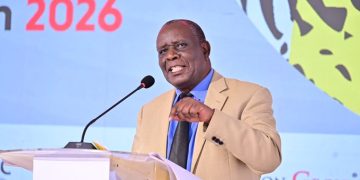



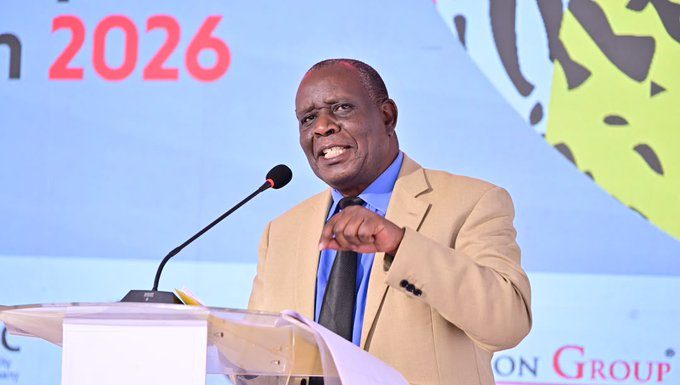
Uganda must move beyond the boundaries inherited from colonial rule and deliberately build a shared national identity, historian Prof. Mwambutsya Ndebesa has said.
Speaking at the inaugural “My Identity Expo and Symposium 2026”, organised by the National Identification and Registration Authority (NIRA), Mwambutsya said Uganda’s geographical boundaries were shaped through a series of colonial arrangements before being settled in 1926, creating the need for Ugandans to consciously develop a sense of nationhood.
“The British may have created the hardware called Uganda, with these boundaries, but we are yet, as Ugandans, to create the software of national identity,” Mwambutsya said.
Mwambutsya, who participated in the making of the 1995 Constitution as the lead researcher of a 20-member research team supporting Constituent Assembly delegates, said his experience gave him insight into both the wording and intentions behind the Constitution.
“It is one thing to know the letter of the Constitution as a lawyer, but it is also another thing to know the spirit of that letter,” he said.
He said Uganda’s current boundaries were the product of several changes beginning with the 1884–85 Berlin Conference and the declaration of Uganda as a British protectorate in 1894.
According to Mwambutsya, the protectorate initially extended as far as Naivasha in present-day Kenya before territorial arrangements between British-administered territories changed Uganda’s boundaries.
He said another section between present-day Karamoja and Lake Turkana was transferred to British East Africa in 1926, bringing Uganda’s boundaries to their current form.
“Therefore, that is when the boundaries of Uganda were finally determined,” he said.
Mwambutsya said the history of Uganda’s borders was important to understanding citizenship because communities existed across the boundaries imposed by colonial administrations.
“You cannot have an effective individual citizen identity when you have no national identity,” he said. “Uganda needs to resolve the national question. Part of the problems and challenges of Uganda is the challenge of national identity.”
He said the 1995 Constitution introduced a legal framework defining Ugandan citizenship, but argued that some aspects of citizenship by birth remained complex.
“Who is a Ugandan? Who is a citizen of Uganda? Some people think it is easy. It is not. It still has contradictions,” Mwambutsya said.
He cited Uganda’s constitutional provisions on citizenship by birth and Schedule 3, which lists communities recognised under the Constitution.
“In 1995, when the Uganda Constitution was being made, they were 56. But through these amendments, they have now become 65,” he said.
Mwambutsya also used his own family history to illustrate how cultural identities can change across generations.
“I think my grandfather originally was a Muhororo. Then in 1901, he became a Munyankore, and he died a Munyankore,” he said. “I don’t know. For me, I will die a what?”
He said such histories complicated attempts to define citizenship solely through place of birth or ethnic identity, particularly among communities divided by national borders.
“We have the Acholi of Uganda and the Acholi of Sudan. Banyarwanda of Uganda, Banyarwanda of Rwanda. Samia of Uganda, Samia of Kenya,” he said.
Identity central to security and development
Minister of Internal Affairs Prof. Ephraim Kamuntu said the historical questions raised by Mwambutsya were directly connected to the work of NIRA and the state’s ability to identify citizens. “Identity matters,” Kamuntu said.
He said the 2026 centenary marked 100 years since Uganda’s current boundaries were determined and described the milestone as an opportunity to deepen national consciousness.
Kamuntu said NIRA’s mandate extends beyond issuing national identification documents, arguing that identification is linked to security, access to public services and economic planning.
“By providing individuals with legal identity, you provide proof of nationality. You cannot be identified as a Ugandan unless you are registered,” he said.
He said accurate population data was also necessary for government planning and allocation of resources. “So, for Uganda to know, you have to have a national register. And the institution mandated to do this is NIRA,” Kamuntu said.
Kamuntu said NIRA had registered about 36.2 million people, representing 78.8% of the population, against a 45.9 million population recorded in the latest census.
He also challenged NIRA to address institutional weaknesses, including infrastructure and staffing.
He also called for greater staffing and resources, arguing that NIRA’s role in national security and economic transformation required adequate human resources.
“Government has money,” he said. “It is simply how you manage, how you network, how you plan.”
Kamuntu also warned NIRA against corruption. “Kisanja, no corruption,” he said, urging the authority to “put your house in order.”
He said the government would increasingly rely on technology, including artificial intelligence, forensic services and CCTV systems, in its efforts to improve security.
NIRA must achieve full registration
Permanent Secretary in the Ministry of Internal Affairs Lt Gen Joseph Musanyufu commended NIRA for organising the expo and said the ministry’s objective was to achieve universal registration.
“NIRA will tell us that we are only at about 80% in terms of registering Ugandans. I think our target is to ensure that we register 100%,” Musanyufu said.
He also endorsed the theme of the event: “My identity, my shadow, never apart.” “As NIRA, we have not registered ghosts, and we shall ensure that shadows are never apart from their identity,” he said.
Musanyufu pledged the ministry’s support for NIRA as it works to expand registration. “As a ministry, we shall support you and do whatever is necessary to enable you to do your work and meet your responsibilities to the country,” he said.
NIRA traces origins of national ID project
NIRA Executive Director Rosemary Kisembo said the centenary was significant not only because of Uganda’s geographical boundaries but also because of the development of a national identity.
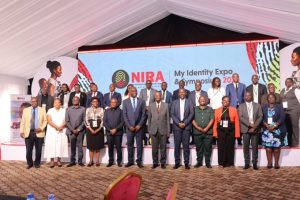
“It is 100 years since our geographical borders came together, but more importantly, it is 100 years since the identity of who we are as a nation began taking shape,” Kisembo said.
She said NIRA’s history was closely connected to earlier efforts to establish reliable identification systems.
Retired Brigadier General Stephen Kwiringira, NIRA’s Director of Registration and Operations, traced the origins of Uganda’s national identification project to an earlier system developed for the Uganda Peoples’ Defence Forces (UPDF).
“Before 2014, there was no NIRA,” Kwiringira said. “When I was in the Army, I got the opportunity and privilege to become the project manager for a project that gave the UPDF its identification cards.”
He said the military identification project was partly driven by difficulties in establishing the exact number and identity of soldiers deployed in northern Uganda.
“The Army is a security institution. We could not stop infiltration because we did not know the people we were putting into the field,” he said.
Kwiringira said the experience eventually informed efforts to establish a national identification system for the wider population.
“That was the background of the Integrated Resource Management Information System, where we gave identity to the UPDF. It was also part of the background from which the idea of giving Ugandans national identification stemmed,” he said.
He recalled that then-Internal Affairs Minister Gen Aronda Nyakairima later instructed him to identify a location for the national ID project.
“I packed my bags and started looking for where we would establish the national ID project,” Kwiringira said.
He said the project was eventually established and became the foundation for the national identification system now managed by NIRA.