




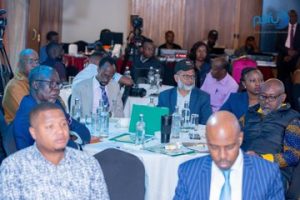
KAMPALA — Leaders from government, the private sector and development partners convened at the Private Sector Foundation Uganda (PSFU) Post-Budget Dialogue on Tuesday, where participants welcomed several measures in the FY2026/27 National Budget while raising concerns over the rising cost of doing business and the need for stronger support to enterprises.
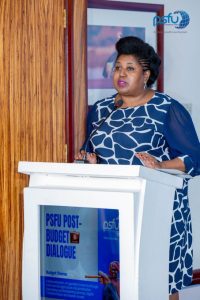
Speaking at the dialogue, PSFU Vice Chairperson Ms Sarah Kagingo welcomed some of the incentives announced in the budget but cautioned that other measures could increase operational costs for businesses.
“We are grateful for the income tax exemption on hotel investments of US$1.5 million and above. However, the excise duty on cement and fuel will increase the cost of doing business,” Kagingo said.
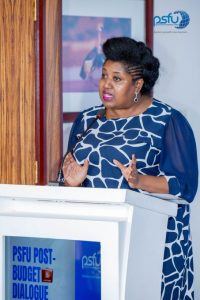
She urged the government to focus on creating conditions that enable businesses to thrive and expand. “The government should allow businesses to make more profits through different strategies. When you hear that the government has increased its tax expectations to over Shs45 trillion, know that more compliance measures will be required by the Uganda Revenue Authority,” she said.
Kagingo further called for practical financing models for small and medium enterprises, faster reforms in procurement systems, land conflict resolution and improved infrastructure to lower business costs.
“Businesses must position themselves to benefit from the budget through contracts, scalable projects and stronger bankable ventures, while PSFU remains committed to serving as their voice and bridge with government,” she added.
Representing the Permanent Secretary and Secretary to the Treasury, Richard Jabo, Principal Economist at the Ministry of Finance, Planning and Economic Development, highlighted Uganda’s strong macroeconomic performance and outlook.
“Uganda’s economy is projected to grow by 10.2 percent next financial year. The economy is now valued at over US$75 billion, exports have increased significantly, and foreign direct investment has reached US$3.2 billion,” Jabo said.
He noted that the country’s return to double-digit growth should now be matched with efforts to create more jobs and improve productivity.

“With Uganda now a lower middle-income economy, the next phase must focus on scaling job creation, investment and productivity,” he said.
Representing Finance Minister Henry Musasizi, Assistant Commissioner for Budget Policy and Evaluation Tagore Ali said the government remains committed to maintaining an enabling environment for private sector growth.
“The dialogue provides critical feedback on what is working and what is not, helping government transition toward outcome-based budgeting focused on real economic impact rather than outputs,” Ali said.
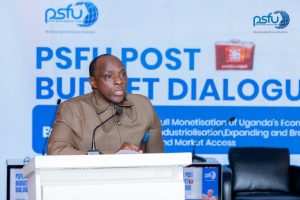
He emphasised that the private sector remains central to Uganda’s development agenda. “The private sector is central to driving growth. Government’s role is to enable and de-risk investment,” he said.
Ali noted that 95.6 percent of discretionary resources have been allocated to sectors supporting production, value addition, exports and job creation. “Uganda’s economy is increasingly self-financing, with more than 80 percent of the budget funded domestically,” he added.
PSFU Chief Executive Officer Stephen Asiimwe raised concerns about the impact of taxes and compliance costs on business competitiveness.
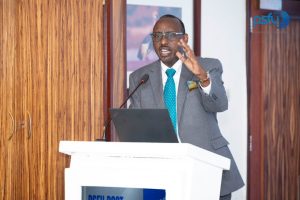
“Manufacturers are feeling the pressure of rising excise duties and high compliance costs. We need a clear tax roadmap and proper impact assessments to protect competitiveness while supporting revenue growth,” Asiimwe said.
He also called for targeted support for micro, small and medium enterprises. “MSMEs need real relief, not just policy intention. Tax systems should be simplified, compliance costs reduced, and thresholds created that allow small businesses to grow into formal enterprises,” he said.
Asiimwe further stressed the importance of long-term financing. “Growth sectors such as agriculture, tourism and manufacturing require patient capital. Businesses have gestation periods and financing models must reflect that reality,” he said.

David Wozemba, Country Director of AGRA, urged greater focus on agricultural commercialisation and value addition.
“Uganda’s agricultural potential is undisputed, but value addition and agro-processing remain limited. We must strengthen value chains, improve market access and position Uganda competitively both regionally and globally,” Wozemba said.
Simon Kaheru, Vice Chairperson of the East African Business Council Uganda Chapter, challenged policymakers to focus on expanding market access rather than limiting production.

“Uganda must not reduce production because of market barriers; we must scale it. The real issue is not demand, it is access,” Kaheru said.
He called for stronger regional integration and industrial growth. “We keep talking about increasing production, but forget the second half—selling what we produce. Uganda already has customers locally and across borders, yet we are not fully tapping into them,” he said.
On taxation, Kaheru argued that the government should broaden the tax base instead of increasing taxes.

“Tax policy must support growth, not suppress it. Instead of raising taxes, we should broaden the tax base and lower costs to increase consumption volumes. More consumption means more revenue, more jobs and more investment,” he said.
Kaheru also urged Uganda to reduce dependence on imports. “Global shocks have shown us that we rely too much on imports. Many inputs, such as fertilisers, can be produced locally. Uganda must unlock resources like Sukulu phosphate to strengthen industrial resilience,” he said.
Meanwhile, Grace Aine, Manager of Special Projects at the Uganda Revenue Authority (URA), highlighted progress in digital tax administration.
“URA has made significant strides in digital tax administration. Systems such as eFRIS and DTS are improving compliance, transparency and VAT collections,” Aine said.
He noted that digitalisation is reducing manual processes and improving efficiency. “Digital systems are clearly the future of compliance in Uganda,” he said.
On rental income tax, Aine revealed that collections had risen significantly. “Rental tax collections have grown from about Shs250 billion after COVID-19 to Shs331 billion today, but compliance gaps remain, particularly in urban rental markets.”

Aine added that URA is increasingly integrating third-party data and targeting e-commerce and online trade to expand the tax base.
The Chairperson of the Tax Appeals Tribunal, Crystal Kabajwara, warned that prolonged tax disputes were locking substantial capital out of the economy.
“More than 500 cases worth approximately Shs1.5 trillion are currently tied up in dispute resolution. Resolving these cases would unlock capital either as working capital for businesses or tax revenue for the government,” Kabajwara said.

She also highlighted what she described as a growing trust deficit. “Beyond the numbers, we are seeing a trust deficit that increases transaction costs, weakens credit systems, and pushes economic activity into less productive spaces. We need to go back to the basics and rebuild trust,” she said.
Participants also discussed the role of digital transformation in economic growth, emphasising the need to make internet and mobile money services more affordable.
The dialogue concluded with a shared call for stronger collaboration between government and the private sector to drive investment, job creation and Uganda’s long-term ambition of building a US$500 billion economy.