


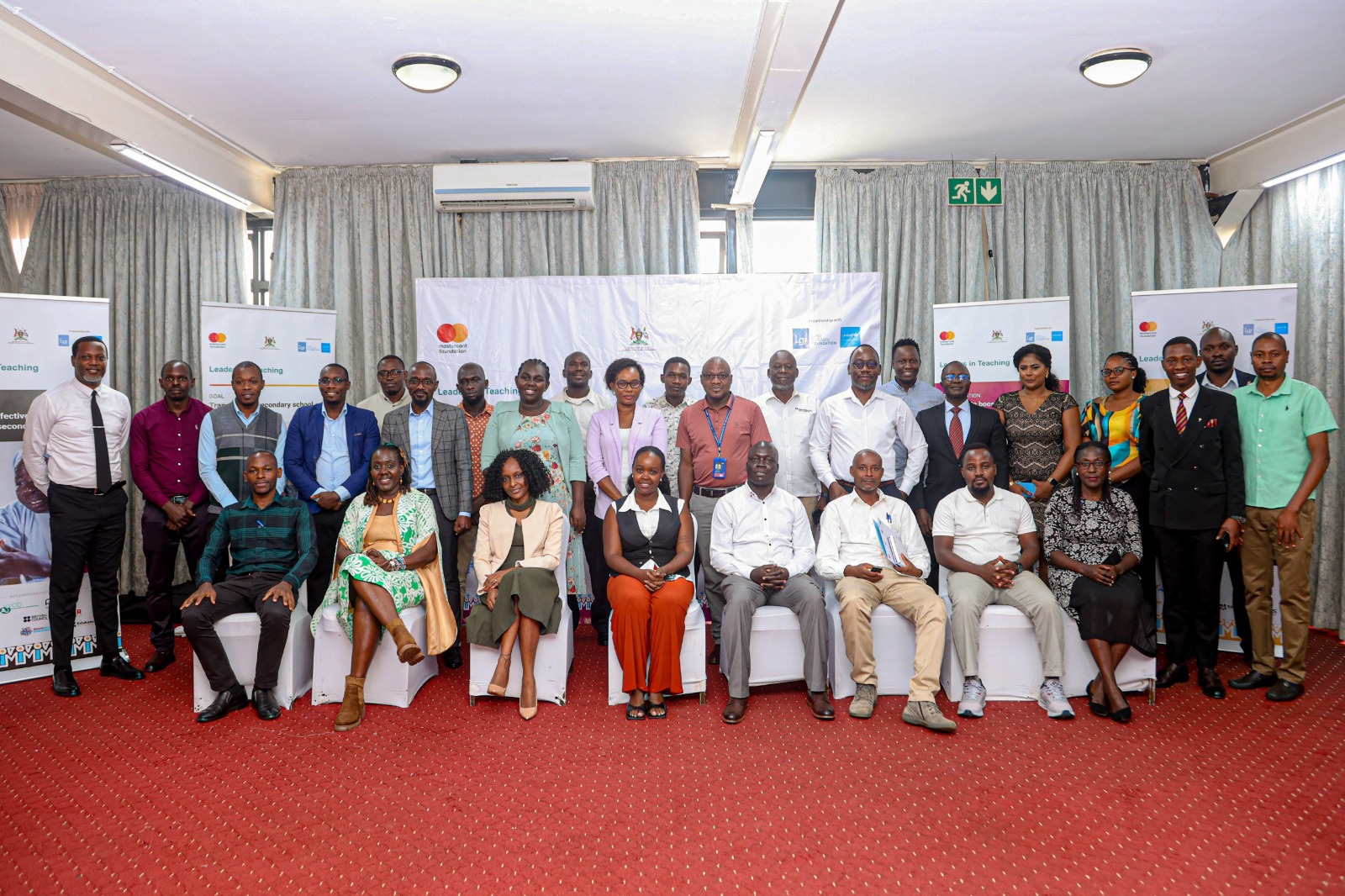
KAMPALA — Education stakeholders have called on journalists and media houses to play a more active role in helping Ugandans understand ongoing education reforms, arguing that stronger public awareness is essential to improving learning outcomes and preparing young people for the future world of work.
The call was made during a media engagement organised by the Leaders in Teaching Uganda Program, a Mastercard Foundation-supported initiative that seeks to strengthen teaching and learning in secondary schools across the country. The program, implemented through a consortium led by Luigi Giussani Foundation and UNICEF under the guidance of the Ministry of Education and Sports, will reach 2,091 secondary schools, 10 universities and 5 Uganda National Institute for Teacher Education (UNITE) campuses across Uganda.
Other consortium partners on the program are Forum for Education NGOs in Uganda (FENU), Teach For Uganda, British Council, Edukans International Uganda, Brainwave Careers Uganda, VVOB – education for development, Promoting Equality in African Schools (PEAS) Uganda, and STiR Education. Cross-cutting support is provided by AfriChild Centre for Monitoring, Evaluation, Research and Learning, Cheshire Services Uganda for disability and inclusion, and WEKOnnect Group for communications for impact.
Opening the dialogue, Emmanuel Adengo, Consortium Manager of the Leaders in Teaching Uganda Program, said education transformation requires collaboration between educators, policymakers, communities and the media.
“Each learner comes into the classroom with a dream, a vision and a unique journey ahead of them. As teachers, we have the power either to nurture that potential or to stifle it,” Adengo said.
He noted that the program aims to create lasting impact on learners, teachers and schools by strengthening teacher development, school leadership and implementation of the Competency-Based Curriculum (CBC).
“There is a great deal of positive change happening within Uganda’s education sector. Partners are investing in schools, teachers are innovating, and reforms are taking shape. The challenge is ensuring that these stories are told and that their impact is visible,” he said.
“We believe the media is a key partner in ensuring that information about educational reforms is communicated accurately and effectively,” he said.
During a panel discussion moderated by Catherine Ntabadde, Advocacy and Communications Specialist at UNICEF, media practitioners highlighted challenges they face in reporting on education, including limited access to information, inadequate resources and the technical nature of education reforms.

One editor noted that journalists are often expected to understand and explain complex reforms with minimal engagement from implementing institutions.
“When the Competency-Based Curriculum was introduced, many journalists were expected to explain it to the public despite having little opportunity to understand the processes behind it,” the participant observed.
Ntabadde urged education stakeholders to involve journalists earlier in reform processes to improve public communication and understanding.
Presenting the program overview, Brenda Akite, the Program Manager at STiR Education, said the initiative will support 1,000 public and 1,091 private secondary schools, while also providing university scholarships to 1,000 female STEM student teachers. The scholarships aim to bridge the gender gap in STEM education by increasing the number of qualified female teachers, especially in rural areas, so that they mentor and inspire more girls to pursue STEM careers.
The program will further support 7,500 pre-service teachers, 300 tutors, and 6,273 school leaders, including headteachers and deputy headteachers.
Akite said the program is built around four pillars: teacher recruitment, teacher training, school leadership and teacher motivation. “We recognise that when teachers are effectively supported, they can support learners better,” she said.
She explained that the program seeks to improve teaching quality, strengthen school leadership, promote gender equity in STEM education and build stronger education systems through collaboration with government structures.
Joseph Semujju, the Leaders in Teaching Program Manager at British Council, stressed that teachers remain the most important factor in determining whether learners benefit from education.
He illustrated his point through the story of a Senior Two girl who attends school but may not necessarily experience meaningful learning. “A child can be at school, but is school coming to the child? Is the lesson meeting this child?” he asked.
Semujju argued that the difference between access to education and actual learning is often determined by the quality and preparedness of teachers. “The teacher who is empowered turns a lesson into a living, solution-oriented experience that enables learners to think, critique and solve real-life problems,” he said.
He called for expanded continuous professional development, stronger coaching and mentoring systems, increased support for female STEM teachers and improved school leadership.
“The challenge before us is not only improving education but also strengthening public understanding of what it takes to transform it,” he said.
During the discussion, journalists proposed practical ways of improving education reporting, including regular briefings, access to research findings, expert sources and field visits to schools implementing education reforms.

Fortunate Kagumaho, Communications and Marketing Manager, Teach For Uganda, encouraged journalists to utilise evidence generated by the program. “We have access to experts, studies, baseline surveys, teacher gap assessments and data on gender inclusion and ICT integration. Reach out to us, and we shall support you with information.”
Kagumaho also urged journalists to focus on impact-driven reporting rather than event-based coverage. “Highlight change and results at a system level rather than simply reporting that a meeting took place,” he advised.
He further called for dignified reporting practices, especially when photographing learners and program participants.
Moderating the closing session, Joanna Bakimi Murungi, the VVOB Communications Advisor, challenged journalists and program implementers to move beyond dialogue and commit to concrete action.
“We want to hear what practical steps we can take together and how we shall measure whether this partnership is working,” she said.
Media representatives are committed to producing more education stories, simplifying education data for public audiences and creating platforms for explaining reforms such as the Competency-Based Curriculum.
Several participants proposed establishing a media working group and holding regular engagements between journalists and education experts to strengthen reporting on education transformation.