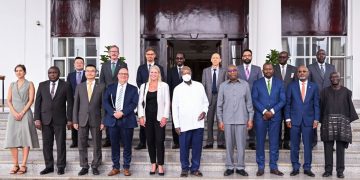



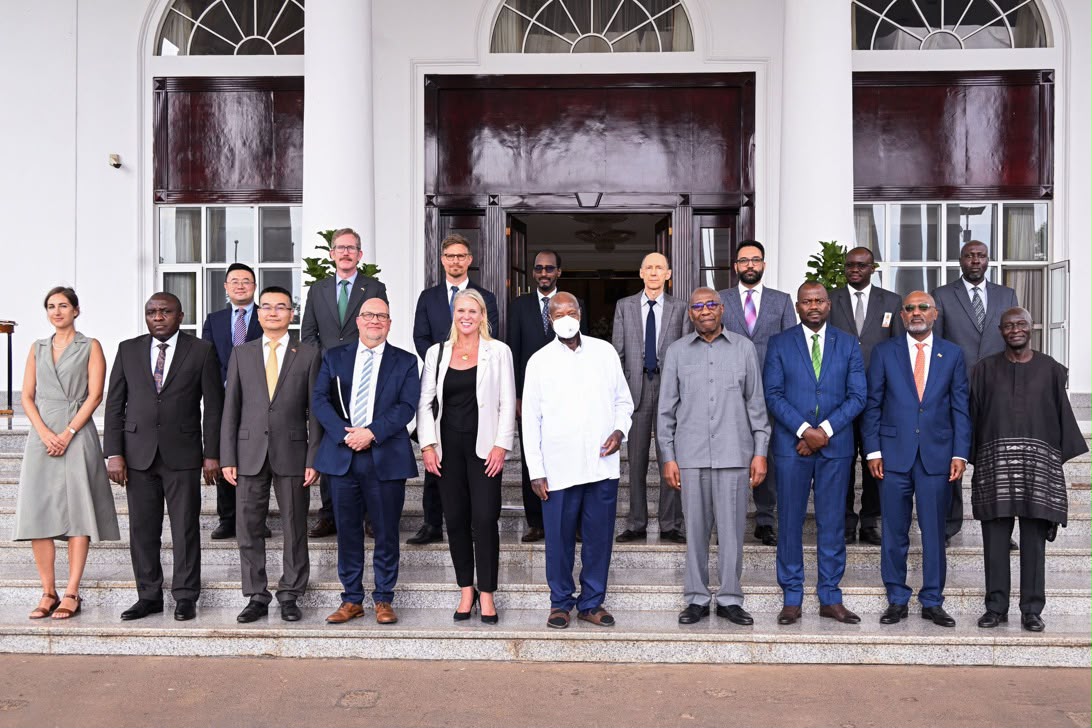
President Yoweri Kaguta Museveni has formally reaffirmed Uganda’s support for Ambassador Olara Otunnu’s candidature for the position of United Nations Secretary-General during a meeting with representatives of member states of the UN Security Council at State House, Entebbe.
The meeting was convened to officially present Uganda’s nominee and reaffirm the government’s commitment to mobilising international support for Ambassador Otunnu’s bid to lead the world’s premier multilateral organisation.
Introducing Ambassador Otunnu to the diplomats, President Museveni described him as an accomplished Ugandan statesman and seasoned diplomat whose extensive experience within the United Nations system makes him well suited to lead the organisation at a time of growing global challenges.
“He is really the type of person you will need in the UN system because he is very much aligned to it. I therefore hand over Olara Otunnu to you,” President Museveni said.
The President said he had known Ambassador Otunnu since their days at Makerere University, where Otunnu served as Guild President. He also highlighted Otunnu’s fluency in English and French, saying his multilingual ability and broad diplomatic experience are valuable assets for the position.
“He speaks English and French very well without a tribal accent, so I hand Ambassador Olara Otunnu to you so that he can brief you himself,” President Museveni added.
President Museveni noted that although Ambassador Otunnu has spent decades serving the international community, he has remained an influential figure in Uganda’s political life, having served as President of the Uganda People’s Congress (UPC) and previously contested for the country’s presidency.
The President further cited Uganda’s record within the United Nations, particularly its contribution to regional peace and security and its progressive refugee policy, as strengths underpinning the country’s endorsement of Ambassador Otunnu.
“Uganda’s credentials in the UN are many, but the uncontested ones are two: our contribution to regional security—I don’t think anybody will say Uganda is not known for that—and our support for refugees. Our candidate comes from that background,” he said.
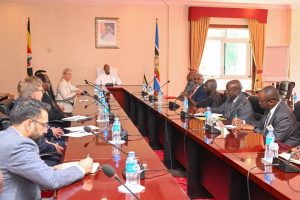
“Of course, we are also excelling in democracy, although others may have different views, which I will not insist upon. But on refugees and our contribution to regional security, I think everybody will agree.”
In his remarks, Ambassador Otunnu thanked President Museveni for the government’s endorsement, noting that several Security Council members had sought assurances regarding Uganda’s continued commitment to his candidature following previous unsuccessful attempts.
He said he had informed them that the President was best placed to clarify Uganda’s position and expressed appreciation for the opportunity to jointly engage the representatives.
Ambassador Otunnu outlined his international career, which includes serving as Uganda’s Permanent Representative to the United Nations, President of the UN Security Council, Chair of the UN Commission on Human Rights, President of the International Peace Academy (now the International Peace Institute), and United Nations Under-Secretary-General and Special Representative for Children and Armed Conflict.
He said his experience spans peace and security, humanitarian affairs, human rights and development, with a leadership approach rooted in consensus-building and dialogue.
According to Ambassador Otunnu, conflict prevention, peacekeeping, peacebuilding and post-conflict recovery should remain at the centre of the United Nations’ work.
He also presented his vision for strengthening the organisation through institutional reforms aimed at improving efficiency, coordination and accountability.
On development, Ambassador Otunnu said the Secretary-General should play a stronger convening role in mobilising long-term financing for developing countries with credible development plans but limited financial resources.
He further proposed that the United Nations should lead global cooperation on emerging technologies, particularly artificial intelligence, by bringing together governments, experts and the private sector to ensure technological progress benefits all humanity.
Ambassador Otunnu also pledged to promote transparency, merit and inclusivity within the UN, saying recruitment should reflect the organisation’s universal character while maintaining the highest professional standards.
He described the office of the Secretary-General as one founded on moral authority, humility, consensus-building and sustained engagement with member states in advancing peace, sustainable development and international cooperation.
Representatives of Security Council member states welcomed the opportunity to engage with President Museveni and Ambassador Otunnu, outlining the priorities that will guide their respective governments during the Secretary-General selection process.
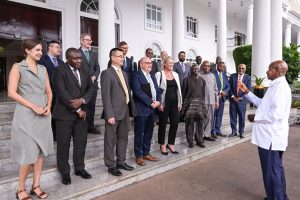
The diplomats commended Ambassador Otunnu’s international record and welcomed his focus on peace and security, development, human rights, institutional reform and emerging global challenges, including artificial intelligence.
They also acknowledged Uganda’s contribution to regional peace and security, particularly in the Horn of Africa and the Great Lakes Region, as well as its internationally recognised refugee policy.
Former Prime Minister Rt. Hon. Dr Ruhakana Rugunda reaffirmed Uganda’s determination to secure broad international backing for Ambassador Otunnu’s candidature.
President Museveni announced that Dr Rugunda would lead a Ugandan delegation to engage governments in various capitals as part of Uganda’s diplomatic campaign.
“We are going to send our delegation led by Dr Rugunda to your capitals,” President Museveni said.
Dr Rugunda described Ambassador Otunnu as a distinguished Ugandan statesman whose service at both the national and international levels has prepared him to lead the United Nations.
He noted that Ambassador Otunnu has remained an important national leader through his leadership of the Uganda People’s Congress and his participation in presidential elections. “I am very happy that you have endorsed Ambassador Otunnu. We will give him our full support,” Dr Rugunda said.
He added that Uganda believes the time has come for Ambassador Otunnu to realise his long-held aspiration of serving as UN Secretary-General. “I think now is the time to actualise this long-postponed aspiration.”
Dr Rugunda also appealed to the diplomats to convey Uganda’s message of support to their respective governments. “I hope that the ambassadors will clearly convey the message to their respective governments.”
The meeting was attended by ambassadors representing both permanent and non-permanent members of the UN Security Council, including Somalia, Denmark, the Democratic Republic of the Congo, Pakistan, Russia, the United Kingdom, France, the United States and other member states.