



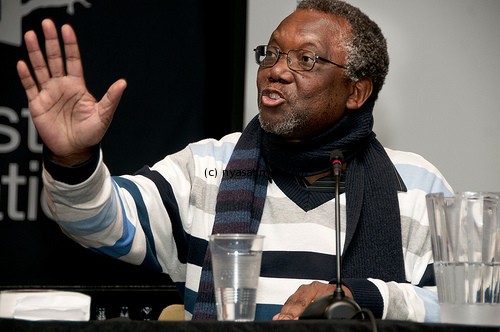
MALAWI — Malawi and the African literary community are mourning poet and academic Jack Mapanje, who died in Britain on November 4, 2026, aged 82, following an illness.
The African Poetry Book Fund announced his death in a tribute circulated on Thursday, November 19, describing him as a literary figure whose work challenged political authority and became part of Malawi’s struggle for intellectual freedom.
Born on March 25, 1944, Mapanje built a reputation for poetry marked by humour, sharp criticism and storytelling techniques influenced by the fictional tales of his childhood. His writing confronted corruption and the abuse of political power.
His first poetry collection, Of Chameleons and Gods, published in 1981 under the Heinemann African Writers Series, was banned in Malawi. In September 1987, he was arrested and detained without charge at Mikuyu Prison, where he remained until May 1991.
Despite his imprisonment, Mapanje continued writing. He won the Rotterdam Poetry International Award in 1988, while still in detention, and wrote much of the material for two subsequent collections: The Chattering Wagtails of Mikuyu Prison (1993) and Skipping without Ropes (1998).
His experience of imprisonment became a central subject in his writing, which examined the relationship between the individual and the state, political repression, survival and the struggle for truth.
“Victory for you is first, survival. Second, if you have the opportunity, tell your story,” Mapanje said in a 2007 interview with The Guardian, a statement that reflected the importance he attached to bearing witness.
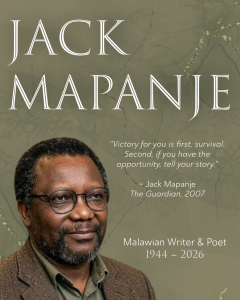
After his release in May 1991, Mapanje relocated to Britain, where he continued writing and teaching. He later taught Creative Writing and Literatures of Incarceration at Newcastle University, sharing his experience of political detention with students and readers.
His later publications included The Last of the Sweet Bananas (2004), Beasts of Nalunga (2007) and Greetings from Grandpa (2016). He also published the memoir And Crocodiles Are Hungry at Night in 2011, recounting his arrest, imprisonment and struggle to understand the reasons behind his detention.
The African Poetry Book Fund said his years in Britain brought him political protection and opportunities to develop his literary career, but also reflected the longing for home experienced by many African writers living in the diaspora.
Mapanje authored and edited more than ten books, including five poetry collections. His work explored political repression, imprisonment, exile, the struggle for African liberation and the search for personal dignity under authoritarian rule.
He is survived by his wife, Mercy Mapanje, their two daughters and son, Lunda, alongside friends, colleagues and former students.
The African Poetry Book Fund has encouraged readers to revisit his work through his books, recorded poetry readings and interviews, including a 2008 reading at Brown University’s “Under the Tongue: A Festival of Literature from Africa”.