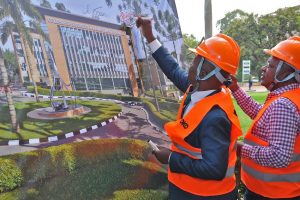



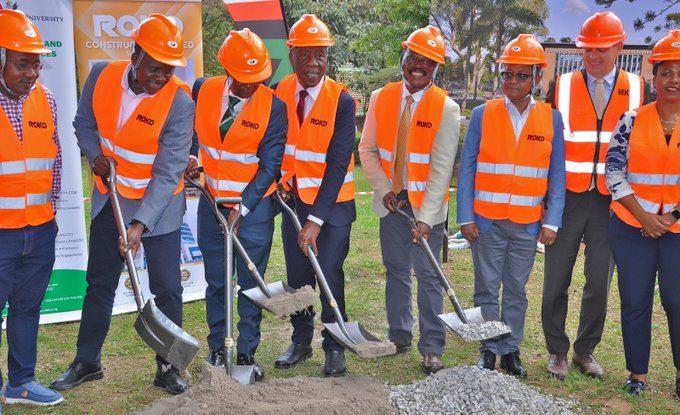
KAMPALA — Makerere University has handed over the site for the construction of a Shs96.6 billion infrastructure complex for the College of Business and Management Sciences (CoBAMS), marking a major step in the university’s plans to expand teaching, research and graduate training facilities.
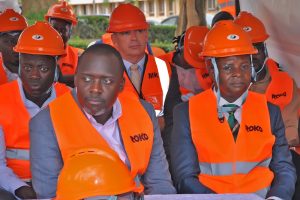
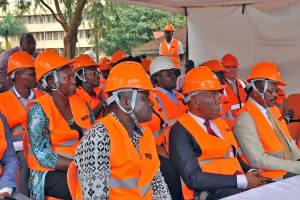
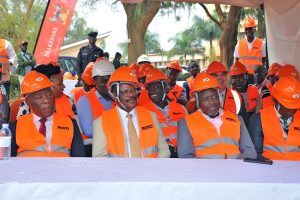
The 15,000-square-metre project, funded by the Government of Uganda, was formally handed over by Makerere University Vice Chancellor Prof. Barnabas Nawangwe to Roko Construction, which will undertake the construction works.
Roko was represented at the ceremony by its Chief Executive Officer, Mark Koehler, while Symbion Uganda Limited, the project consultant, was represented by its Managing Director, Pius Muli.
The project comes as CoBAMS continues to expand its academic programmes and student population, placing pressure on the college’s existing and fragmented infrastructure.
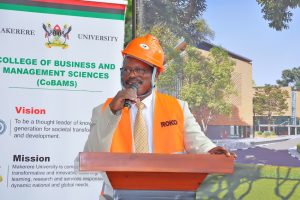
Nawangwe described the site handover as a historic moment for the university and the college, which has grown considerably from its origins as a breakaway from the former Faculty of Social Sciences.
“This is a historic moment in many ways,” Nawangwe said. “CoBAMS has come a long way. Those of you who are here know that CoBAMS started as a breakaway from what was then the Faculty of Social Sciences. It has grown tremendously to become one of the largest colleges at Makerere University.”
The Vice Chancellor said the college’s growth had made some of its existing facilities inadequate, with academic activities being conducted from buildings that are increasingly unable to accommodate its expanding needs.
“It is no longer a very small school. It has grown very big, and because of that growth, it has also been operating from accommodation that is fragmented,” he said.

Nawangwe said the new project would provide CoBAMS with a modern and consolidated home while supporting Makerere’s wider transformation agenda.
“I think it is going to be a fitting home for our second-largest college. I believe it will soon become the largest, because they have got a lot of new programmes, and nationally in Uganda, the subjects they teach are among the most sought-after by students,” he said.
The Vice Chancellor also praised the design developed by Symbion, saying the proposed development could significantly change Makerere’s physical landscape.
“I have looked at the designs, and I want to congratulate Symbion on a good design. If Roko constructs these buildings and they look like this, it will be a major transformation of Makerere’s landscape,” Nawangwe said.
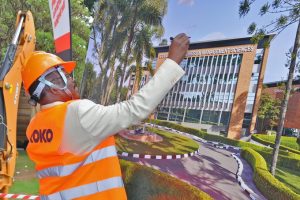
The project consultant said the proposed facility had been designed to accommodate the diverse needs of the college, including academic and administrative functions.
Muli said the approximately 15,000-square-metre complex would include offices, academic facilities and extracurricular and social spaces intended to create a better learning environment.
He said Symbion had worked with Makerere management over the past several months to develop the project brief and ensure that the final design reflected the university’s requirements. “I am happy that today we have reached a point where we are now moving into the actual implementation,” he said.
Sustainability, Muli added, had been central to the design process, with the consultants seeking to ensure that the facility would remain functional and economical to maintain over the long term.
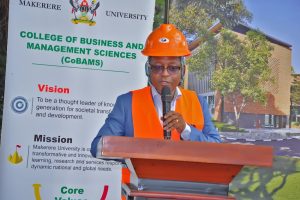
“We want to create a building that will stand the test of time. We also want to ensure that it does not become another burden to the University when it comes to maintenance over an extended period of time,” he said.
Muli also congratulated Roko for securing the construction contract and expressed confidence that the contractor would deliver the project according to the required standards.
For Roko, however, the project represents more than another construction contract. Koehler said the company understood the responsibility attached to constructing a major academic facility at one of Uganda’s oldest universities.
“Of all the buildings Roko has had the privilege of constructing over the years, I am particularly proud that we will now be building a new home for the teaching of business, economics and management here at Makerere University,” he said.
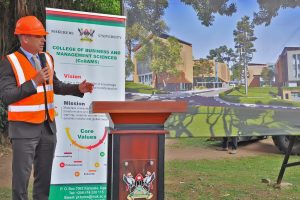
Koehler pledged that the contractor would focus on three priorities: safety, quality and timely completion. “Our commitment is very simple: we will build it safely because we don’t want any injuries; we don’t want anybody harmed during construction,” he said. “We will build it to the highest quality standards, but we will also build it on time.”
The Roko CEO also addressed criticism that the company sometimes takes longer to complete projects, saying the contractor had taken note of the concerns.
“Over the past few years, we have heard comments such as, ‘Roko is slow.’ People say, ‘Roko may take longer, but they will deliver the quality.’ So, we have listened to these comments, and we have challenged ourselves on this issue,” Koehler said.
“For this project, our commitment is clear. We want to deliver the quality for which Roko is known, but at the same time, we want to deliver within the agreed programme.”
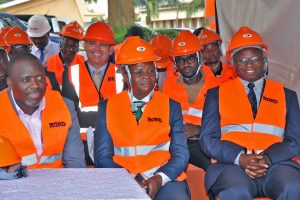
He called for close cooperation between Makerere, the consultant, contractor and other stakeholders, particularly timely decision-making and the availability of funds.
Koehler said Roko’s history at Makerere stretched back decades and recalled visiting the university as a teenager when his father was involved in construction projects there.
Prof Edward Bbaale, Principal of CoBAMS, said the project would help position the college as a leading centre for business, economics and statistics education and research.
“Once it is completed, I think that the College of Business will be one of the leading schools of business, economics and statistics in the world,” Bbaale said.
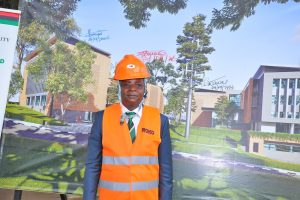
He said the project would help the college take its “rightful position” among leading institutions in the fields it teaches.
The entire project will span five years and be delivered in a phased approach, with the first phase of the building completed within 18 months.