



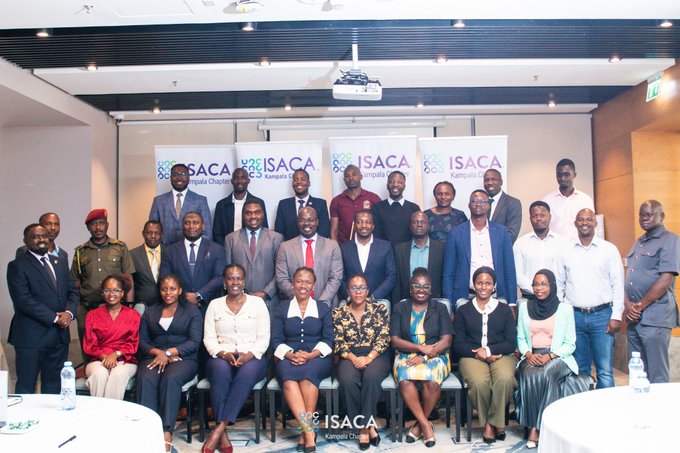
The Information Systems Audit and Control Association (ISACA) Kampala Chapter has urged corporate boards and senior executives to take greater responsibility for cybersecurity and digital trust as organisations increasingly rely on technology to deliver services and engage customers.
The call was made during the ISACA Kampala Chapter CEO and Board Executives Breakfast held at Four Points Hotel in Kampala, bringing together CEOs, board members and senior leaders from public and private sector organisations to discuss cybersecurity, digital trust, governance and organisational resilience.
ISACA Kampala President Maurice Taremwa said cybersecurity decisions should no longer be left solely to technical teams, noting that boards and senior executives play a critical role in approving investments in security technologies, staff training and awareness.
He said Uganda has the capacity to protect its digital ecosystem but warned that organisations must continuously strengthen their capabilities as cyber threats evolve. Taremwa noted that organisations should not focus only on preventing attacks but also on limiting their impact and ensuring they can recover quickly when breaches occur.
Delivering the keynote, Peter Mukuru, Director of Business Technology at Uganda Development Bank, challenged organisations to look beyond cybersecurity as a purely technical responsibility and instead focus on protecting the people who depend on digital systems.
“As machines get intelligent, our institutions must become more human,” Mukuru said, emphasising that cybersecurity should protect not only systems and data but also people’s dignity, livelihoods and trust.
Mukuru described digital trust as the confidence people have that their online transactions, communications and relationships are secure.
He said for ordinary users, trust means being confident that money sent through a digital platform reaches the intended recipient, that online communications are genuine and that digital systems work when needed.
He also called for greater collaboration across the digital ecosystem, noting that organisations are interconnected through suppliers, cloud service providers, internet service providers, fintechs and payment platforms. A weakness in one organisation, he warned, can expose others across the wider ecosystem.
The discussions further highlighted the responsible use of artificial intelligence, with organisations encouraged to consider not only whether technology can be deployed, but whether it should be deployed, who may be affected and who remains accountable for technology-driven decisions.
The engagement comes ahead of the 15th Annual East Africa Information Security Conference, scheduled for September 14–18, 2026. The conference is expected to attract about 500 delegates and 10 sponsors and will feature masterclasses on cybersecurity, artificial intelligence, and data analysis and privacy.
The breakfast underscored that digital trust is no longer solely a technology issue, with ISACA calling for accountability to extend to boardrooms, senior management and every organisation that collects, processes or relies on digital information.