


KAMPALA – Researchers at the Infectious Diseases Institute (IDI) at Makerere University are exploring an oral antiviral approach that could help prevent Ebola infection among people exposed to the virus.
The research involves the use of a pill-based antiviral medicine given to individuals at risk of infection before they develop the disease, according to IDI Executive Director Dr Andrew Ddungu Kambugu.
Dr Kambugu said the research is part of broader efforts by Makerere University and its partners to strengthen Africa’s ability to respond to viral haemorrhagic fever outbreaks through science, innovation and evidence-based interventions.
“We are working with partners to develop and approve research protocols that can be rolled out during the outbreak,” Dr Kambugu said.
He explained that one of the approaches under consideration involves providing an antiviral agent to people exposed to Ebola to prevent them from developing the disease.
“This is called an antiviral agent, which is often swallowed, and the approach is called pre-exposure prophylaxis. It is a concept that is well developed in HIV, and now we are applying this for viral haemorrhagic fever,” he said.
The development comes as Uganda and the region continue responding to an Ebola outbreak, with IDI playing a central role in surveillance, treatment support, research and coordination.
IDI Hosts Continental Ebola Response Coordination Hub
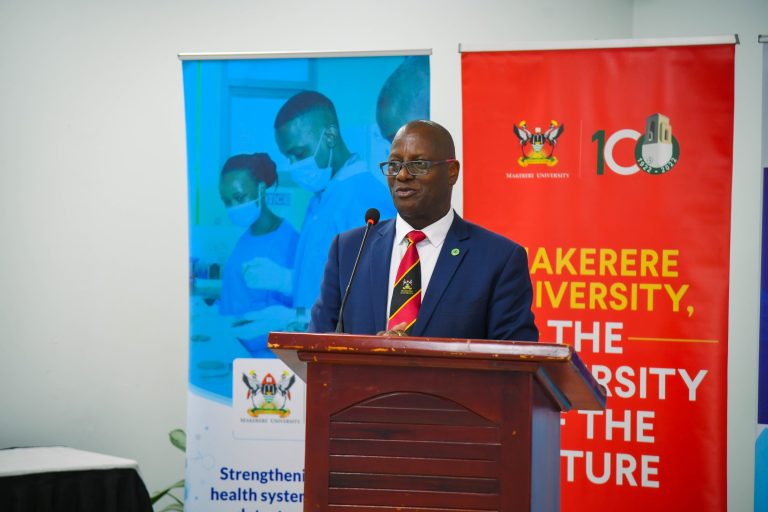
Dr Kambugu was speaking during a media briefing at Makerere University where he highlighted the role of the Joint Continental Incident Management Support Team (IMST), hosted at IDI’s McKinnell Knowledge Centre in Kampala.
The IMST is a partnership between the Africa Centres for Disease Control and Prevention (Africa CDC) and the World Health Organisation (WHO) Africa, established to coordinate partners supporting outbreak preparedness and response across African countries.
Dr Kambugu said hosting the continental coordination platform demonstrates the growing role of African institutions in leading health security responses.
“Hosting the continental IMST is not simply about providing a location; it is about creating an environment where science, evidence and partnerships strengthen Africa’s capacity to prepare for and respond to public health emergencies,” he said.
He added that the long-term impact of the platform would extend beyond the current Ebola response.
“The greatest legacy of the Joint Continental IMST will not only be the support it provides during the current response, but the stronger institutions, stronger partnerships and stronger public health systems it helps build for the future,” Dr Kambugu said.
The team coordinates various partners involved in outbreak response, ensuring that resources, information and technical support are deployed effectively.
“Many partners want to help, but if they are not careful, if they are not working in a streamlined way, then we may not get a good response,” Dr Kambugu said.
He explained that the physical presence of the coordination team at IDI provides infrastructure for communication, planning and operational management.
“As I speak to you now, that team is active. It is making sure that supplies are getting where they are needed, that clinical trials are coordinated to address the response, and that critical issues are brought to the attention of political leadership,” he said.
Uganda Makes Progress in Ebola Containment
Dr Kambugu said Uganda has made significant progress in containing Ebola, with most cases recorded in the country linked to imported infections from the Democratic Republic of Congo (DRC).
“I am pleased to tell you that we haven’t seen a new case for over twenty days in Uganda. That means that we are inching towards a time when we can say we don’t have any Ebola in Uganda,” he said.
He credited contact tracing efforts as one of the key interventions that have helped prevent further spread. “Once you have confirmed a specific case of Ebola, you really have to do the hard work of knowing who that person has been in touch with. If you don’t do that, then the disease will spread,” he explained.
IDI has supported contact tracing activities in Kampala and Wakiso, areas with some of the country’s highest population densities.
The institute has also deployed teams to support surveillance along Uganda’s border with the DRC, particularly in the West Nile region. “Government has called upon us as a partner who knows that region well to support efforts to screen everyone who is crossing the border,” Dr Kambugu said.
Building Ebola Treatment Capacity
Dr Kambugu said IDI continues to strengthen Uganda’s capacity to manage Ebola cases through specialised treatment facilities.
The institute runs two Ebola treatment units, including one at Fort Portal Regional Referral Hospital, which he described as among the most advanced facilities of its kind in East Africa.
During Uganda’s previous Ebola outbreak in Mbale, Dr Kambugu said the Fort Portal unit played a major role in managing patients while protecting health workers.
“When we had the Mbale outbreak a few years ago, the unit at Fort Portal managed all the healthcare in that outbreak. It is on record that during that outbreak, we did not lose a single healthcare worker,” he said.
The same expertise is now being considered for support to the DRC, where Ugandan teams are discussing assistance in establishing Ebola treatment units.
Makerere’s Expanding Research Role
Makerere University Vice Chancellor Prof. Barnabas Nawangwe said the institution’s investment in research infrastructure has positioned it among leading universities on the continent.
He highlighted IDI as one of Makerere’s flagship research centres, noting its contribution to tackling infectious diseases such as HIV/AIDS and Ebola.
Prof. Nawangwe said government support, development partners and philanthropists have helped Makerere establish advanced laboratories that support scientific innovation. “If you decided to write about Makerere research, you would have enough stories to write for a whole year,” he said.
He encouraged journalists to highlight research work taking place at the university, saying such efforts contribute significantly to national development.
Dr Kambugu said IDI’s involvement in the Ebola response reflects Makerere University’s commitment to applying research and knowledge to solve real-world challenges.
“We are moving beyond our ivory tower image as a university to really stand up to the challenge during this outbreak,” he said.
The Infectious Diseases Institute (IDI) is a not-for-profit health research and capacity-building institution owned by Makerere University, focusing on infectious diseases, health systems strengthening, training, research and policy engagement across Africa.