


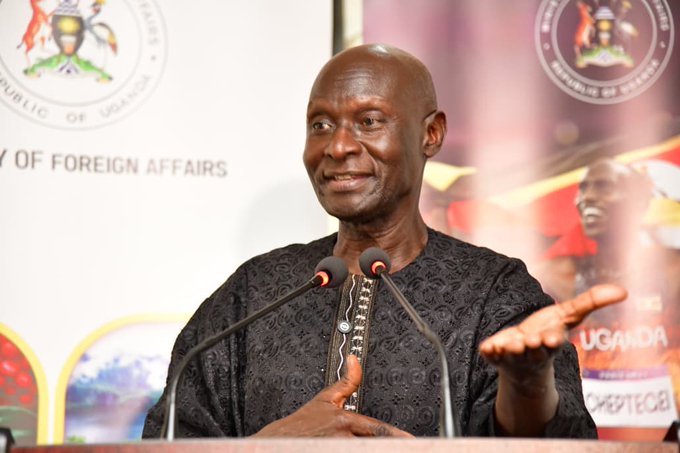
KAMPALA — Former United Nations Under-Secretary-General Ambassador Olara Otunnu has said he is ready to lead reforms at the United Nations, pledging to restore the moral authority of the Secretary-General’s office and transform the global body into a more responsive institution focused on peace, human rights and sustainable development.
Addressing journalists at the Ministry of Foreign Affairs headquarters in Kampala on Wednesday after Uganda officially presented his candidature for the UN Secretary-General position, Otunnu said his bid is anchored on a vision to strengthen multilateralism and reconnect the United Nations with the people it serves.
“The Secretary-General of the United Nations has something else — moral authority. That moral authority flows directly from the principles of the UN Charter and from the collective membership of the United Nations and the peoples of the world,” Otunnu said.
He argued that although the Secretary-General does not command military power, financial resources or the direct mandate enjoyed by national leaders, the office possesses significant influence through its moral standing.
“The Secretary-General must use that moral authority carefully and courageously to lead the United Nations. That authority has not disappeared, but it has been eroded, and I believe some steps can be taken to restore and strengthen it,” he said.
Reforming the United Nations
Otunnu said reform of the United Nations would be one of his key priorities if elected, including making the institution more representative, efficient and effective.
He pointed to ongoing debates on reforming the UN Security Council and called for changes that reflect the realities of today’s world.
“There is the ongoing debate about making the Security Council more representative of today’s world. That discussion must continue and hopefully reach a successful conclusion,” he said.
He also called for reforms within the UN bureaucracy to improve efficiency and ensure the organisation delivers on its mandate.
“The UN must become an organisation that reflects the aspirations of its members and the people it serves. It must be efficient, effective and responsive,” Otunnu said.
Peace and Security at the Centre
Otunnu identified peace and security as the foundation of the United Nations, saying the organisation must do more to prevent conflicts, resolve disputes and rebuild societies affected by war.
“The central foundation of the UN is conflict prevention, conflict resolution and peace-building. In short, the peace and security role of the United Nations remains its most important responsibility,” he said.
He said the Secretary-General must engage major global powers and other stakeholders to address conflicts with serious geopolitical consequences.
Otunnu also highlighted the disproportionate impact of wars on women and children, saying the UN must strengthen efforts to protect vulnerable populations and support rehabilitation programmes.
“The United Nations cannot be indifferent. It must lead efforts to reduce the impact of conflicts on vulnerable communities,” he said.
Global Framework Needed for Artificial Intelligence
The former UN official also identified artificial intelligence as one of the defining challenges facing humanity, warning that the technology must be guided by global rules and ethical standards.
He said AI presents enormous opportunities but also risks if not properly regulated.
“One of the most important issues for the United Nations must therefore be creating a global framework — with rules, standards, values and mechanisms — to guide the development and deployment of artificial intelligence,” Otunnu said.
He emphasised that access to technological opportunities should not be limited to a few countries or elites. “The young man under the mango tree in Katwe, the creative young man and the creative young woman everywhere, must also be part of this technological future,” he said.
Climate Change and Development Financing
Otunnu said developing countries require greater access to affordable long-term financing to achieve sustainable development.
He argued that while the Secretary-General does not control financial resources, the office can use its convening power to mobilise international support.
“The moral authority of the Secretary-General can be used to bring together partners and ensure that developing countries that are doing the right things have access to the resources needed for transformation,” he said.
On climate change, Otunnu called for solutions that balance development needs with environmental protection.
“Climate action should not be seen as a competition between developed and developing countries. We must find win-win solutions that benefit all humanity,” he said.
From Local Communities to Global Leadership
Otunnu said the United Nations must avoid becoming detached from ordinary people and instead strengthen the connection between global decisions and local realities.
“The United Nations must not become a diplomatic ivory tower. There must be a connection between the global and the local, and between the local and the global,” he said.
He cited his own career journey, from working in Uganda to serving in senior international roles, as an example of his ability to bridge local experiences with global challenges.
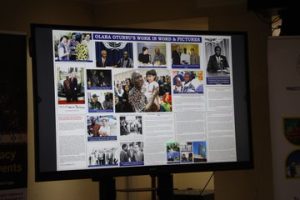
Otunnu said his experience includes serving as Uganda’s Ambassador to the United Nations, President of the UN Commission on Human Rights, and UN Under-Secretary-General and Special Representative for Children and Armed Conflict.
Leadership Built on Service
Otunnu said the next UN Secretary-General must be non-partisan, humble and committed to serving humanity.
“A Secretary-General must first and foremost be non-partisan. The person must belong to all people and must put aside personal ego so that ideas and solutions can come forward,” he said.
He said his leadership philosophy is inspired by the prayer of Saint Francis of Assisi, emphasising peace, humility and compassion.
“Make me an instrument of peace. Where there is hatred, let me sow love. Where there is injury, pardon. Where there is doubt, faith. Where there is despair, hope. Where there is darkness, light,” he quoted.
Otunnu thanked President Yoweri Museveni, the Government of Uganda and Ugandans for supporting his nomination, saying representing the country on the global stage was a great honour.
“There is no greater honour than going forward into the world in the name of my beloved country, Uganda, and on behalf of my fellow Ugandans,” he said.
Uganda formally nominated Otunnu for the UN Secretary-General position on July 24, 2026. His candidature will now proceed through diplomatic engagements with UN member states, including the five permanent members of the UN Security Council whose recommendation is required before appointment by the General Assembly.
The former UN Under-Secretary-General joins a field of candidates that includes former Chilean President Michelle Bachelet, Costa Rica’s Rebeca Grynspan, Ecuador’s María Fernanda Espinosa, Argentina’s Rafael Mariano Grossi, Mexico’s Alicia Bárcena and Austria’s Carolina Larriera.