


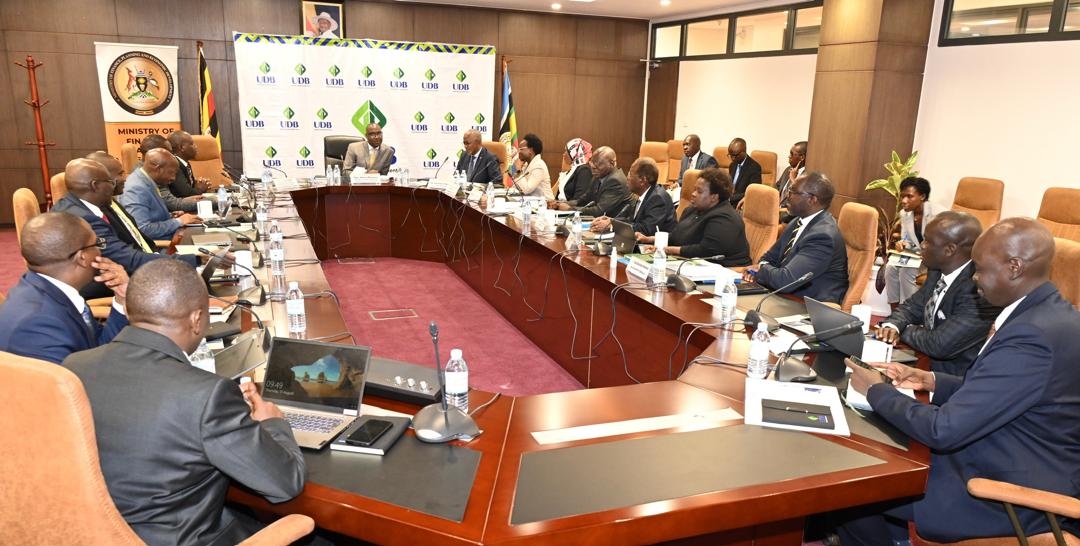
Finance Minister Henry Musasizi has commended Uganda Development Bank (UDB) for its strong financial performance in 2025, while challenging the development lender to ensure its financing translates into jobs, increased production and measurable improvements in the economy.
Musasizi, together with Minister of State for Investment Aminah Mukalazi, praised the UDB Board and Management led by Board Chairman Geoffrey T. Kihuguru during the bank’s reflection on its 2025 performance.
UDB reported a profit after tax of Shs63.4 billion, assets of Shs2.26 trillion and gross loans of Shs1.77 trillion during the year.
The bank said it disbursed Shs502.2 billion to 112,392 borrowers, with its interventions contributing to the creation of 69,202 jobs.
Musasizi said the figures were encouraging but argued that the ultimate measure of UDB’s performance should be the development impact generated by the money it lends.
“Every shilling deployed must translate into jobs, stronger businesses, increased production, exports and Uganda’s economic transformation,” Musasizi said.
He said UDB must remain focused on providing affordable and patient financing to manufacturers, small and medium enterprises and other productive businesses as Uganda seeks to strengthen its industrial base.
“UDB is a development bank for the country. It aims to support the country’s development agenda, particularly by providing affordable financing to the private sector,” Musasizi said.
Government approves additional capital
Musasizi revealed that Government has authorised UDB to retain about Shs63 billion from its 2025 profits as additional capital, alongside plans to strengthen the bank’s authorised share capital.
“We have also approved a proposal to increase UDB’s authorised share capital from Shs2 trillion to Shs5 trillion. This means we have approved an additional Shs3 trillion in authorised capital,” he said.
He said the measures were intended to build a stronger development bank capable of extending affordable financing to businesses and projects across the country.

“The strength of the bank is measured by its capital base. We want a strong bank that can provide affordable credit to our people — whether they are big businesses, small businesses, youth, women, entrepreneurs or people working on different projects,” Musasizi said.
He said UDB is currently lending at around 12 percent, but Government wants the cost of borrowing to fall to 10 percent in the medium term and eventually reach single-digit rates.
“That is what we are looking ahead to. We want to see more of our people borrowing from UDB at affordable rates,” he said.
Musasizi said Government would continue supporting the bank through recapitalisation and had also authorised it to explore external sources of financing.
Focus on priority sectors
The Minister said UDB’s lending strategy should remain aligned with the National Development Plan IV, particularly sectors identified as critical to economic transformation.
These include agro-industrialisation, minerals development, science, technology and innovation, manufacturing, agriculture, agro-processing, furniture and tourism.
“We are particularly interested in supporting SMEs and small-scale enterprises, as well as specific programmes targeting young people and women,” Musasizi said.
He also called for more efficient processing of loan applications, arguing that viable projects should not remain in the bank’s pipeline for unnecessarily long periods.
“If, for example, a company comes to the bank with a viable project, how long does it take to process the application? How long should someone have to move up and down chasing the bank?” he asked.
Musasizi said UDB must also expand its presence outside Kampala so that businesses and entrepreneurs in other parts of Uganda can access development financing without travelling long distances.
“We want the bank to become more visible and accessible outside Kampala so that people in different parts of the country can benefit from its financing,” he said.
He added that Government’s support for UDB would be accompanied by expectations for greater efficiency and measurable results.
According to Musasizi, UDB has so far disbursed about Shs1.7 trillion, but demand for development financing remains high.
“We have made good progress, but I am also challenging them to do more. We want to continue improving. We want to do things better. We want to reduce the cost of borrowing so that we can respond to the needs of our people in Uganda,” he said.
UDB targets agriculture, manufacturing
UDB Managing Director Patricia Ojangole said the bank’s growing capital base and supportive policy environment were enabling it to respond to increasing demand for long-term financing.
She said most of the bank’s approvals and new loans were going into agriculture, commercial agriculture, manufacturing and industry, sectors which account for about 60 to 70 percent of the bank’s annual growth.
“As the economy has been expanding, we are seeing increased demand for support from the bank,” Ojangole said.
She said the bank was also working to mobilise additional funding from domestic shareholders and traditional international lenders to meet the growing demand for financing.
Ojangole said UDB’s ability to mobilise external capital was closely linked to its ability to demonstrate that it could effectively deploy the funds.
“When we approach funders to mobilise funding, they want to see our pipeline. They want to know what our strategy is, where we are going to deploy the money, which sectors we are targeting and how much we have deployed in previous years,” she said.
Non-performing loans below 7 percent
Ojangole said UDB’s non-performing loan ratio remained within the bank’s acceptable risk range, standing at about 6.7 percent.
She attributed the position partly to the bank’s collections efforts, saying UDB was able to recover a significant proportion of the loans it extends.
On the 69,202 jobs reported in the bank’s annual performance figures, Ojangole said the bank tracks, verifies and evaluates the employment generated through its interventions.
She said UDB would continue seeking ways to reduce lending rates as its capital base and funding sources grow, although the bank must balance cheaper credit with financial sustainability.
UDB Board Chairman Geoffrey T. Kihuguru said the bank was adopting a more proactive approach to development financing by helping businesses develop bankable projects, de-risking investments and mobilising private capital.
The approach, he said, is intended to ensure that UDB’s financing produces tangible economic outcomes while strengthening enterprises and expanding productive capacity.
Musasizi said Government’s continued recapitalisation of UDB was therefore not an end in itself, but a means of giving the bank sufficient capacity to finance Uganda’s transformation.
The Government, he said, expects the bank’s growing balance sheet to translate into stronger enterprises, more employment, increased production and greater participation of Ugandan businesses in domestic and export markets.