


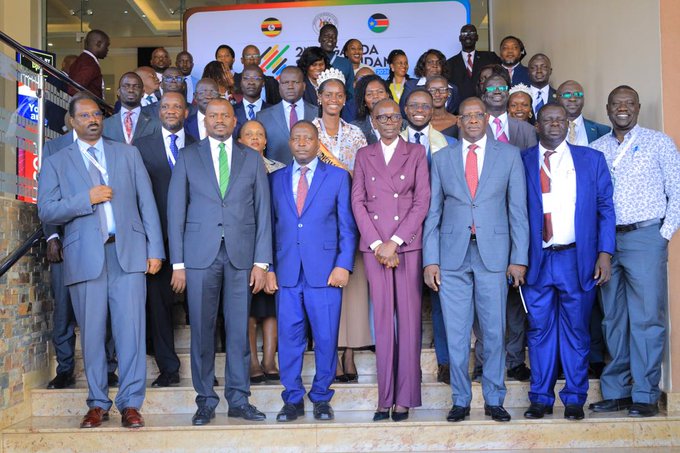
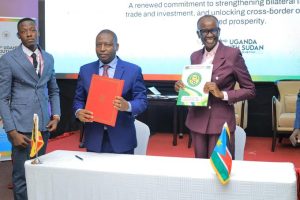
KAMPALA — Uganda and South Sudan have signed a Memorandum of Understanding (MoU) on Trade aimed at improving market access, addressing cross-border trade barriers and expanding investment between the two countries.
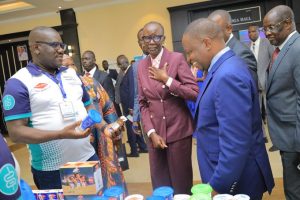
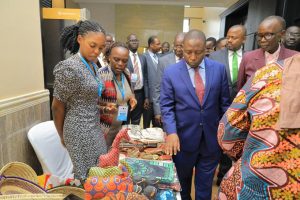
The agreement was signed at the conclusion of the Second Uganda–South Sudan Business Forum and Exhibition 2026 in Kampala, where officials called for improved border procedures, stronger security along trade routes and greater cooperation in industrialisation and energy.
Uganda’s Minister of State for Foreign Affairs in charge of Regional Cooperation, Haruna Kasolo Kyeyune, said the agreement provides a framework for closer institutional cooperation, information exchange, investment facilitation and follow-up on commitments made by both governments.

“The significance of the MOU will ultimately depend on its implementation,” Kyeyune said, urging the relevant ministries and institutions to establish follow-up mechanisms to ensure the commitments translate into practical benefits for businesses.
He said discussions at the forum had highlighted persistent challenges affecting cross-border commerce, including border procedures, the movement of goods along trade corridors, security and coordination among local authorities.
The agreement comes as the two countries seek to strengthen economic ties and translate their longstanding historical and geographical connections into increased trade, investment and employment.
Uganda’s Minister of State for Trade, Industry and Cooperatives in charge of Industry, David Bahati, described South Sudan as a key trading partner and called for greater production and value addition within the region rather than continued dependence on imported manufactured goods.
Bahati cited figures showing that Uganda exports goods worth about $534 million annually to South Sudan, compared with South Sudan’s exports to Uganda of approximately $22 million.
He attributed part of the difference to the countries’ respective population sizes, while urging both governments to expand trade in locally produced goods and develop their industrial capacity.
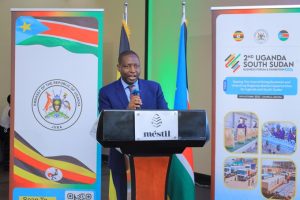
“We want trade between South Sudan and Uganda to trade the goods that are being produced in these countries,” Bahati said.
He called for stronger cooperation in steel manufacturing, iron ore processing and electricity generation, arguing that affordable and reliable energy would be essential for industrial growth.
Bahati said Uganda was seeking to expand its iron and steel production capacity and that cooperation with South Sudan could help address shared infrastructure and energy needs.

He cited the scale of Uganda’s steel imports as evidence of the opportunity for domestic production, saying the country imports steel worth about $1 billion annually.
The minister also raised concerns about the cost of moving goods across the border, citing delays associated with the electronic permit system, repeated cargo verification, checkpoints, unofficial charges and inconsistent clearance procedures.
He called for a review of the electronic permit system to improve transparency, clarify applicable charges and establish effective mechanisms for resolving disputes.
Bahati also pointed to gaps in coordinated border infrastructure, saying the absence of corresponding one-stop border facilities on the South Sudan side limits the benefits of investments made by Uganda.
One-stop border posts are designed to bring the clearance procedures of neighbouring countries together at a single location, reducing duplication and delays for traders and transporters.
South Sudan’s Minister of Trade and Industry, Dr Labanya Margaret Mathya Ugila, said the agreement should help address concerns over product quality, certification, access to manufacturers and the efficiency of border clearance.
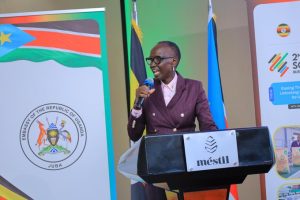
She said South Sudanese traders sometimes struggle to access Ugandan manufacturers and distributors directly, limiting their ability to source goods competitively.
“Our traders don’t have access to manufacturers to buy goods from Uganda,” she said, calling for measures to improve access and promote fair competition.
Ugila also urged the two countries to strengthen cooperation on quality assurance, certificates of origin and regional trade corridors, saying these were necessary to improve the competitiveness of businesses.
She said South Sudan had introduced a digital tax and levy collection system to strengthen revenue collection and address tax evasion.
The minister also highlighted the importance of security in sustaining trade, while acknowledging that challenges persist in some parts of South Sudan. She said the government was working to address concerns affecting traders and other businesses.
Uganda’s Permanent Secretary in the Ministry of Foreign Affairs, Bagiire Vincent Waiswa, said the forum provided an opportunity for both governments and the private sector to review progress in bilateral economic relations and identify areas requiring intervention.
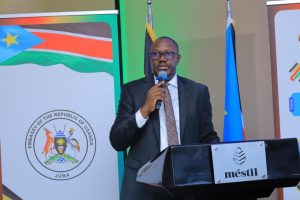
He said the meeting built on an earlier Uganda–South Sudan business forum held in Uganda in July 2022, adding that the latest gathering reflected the two countries’ determination to sustain engagement and strengthen commercial relations.
Brig Gen Ronnie Balya, Uganda’s ambassador to South Sudan, said the forum should provide a platform for businesses to identify opportunities, establish business-to-business networks and develop a joint business forum that meets regularly.
He also called for closer coordination on border security, customs and immigration procedures to facilitate the lawful movement of people and goods.

Balya said regular border meetings, alongside other bilateral mechanisms, could help resolve trade and security concerns while improving relations between border communities.
The two countries are members of the East African Community (EAC) and the Common Market for Eastern and Southern Africa (COMESA), regional blocs that promote economic integration and cross-border commerce.