


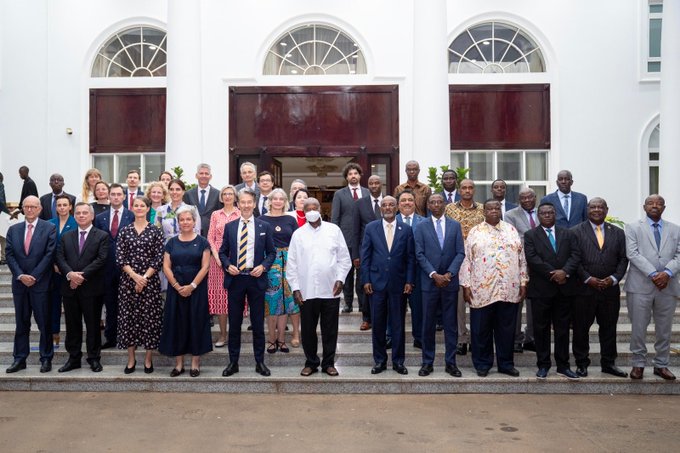
President Yoweri Kaguta Museveni has urged the European Union (EU) to support Africa’s industrialisation by investing in the processing of raw materials on the continent, arguing that value addition would create jobs, increase export earnings and expand markets for European goods.
Museveni said Europe should pursue a partnership with Africa based on mutually beneficial trade and shared prosperity rather than a system in which some countries accumulate wealth while resource-rich nations remain dependent on exporting unprocessed commodities.
“Europe should really help Africa process its raw materials. Your companies should be encouraged and facilitated to work with African countries so they export refined products and create more jobs. We must all process fully so that we all become partners and not victims of cooperation,” he said.
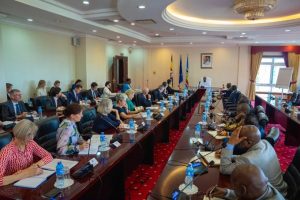
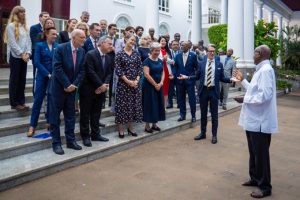
The President made the remarks on Wednesday, October 14, 2026, while hosting and co-chairing the first Uganda–EU Partnership Dialogue at State House, Entebbe.
The meeting, held as the two sides marked 50 years of cooperation, brought together government officials and European diplomats to discuss trade, investment, climate action, development cooperation, governance, human rights and regional security.
Museveni argued that Africa loses substantial economic value by exporting raw materials that are processed elsewhere before being sold as finished products, often at significantly higher prices.
He cited coffee as an example, saying a kilogramme of unprocessed coffee could fetch about $2, compared with approximately $40 when processed.
The President also said the global coffee business was worth about $460 billion, while coffee-producing countries collectively earned approximately $25 billion. Germany, despite not being a coffee-producing country, earned about $65 billion from the business, he said.
Museveni attributed the disparity to the limited processing and manufacturing capacity of African economies, blaming African leaders for failing to maximise the value of the continent’s natural resources.
“This is really the fault of the African leaders who have betrayed their people. They give away African resources daily instead of maximising what God gave us, especially by selling unprocessed raw materials. This is criminal,” he said.
He defended Uganda’s policy of discouraging exports of unprocessed raw materials, saying the country needed to retain more value from its resources to create employment and increase domestic incomes.
The President argued that Africa’s economic potential remained constrained by low industrialisation despite its considerable natural resources and expanding markets.
He compared Africa’s combined gross domestic product, which he put at approximately $3.8 trillion, with about $32 trillion for the United States and more than $20 trillion for China.
Museveni said the prosperity of developing economies should be viewed as an opportunity for wealthier countries because higher incomes would increase demand for imported goods and services.
“I reject this idea of partial wealth. It is satanic, bankrupt and self-defeating. Why would you be blind and fail to see that your neighbour’s prosperity is your own interest? How can they say trading with poor people is better than trading with rich people?” he asked.
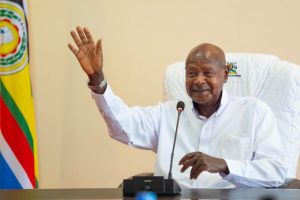
He called for a shift away from international competition based on economic dominance towards cooperation that allows countries to build productive capacity and expand their markets.
Museveni said Uganda’s exports to Europe, which he put at €1.8 billion, could increase substantially if the country processed more of its agricultural and mineral resources before exporting them.
“In my view, the €1.8 billion exports to Europe, we should be talking of tens of billions, if not hundreds. That is still suppressed demand because if we were adding value here, we would earn much more than this,” he said.
He argued that higher export earnings would enable Uganda to purchase more European products, including medical equipment and machine tools.
“If we were exporting finished products and earning more money, then we would buy more of the European products we need here, like medical equipment and machine tools. We would have more trade in higher-value products,” he said.
The President also proposed that the EU consider becoming an associate member of the African Union, citing the historical relationship and geographical proximity between the two continents.
“The historical relationship between Africa and Europe can be better used. I have suggested that the European Union could become an associate member of the African Union because of proximity,” he said.
Poverty eradication, irrigation and energy
Museveni urged the EU to support Uganda’s Parish Development Model (PDM), a government programme intended to move households from subsistence production into the money economy.
He said the programme was central to the government’s efforts to lift at least seven million households out of poverty and expand employment opportunities.
“You help me support the PDM so that we convert at least seven million of the households out of poverty. Support the Ugandans to create jobs; that will be an easier entry point,” he said.
The President also called for European support for large-scale irrigation, saying the recent delay in rainfall had demonstrated the risks of relying on rain-fed agriculture.
“God has woken up a bit of Ugandans by causing drought. The rain was delayed for two months, and I thanked God that He is doing it deliberately to wake them up. We want to launch massive irrigation to stabilise agriculture,” he said.
On environmental protection, Museveni urged European partners to support efforts to protect wetlands and forests from encroachment and destructive agricultural practices.
He proposed fish farming around wetland peripheries, alongside irrigation, as alternatives to cultivation practices that degrade sensitive ecosystems. He also appealed for support in acquiring earth-moving equipment to construct valley dams and improve water conservation.
The President maintained that the government would continue removing encroachers from wetlands and forests, arguing that environmental protection required enforcement as well as investment in alternative livelihoods.
On electricity, he called for private investment backed by patient capital to ensure affordable power for manufacturing.
“We need either the private sector with patient capital because we don’t want to have expensive electricity. We are ensuring that for manufacturing it should be five cents,” he said.
Museveni asked the Minister of Trade, Industry and Cooperatives, Sanjay Tanna, to engage the EU in further discussions on improving the business environment and expanding economic cooperation.
Museveni cautions EU against political interference
The President welcomed continued dialogue with the EU but said cooperation should respect Uganda’s sovereignty and domestic decision-making processes.
He distinguished exchanges of views between partners from what he described as attempts to manipulate Uganda’s political and social affairs.
“Once you don’t interfere with our political issues and social issues, leave us; don’t interfere with us. Influence people, for example, do what you think is right, but don’t manipulate,” he said.
Museveni defended Uganda’s electoral and representation arrangements, including constituency-based Members of Parliament and special representation for women, youth and persons with disabilities.
He said Uganda was willing to exchange views with European partners but opposed foreign funding intended to influence domestic political choices.
On social issues, the President reiterated the government’s position opposing the promotion of homosexuality as an alternative way of life.
EU pledges continued cooperation
The EU delegation was led by its ambassador to Uganda, Jan Sadek, who co-chaired the dialogue.
Sadek said the partnership remained important to the EU, estimating that European support to Uganda over the past 50 years amounted to approximately €20 billion.
He described the relationship as a broad partnership involving governments, institutions, businesses and young people, adding that both sides had opportunities to strengthen cooperation in the coming years.
“Uganda’s voice matters. We ought to work together. We want to be reliable and predictable, working together with Uganda. Fifty years gives us a lot to reflect on and see what to do next in our partnership,” he said.
The ambassador identified coffee and other value-added products as areas with potential for increased cooperation, saying the EU wanted processing and its associated economic benefits to remain in Uganda.
He cited Ugandan chocolate as an example of a product that could attract European investment and access European markets, linking the opportunity to Uganda’s development ambitions for 2040.
Sadek also highlighted EU support for private-sector development and cooperation in mineral development and processing.
He announced €50 million in new support for conservation and tourism.
The ambassador commended Uganda’s military contribution to African Union security efforts in Somalia and its role in regional stability. He also praised Uganda’s response to Ebola and its contribution to disease control, calling for continued information sharing.
Trade and regional security
The dialogue recognised the EU as Uganda’s largest trading partner outside Africa, with bilateral trade estimated at €2.4 billion annually and Uganda recording a trade surplus of approximately €1 billion, according to the meeting’s account.
Both sides agreed to establish a structured dialogue on improving the business environment and continue discussions on securing Uganda’s favourable access to the EU market, including through a possible Economic Partnership Agreement.
They also agreed to hold a dedicated security dialogue.
The delegations highlighted cooperation under the EU’s Global Gateway investment initiative, climate action, renewable energy and refugee support. Team Europe is contributing more than €520 million towards refugee-related interventions, according to the meeting’s account.
The EU acknowledged Uganda’s role in regional peace and security, particularly in Somalia, where it said it had provided almost €2.8 billion in support since 2007. It encouraged Uganda to continue contributing to stability in the Democratic Republic of Congo, Somalia and South Sudan.
The two sides also discussed international developments, including Russia’s war against Ukraine, and reaffirmed their commitment to multilateral cooperation and international criminal justice institutions.
They agreed to hold the Uganda–EU Partnership Dialogue annually.
The EU delegation included resident ambassadors and heads of mission from Belgium, Denmark, Germany, Ireland, France, Italy, the Netherlands, Sweden and Austria, alongside non-resident representatives from Czechia and Spain.
Uganda was represented by Foreign Affairs Minister Adonia Ayebare, Defence and Veteran Affairs Minister Kiryowa Kiwanuka, Attorney General Dr Sam Mayanja, Agriculture Minister Frank Tumwebaze, Justice and Constitutional Affairs Minister Norbert Mao, Water and Environment Minister Kahinda Otafiire, Trade Minister Sanjay Tanna and State Minister for Finance, Planning and Economic Development Amos Lugoloobi.
The meeting ended with commitments to deepen cooperation in trade, investment, security and development. However, the central economic question remains whether the partnership can translate its declarations into more processing plants, better-paying jobs and greater returns for African producers whose raw materials continue to supply global markets.