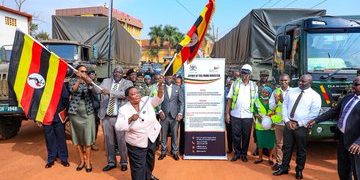



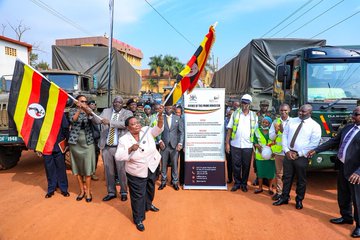
KAMPALA — The Government has launched an emergency food relief operation for the Karamoja sub-region, targeting 313,987 households affected by a prolonged dry spell that has disrupted agricultural production and heightened the risk of food insecurity.
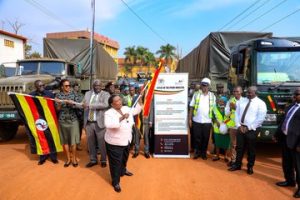
Prime Minister Robinah Nabbanja on Monday flagged off the relief food at the National Enterprise Corporation (NEC) headquarters in Bugoloobi, Kampala, saying the intervention underscores the government’s commitment to supporting vulnerable communities while strengthening their resilience against future climate shocks.
The emergency response will see the distribution of 9,419,610 kilograms of relief food, comprising maize flour and dry beans, to 313,987 households across 480 parishes in Karamoja’s nine districts.
The Office of the Prime Minister (OPM) said the prolonged dry spell had significantly reduced agricultural output, depleted household food stocks and increased food insecurity across the sub-region.
The food distribution will be coordinated jointly by the Office of the Prime Minister, the National Enterprise Corporation (NEC), the Uganda People’s Defence Forces (UPDF), the Uganda Prisons Service, the Uganda Police Force and local government authorities.
Speaking at the flag-off ceremony, Prime Minister Nabbanja said the government would continue mobilising resources to respond to the humanitarian situation in Karamoja.
“The Government stands with the people of Karamoja and will continue to mobilise the necessary resources to support their recovery and build resilience against future shocks,” Nabbanja said.
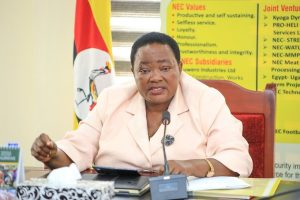
She urged all leaders and officials involved in the exercise to ensure the food reaches the intended beneficiaries.
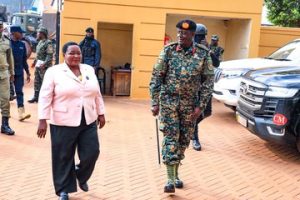
Also attending the ceremony were the Minister for Relief, Disaster Preparedness and Refugees, Hilary Onek’s successor Hon. Sam Engola; Minister of State for Karamoja Hon. Esther Anyakun; Minister of State for Disaster Preparedness Hon. Musa Ecweru’s successor Hon. Ali Odria; NEC Managing Director, Lt Gen James Mugira; and Members of Parliament from the Karamoja sub-region.
Minister for Relief, Disaster Preparedness and Refugees Sam Engola called on leaders and communities to safeguard the integrity of the exercise.
“We appeal to political, religious and community leaders, civil society organisations and beneficiaries to support the exercise by promoting transparency, accountability and peaceful distribution,” Engola said.
He added that while emergency relief was necessary, the government remained focused on long-term interventions to improve resilience against recurrent droughts and other climate-related shocks.
Permanent Secretary in the Office of the Prime Minister Alex Kakooza said the government would continue monitoring the food security situation in Karamoja and neighbouring districts to guide further interventions.
“The Office of the Prime Minister will continue to closely monitor the food security situation in Karamoja and neighbouring districts while coordinating both immediate humanitarian assistance and long-term resilience interventions,” Kakooza said.
He added that the government was working closely with development partners to protect lives and livelihoods, guided by the recently approved Karamoja Regional Development Plan.
Karamoja has experienced repeated cycles of drought and food insecurity in recent years, prompting both emergency humanitarian assistance and long-term government investments aimed at improving agricultural productivity, water access and household resilience.