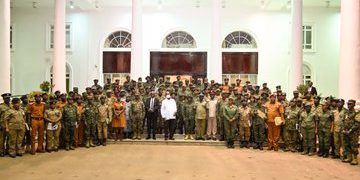



ENTEBBE — President Yoweri Kaguta Museveni has called on senior security officers to deepen their understanding of Uganda’s development path, saying ideological clarity is essential in guiding the country’s socio-economic transformation.
President Museveni, who is also the Commander-in-Chief of the Uganda Peoples’ Defence Forces (UPDF), made the remarks on Friday, July 17, 2026, while passing out 106 senior security officers who completed the Advanced Joint Senior Political Education and Leadership Development Course at the National Leadership Institute (NALI), Kyankwanzi.
The graduates included officers from the UPDF, Uganda Police Force (UPF), Uganda Prisons Service (UPS), Internal Security Organisation (ISO), External Security Organisation (ESO), and Wazalendo SACCO.
The 59-day programme, which started on May 26, 2026, focused on strengthening ideological grounding, leadership capacity and strategic thinking among senior officers. Of the 106 participants, 52 were from the UPDF, while the rest represented other security institutions. Sixteen of the graduates were female officers, with several serving at battalion and brigade command levels.
The course covered areas including the National Resistance Movement (NRM) Manifesto, revolutionary philosophy, political economy, Uganda’s political history, geopolitics, leadership, skills at arms, and the role of ideology in policy formulation and implementation.
During the pass-out ceremony at State House Entebbe, President Museveni delivered what he described as a “Lecture of Opportunity” after responding to questions from the officers on Uganda’s development agenda, strategic security and Vision 2040.
He said national transformation happens gradually and requires proper guidance, comparing the process to biological change.
“Society transforms just like an insect changes from an egg to a caterpillar, then a pupa and finally a butterfly. Societies also transform in stages and must be guided correctly through those stages,” President Museveni said.
The President said Uganda’s transformation strategy is centred on moving households from subsistence production into the money economy through commercial agriculture, manufacturing, information and communications technology (ICT), and services.
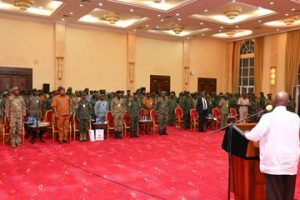
To illustrate the journey, he showed videos of communities he interacted with in western Uganda during the 1960s, saying many households had resources such as land and cattle but were not participating in the wider market economy.
“Those people had land and cattle, but they were outside the money economy. We studied how Europe transformed itself and concluded that prosperity comes from production and participating in the market economy,” he said.
President Museveni said Uganda’s economic strategy had evolved from focusing mainly on traditional cash crops such as cotton, coffee and tobacco to promoting all agricultural products as commercial opportunities.
“Long ago people only talked about cotton, coffee and tobacco. I wondered why we should emphasise beverages and ignore food. That is why when we came into government we said all food crops are cash crops,” he said.
He urged security officers to support efforts to sensitise communities on wealth creation through the Four-Acre Model, which encourages households to dedicate land to commercial crops, fruits, pasture and food production while utilising backyard spaces for activities such as poultry and piggery.
The President cited examples of farmers who have benefited from commercial agriculture, including Richard Nyakana of Fort Portal, whom he said earns about Shs1 million daily through integrated farming, and Joseph Ijala of Serere District, whom he said transformed a small piece of land into a poultry and dairy enterprise.
“When our people wake up and properly utilise their land, they create wealth not only for themselves but also jobs for others,” he said.
President Museveni also linked Uganda’s development strategy to the four ideological principles promoted by the NRM — patriotism, Pan-Africanism, socio-economic transformation and democracy.
He said patriotism was necessary because prosperity depends on production and trade beyond local identities.
“If I produce milk, beef or bananas, my prosperity does not come from my tribe because they produce the same things. My prosperity comes from other Ugandans who buy my products,” he said.
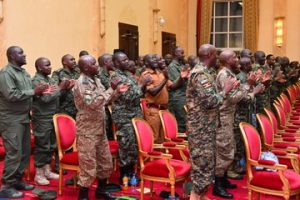
The President cautioned against sectarian politics based on tribe or religion, saying such approaches undermine national development.
“Anybody telling you to care more about your tribe than Uganda is an enemy of your prosperity,” he said.
He further emphasised the importance of regional integration, arguing that Uganda’s expanding production requires access to larger markets beyond its borders.
“When our people started producing more sugar, textiles, milk and maize, they discovered that Uganda alone was not enough. That is why Pan-Africanism is essential,” President Museveni said.
On security, he said economic progress must be protected through strategic defence capabilities. “You may become prosperous but still face aggression. Therefore, strategic security is essential,” he said.
He noted that modern security challenges now extend beyond traditional domains of land, air and sea to include space, adding that African countries need deeper cooperation to compete globally.
The President also challenged Africans to overcome what he described as an inferiority complex, saying the continent has the resources required for industrialisation.
“The inferiority complex is very dangerous,” he said, citing Uganda’s ability to produce cassava-based starch as an example of reducing dependence on imports.
On education, President Museveni called for a balanced system that combines academic learning with practical skills while allowing learners to pursue areas of interest.
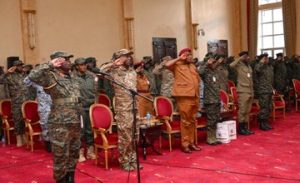
Speaking on behalf of the security agencies, ESO Director General Ambassador Joseph Ocwet thanked the President for what he described as an important engagement with the officers.
“Every time we meet you, Your Excellency, we learn something new. Tonight, the 14 questions raised by the participants turned into a golden Lecture of Opportunity from which all of us have learnt immensely,” Ocwet said.
He commended NALI for strengthening ideological training among security agencies and praised joint training programmes involving the UPDF, ISO, ESO, police and prisons services.
The Director of NALI, Col Okei Rukogota, said the course was designed to equip senior officers with ideological and leadership tools to support Uganda’s development goals.
He said the institute would continue promoting patriotism, Pan-Africanism, socio-economic transformation and democracy as guiding principles for national development.
Representing the graduating officers, Ms Grace Katushabe said the programme had equipped participants with knowledge on patriotism, political economy and national development. “This has been more than a lecture. It has been a call to responsibility and action,” she said.
President Museveni later congratulated the officers upon completion of the course and officially passed them out.