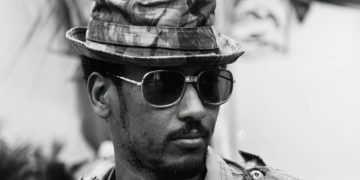



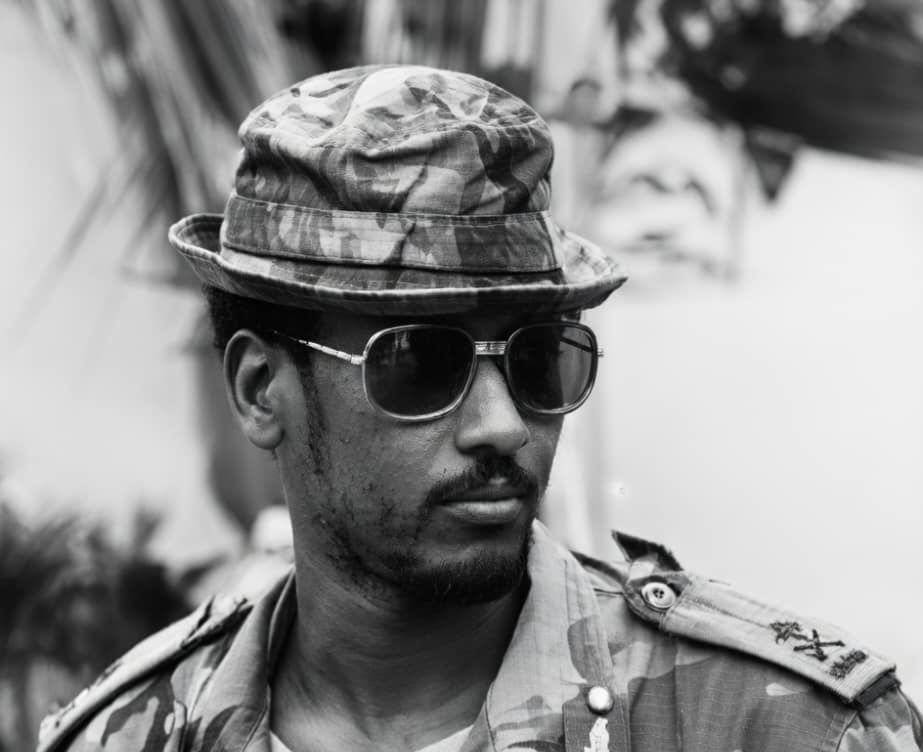
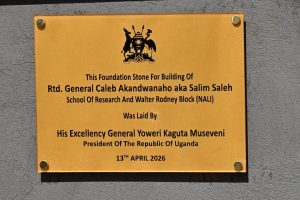
KYANKWANZI — Retired General Caleb Akandwanaho Salim Saleh was the centre of glowing tributes at the National Leadership Institute (NALI), with speakers praising his legacy as a liberation struggle hero, peacebuilder and key architect of Uganda’s wealth creation drive.
On the occasion of the unveiling of the Salim Saleh School of Research by President Museveni, Col. Okei Rukogota delivered a stirring citation, describing Gen Saleh as a “warrior-peacemaker” whose life has defined Uganda’s military and socio-economic trajectory.
“We stand today to honour a most courageous Commander, a General whom Providence has shielded through unimaginable escapades to serve his nation,” Rukogota said.
He traced Saleh’s journey back to his early years, noting that his patriotism emerged at a young age when he joined the Front for National Salvation (FRONASA) in 1976.
“By 1979, his charismatic leadership and courageous character had elevated him to command the ‘Red Army,’ one of FRONASA’s formidable fighting outfits during the liberation war,” he said.
Rukogota highlighted Saleh’s battlefield bravery during the National Resistance Army (NRA) struggle, singling out the 1982 Battle of Bukalabi as a defining moment.
“During the famous Bukalabi battle, his fearless nature was immortalised when he stood his ground, commanding his troops while his body was riddled with a hailstorm of enemy bullets,” he said.
He added that despite his injuries, Saleh quickly returned to the frontlines to lead further decisive engagements, including the Battle of Kembogo.
Beyond the battlefield, the citation portrayed Saleh as a key figure in Uganda’s reconciliation efforts, particularly in northern Uganda. “In a mind-rattling display of daring, he flew into enemy strongholds not to fight, but to talk peace and reconciliation with those who had nearly killed him,” Rukogota said.
He noted that such efforts culminated in the 1988 Pece Peace Agreement, which enabled many former combatants to return home and serve in national institutions.
Rukogota also credited Saleh with overseeing major military campaigns, including the decisive Operation Mwisho. “Undeterred by odds, he directed the epic Operation Mwisho III, which left many enemy tanks aflame and forced opponents to yield,” he said.
However, most of the acclaim focused on Saleh’s civil -military role in advancing President Yoweri Museveni’s ‘Musevenomics.’
“General Saleh is the most ardent proponent and apostle of Musevenomics,” Rukogota said. “While the President provided the philosophical foundation, he has been the primary operative implementing this vision on the ground.”
He cited Saleh’s role in rural finance and wealth creation initiatives, including the establishment of hundreds of community SACCOs and his leadership of Operation Wealth Creation.
“His contribution led to the building of cooperative financial infrastructure extending services to underserved communities,” he said, adding that such efforts have helped shift many Ugandan households into the money economy.
Rukogota further pointed to Saleh’s involvement in industrialisation initiatives, including the Namunkekera Industrial Complex, as evidence of his continued impact.
The tribute framed Saleh as a leader who successfully pivoted from military to national economic pursuits.
“The Salim Saleh School of Reaserch honours a leading mobiliser who transitioned from mobilising for war efforts to mobilising for the theoretical and practical implementation of economic liberation,” Rukogota said of the Chief Coordinator of Operation Wealth Creation (OWC), the biggest civil -military operation in Africa and the first of its kind.
The event underscored Saleh’s enduring influence within Uganda’s military and economic landscapes, with speakers portraying him as a symbol of continuity between the country’s liberation struggle and its ongoing development agenda.
“Based on the evidence of this General’s heroic exploits on both the military and socio-economic fronts, the request to honour this illustrious son of Africa is justified,” Rukogota concluded.
Read More: Legacy: Museveni Lays Foundation for Salim Saleh Research School in Kyankwanzi