


KAMPALA — More than six decades after African nations began securing political independence, a new conversation is emerging among scholars, youth leaders, diaspora advocates and traditional leaders: what does liberation mean in the 21st century?
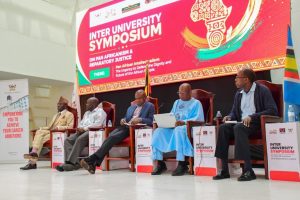
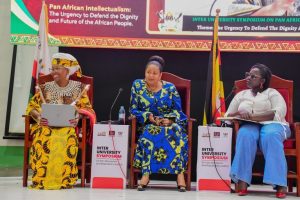
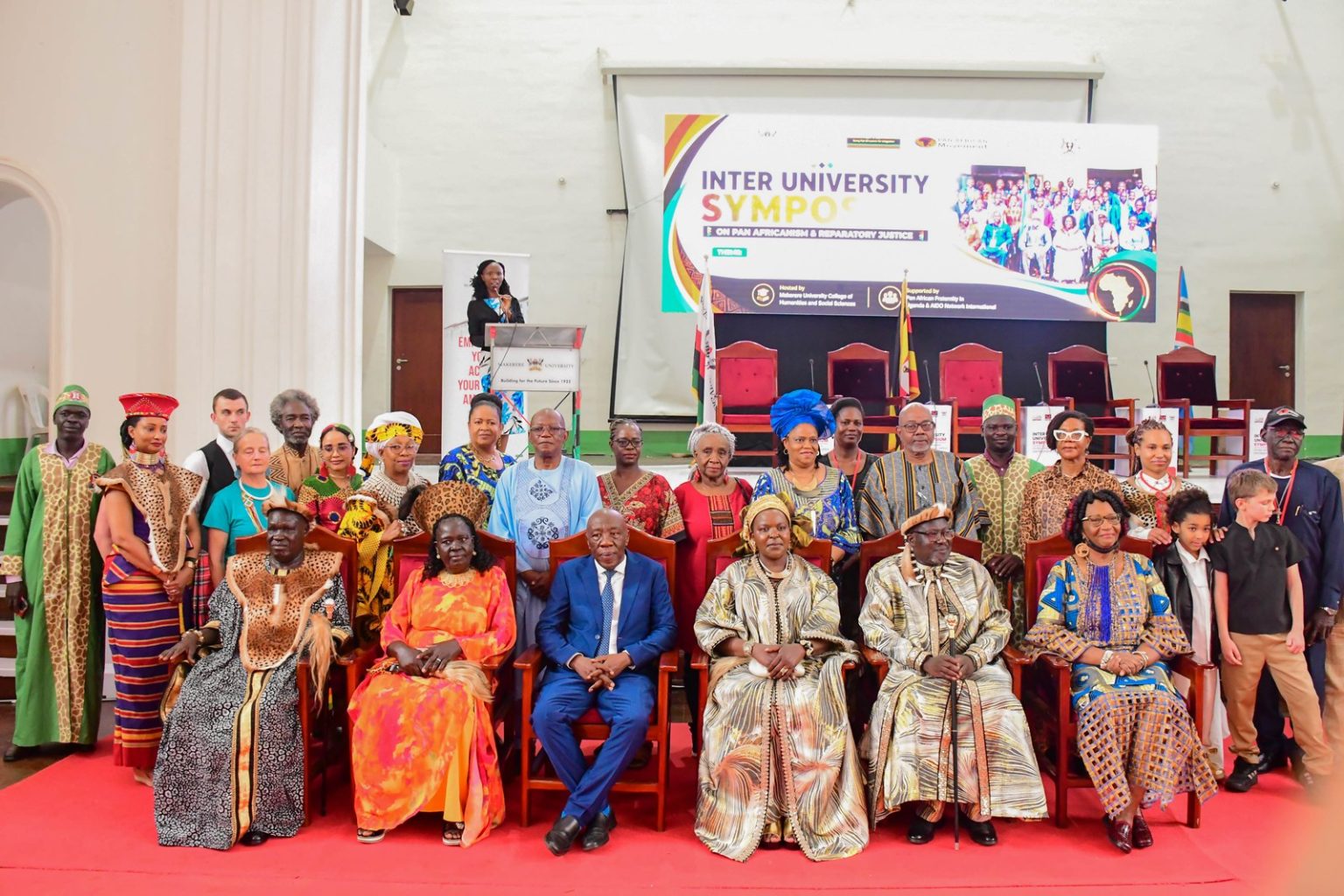
That question dominated discussions at Makerere University as delegates from over 23 universities, alongside representatives from Africa, the Caribbean, Europe, Asia and the global African diaspora, gathered for an Inter-University Symposium on Pan-Africanism and Reparatory Justice ahead of Africa Day celebrations.
While the language of Pan-Africanism is often associated with historic figures such as Kwame Nkrumah, Julius Nyerere and Patrice Lumumba, participants argued that the movement is increasingly evolving into a platform for addressing contemporary challenges ranging from economic dependence and educational reform to cultural identity and reparatory justice.
For keynote speaker Chief Eric Phillips, the discussion was ultimately about Africa’s ability to shape its own future.
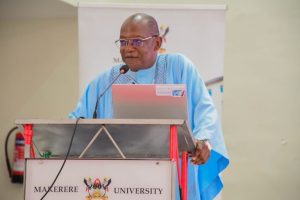
“Pan-Africanism is about survival, dignity and power,” Phillips told participants. “It’s the understanding that Africa’s problems cannot be solved in isolation. Division is our greatest weakness. Unity is our strongest weapon.”
His remarks set the tone for a day-long dialogue that challenged participants to think beyond national boundaries and consider the interconnected future of Africans and people of African descent around the world.
Beyond Political Independence
Opening the symposium on behalf of Vice Chancellor Prof. Barnabas Nawangwe, Acting Vice Chancellor Prof. Henry Alinaitwe described the gathering as evidence of a growing global African consciousness.
“As we gather in the Makerere University Main Hall, we are deeply honoured to host distinguished delegates from across Africa, the Caribbean, Europe, Asia, and the wider global African diaspora,” he said.
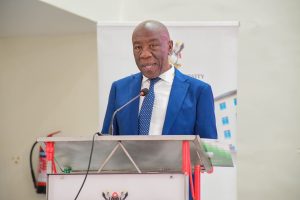
Prof. Alinaitwe argued that the African liberation project remains unfinished, noting that contemporary struggles increasingly revolve around intellectual independence, economic sovereignty and ownership of African narratives.
“This symposium is happening at a critical moment in global history when Africa and people of African descent are redefining their place in a multipolar world,” he said.
The academic leader also challenged students to see themselves as architects of the next phase of Pan-Africanism. “The future of Pan-Africanism will be shaped by your ideas, courage and innovation,” he said.
Knowledge as a Tool of Transformation
A recurring theme throughout the symposium was the role of universities in shaping Africa’s future.
Prof. Helen Nambalirwa Nkabala, Principal of Makerere University’s College of Humanities and Social Sciences, argued that meaningful social transformation begins with ideas.
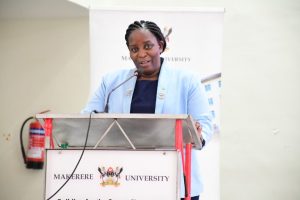
“Our presence here reflects the urgency of defending the dignity and future of African people through knowledge,” she said.
She emphasised that the humanities and social sciences remain critical disciplines for understanding and transforming society.
“The humanities and social sciences hold the key to understanding society and reshaping it,” Prof. Nkabala noted.
The discussion reflected growing calls across African universities for curricula that are more responsive to African realities while remaining globally relevant.
Reparations Return to the Global Agenda
Another major focus of the symposium was reparatory justice.
Prof. Eric Awich Ochen, Deputy Principal of CHUSS, said conversations around reparations have gained momentum across Africa and the diaspora.
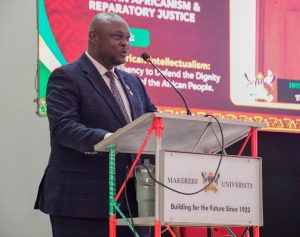
“When we talk about reparations, Africa suffered from slavery and a lot of injustices during that period. Those responsible for that kind of injustice to us may need to find a way of making some compensation to Africa,” he said.
For many participants, however, reparations were framed as extending beyond financial compensation.
Discussions touched on cultural restoration, historical truth-telling, recovery of African artefacts, educational reform and rebuilding institutions weakened by centuries of exploitation.
Chief Eric Phillips echoed that broader understanding of justice while tracing the origins of Pan-Africanism.
“Before borders were drawn, before Africa was divided in Berlin, before the world told us who we were, Africans were already connected by culture, by trade, by identity and by civilisation,” he said.
“Today, the chains may look different — economic dependency, mental colonisation. But the mission of Pan-Africanism remains the same. A united Africa is not a dream. It’s a necessity.”
Youth at the Centre of the Movement
One of the strongest messages from the symposium was that the future of Pan-Africanism belongs to young people.
Her Highness Dr Queen Grace Eganda, General Secretary of AIDO Network International, described the gathering as a bridge between generations.
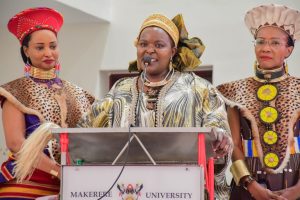
“As we reflect on the journey of Pan-Africanism, we are looking at our historical realities, present situations, and exploring how we move forward progressively,” she said.
She stressed that youth participation was not optional.
“Any space where there’s no youth, any organisation or planning where there is no youth is a dying moment,” she said. “We are passing the baton, the future is bright, and where we end, we know that the fire will keep burning.”
That message resonated strongly among student participants, many of whom called for greater involvement in policy discussions, research initiatives and continental development programmes.
Building Bridges Across Continents
For His Highness Papa Dr Paul Jones Eganda, President of AIDO Network International and Chairman of the Global Africa Diaspora Kingdom, the symposium demonstrated the growing importance of partnerships between Africa and its diaspora.
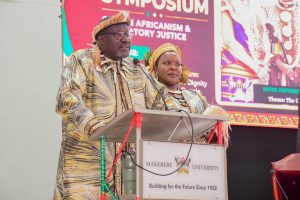
“We are here to listen and learn from each other, and build partnerships,” he said. “We would like to promote inter-university collaborations, research opportunities, and scholarships.”
His remarks reflected a broader consensus that Africa’s future cannot be separated from the experiences, expertise and investments of millions of people of African descent living across the globe.
As Africa Day approaches, participants left Makerere with a renewed sense that Pan-Africanism is no longer merely a historical movement or political slogan.
Instead, they argued, it is increasingly becoming a framework through which Africans are debating identity, development, education, economic sovereignty and justice in an interconnected world.
The challenge now, speakers agreed, is translating those conversations into action.