


Minister of State for Karamoja Affairs in the Office of the Prime Minister, Anyakun Esther Davinia, has called for sustained, long-term interventions to address the food and nutrition challenges facing communities across the Karamoja region.
“More than half a million people in Karamoja are deeply affected by the current food insecurity crisis. Thousands of young children, aged between six months and 49 months, are projected to suffer from acute malnutrition in the coming months through February 2027,” Anyakun said.
“When a child is hungry, the consequences ripple far beyond their health. Hunger follows them directly into the classroom. It manifests in empty desks, poor attendance and disrupted learning. We cannot expect our children to build the future of Uganda on an empty stomach.”
Anyakun revealed that the Government made an intervention in July 2026 to support families affected by the food crisis. The Government provided 6.2 million kilograms of maize and 3.1 million kilograms of beans to 314,000 households, helping to address immediate food needs among vulnerable communities in Karamoja.
However, she stressed that while emergency food assistance is critical in responding to immediate needs, it must be complemented by sustained interventions that address the underlying and longer-term challenges affecting children, families and communities.
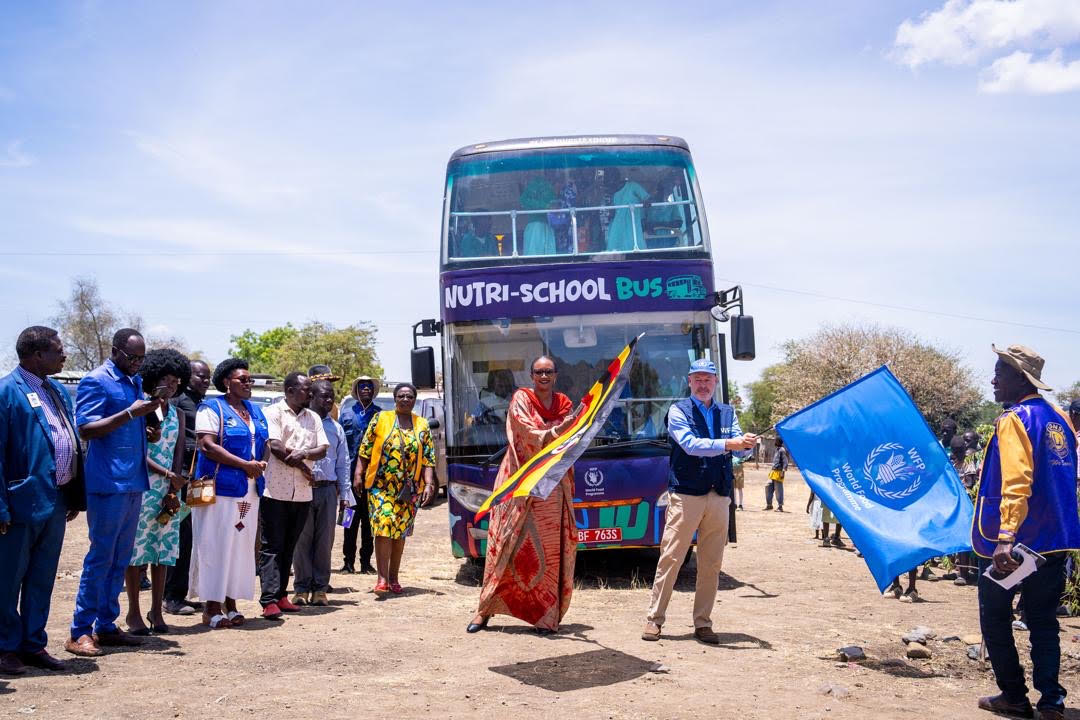
Anyakun was speaking during the launch of the Nutri-School Bus 2.0, a mobile nutrition and education campaign implemented by the World Food Programme (WFP) in collaboration with the Ministry of Gender, Labour and Social Development and Lions Clubs International under the theme “The Bus that brings us together.”
She commended the Nutri-School Bus 2.0 initiative as an important long-term intervention that complements government efforts by taking nutrition education and awareness directly to schools and communities, while promoting better nutrition, learning, child development and gender-responsive practices.
Running until October 26, 2026, the initiative will target at least 183,000 people across the Karamoja region, reaching schools and communities with nutrition education, gender-responsive engagement and community accountability activities.
According to the IPC Acute Food Insecurity Analysis, approximately 473,000 people in Karamoja faced acute food insecurity (IPC Phase 3 or above) between April and July 2026, including 41,000 people in Emergency (Phase 4). All nine (9)districts were classified in Crisis (Phase 3), with the situation driven by climatic shocks, failed or reduced food harvest and livestock production, pests and diseases, and high food prices.
The IPC analysis estimated that 122,100 children aged 6-59 months would suffer acute malnutrition between March 2026 and February 2027, including 30,600 children with severe acute malnutrition.
The Nutri-School Bus 2.0 campaign will reach nine (9) districts across the Karamoja region, bringing nutrition education, awareness and engagement activities to 64 government-aided primary schools that create a multiplier effect by reaching the community.
The initiative brings together three key pillars: school feeding, gender inclusion and community engagement to promote collective action around the importance of children’s nutrition as a foundation for their health, learning and development.
Speaking at the flag-off event held at Kasimeri Primary School in Moroto, WFP Uganda Deputy Country Director Marcus Prior said the Nutri-School Bus has significantly expanded its reach, from 19 schools in six districts last year to 64 schools across all nine districts of Karamoja this year.
He noted that WFP and the Government of Uganda have provided school meals in Karamoja for more than three decades, currently reaching 221,000 children in 284 schools through a home-grown school feeding programme that sources food from local farmers.
“As part of WFP’s response to the worsening food insecurity, learners also received take-home rations at the end of last term to help protect them and their families from the worst impacts of the drought.”
He said Nutri-School Bus 2.0 builds on this work, focusing on three interconnected pillars: school nutrition, gender, and community engagement. The initiative seeks to equip teachers, learners, school nutrition clubs, parents, caregivers, communities and elders with practical knowledge and tools to influence everyday cooking and feeding practices both at school and at home.
He highlighted the importance of protecting children’s school meals, particularly as failed rains have increased food insecurity, stressing that school food is children’s food and that safeguarding these meals is a shared responsibility of schools, families and communities.
Obalim Frances Betty, Patron of the Nutrition Club at Kasimeri Primary School, noted that the Nutri-School Bus’ gender-focused nutrition sessions are helping boys become more open to taking on activities they previously considered to be for girls.
She added that the NutriBus would also help learners understand the importance of fairness when serving food, ensuring that both boys and girls receive equal portions.