


GENEVA — Switzerland has retained its position as the world’s most innovative economy for the 16th consecutive year, followed by Sweden and the United States, according to the World Intellectual Property Organisation’s (WIPO) 2026 Global Innovation Index.
The 19th edition of the index ranks 139 economies using 79 indicators covering areas including research and development, human capital, infrastructure, high-tech trade, business sophistication, intellectual property and technology outputs.
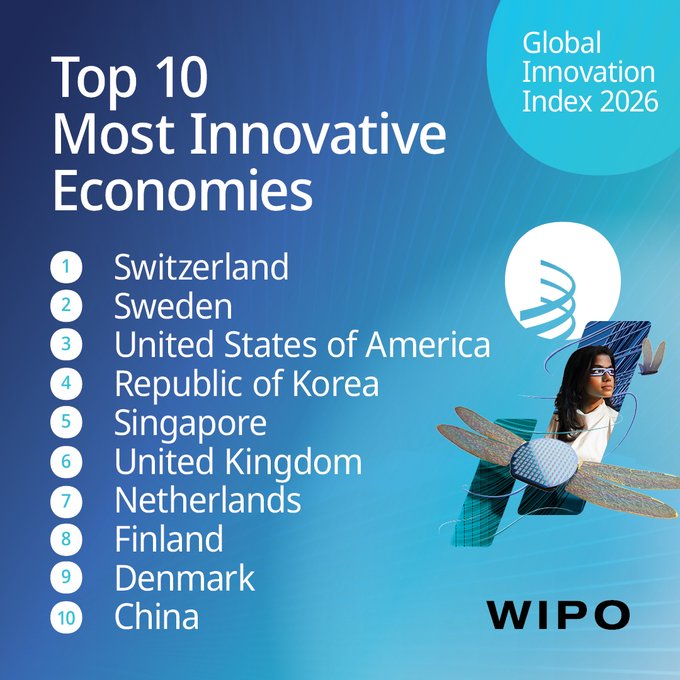
The top 10 economies are:
- Switzerland
- Sweden
- United States
- Republic of Korea
- Singapore
- United Kingdom
- Netherlands
- Finland
- Denmark
- China
The Netherlands moved up to seventh from eighth place, while Finland dropped to eighth from seventh. The other countries in the top 10 retained their positions from 2025.
WIPO said the 2026 index points to continued growth in global innovation, although investment and technological progress are expanding more slowly than in previous periods.
Global research and development spending increased by more than 3.3% in real terms in 2025 and is projected to grow by 3.6% in 2026 to about $3.4 trillion.
Venture capital investment also rebounded in 2025, with funding for innovative start-ups rising 28% to $510 billion. However, investment has become increasingly concentrated in artificial intelligence companies, which accounted for 53% of global venture capital deal value in 2025 and 77% during the first half of 2026.
Africa makes gains
The report records several advances among African economies, with Mauritius leading Sub-Saharan Africa at 50th globally, followed by South Africa at 63rd, Botswana at 82nd and Senegal at 90th.
Rwanda recorded the strongest advance among low-income economies, rising to 96th place, while Kenya moved up five places to 97th. WIPO identified Rwanda, South Africa, Botswana and Kenya among the African economies showing notable progress in innovation performance.
Seven Sub-Saharan African economies were among the countries that performed above expectations for their level of economic development, according to WIPO.
The organisation also reported growing venture-capital activity around innovation hubs in Kenya, Mauritius, Nigeria and Rwanda, although early-stage funding remains limited across much of the region.
WIPO said African start-ups raised about $3.2 billion in venture capital in 2025, a 40% increase from the previous year.
China remains leading middle-income economy
China retained 10th position and remained the only middle-income economy in the global top 30.
India ranked 38th, followed by Malaysia at 34th and Vietnam at 43rd. Morocco, Türkiye, the Philippines and Indonesia also featured among the middle-income economies that have strengthened their positions in the upper half of the index.
WIPO said China stands out for converting innovation inputs into outputs, with its output score exceeding that of several higher-income economies despite lower levels of innovation inputs.
Innovation increasingly concentrated in major hubs
The index also tracks innovation clusters — geographic concentrations of inventors, scientific researchers and venture-capital activity.
The leading clusters in 2026 are Shenzhen-Hong Kong-Guangzhou, Tokyo-Yokohama, San Jose-San Francisco, Beijing and Seoul. Other clusters in the global top 10 include Shanghai-Suzhou, New York City, London, Boston-Cambridge and Osaka-Kobe-Kyoto.
WIPO’s 2026 report also focuses on so-called “deep science” ventures: businesses built around scientific discoveries in fields such as physics, chemistry, biology and mathematics.
More than 30,000 deep-science start-ups have been created since 2000, according to the report. Collectively, they were valued at about $7.6 trillion in 2025, up 23% from 2024.
WIPO said the challenge for many of these ventures is moving from scientific research to proof of concept, and then from pilot projects to commercial-scale businesses.
The Global Innovation Index is published annually by WIPO and is used by governments and other institutions to assess innovation performance and inform policy. The 2026 edition draws primarily on data from 2024 to 2026, with more than 80% of its data points coming from those years.