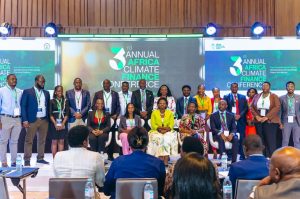



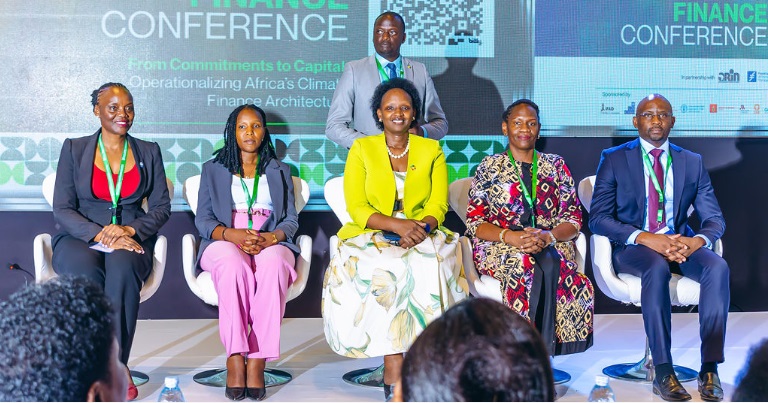
KAMPALA — Africa must stop measuring climate action by the number of agreements, strategies and pledges it produces and instead focus on whether money is reaching bankable projects, businesses, farmers and communities, speakers at the 3rd Annual Africa Climate Finance Conference have said.
The two-day conference, running September 1–2 at the Kampala Marriott Hotel, is organised by the Climate Finance and Sustainability Centre (CFSC) at Makerere University Business School (MUBS) under the theme “From Commitments to Capital: Operationalising Africa’s Climate Finance Architecture.”
Opening the conference, Minister of State for Finance, Planning and Economic Development (Microfinance) Hon. Shartsi Kutesa Musherure said Africa has no shortage of climate commitments, but continues to struggle to convert them into investable opportunities.
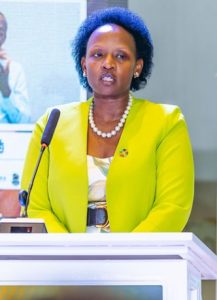
“We have the Paris Agreement, Nationally Determined Contributions, national development plans, climate strategies and sustainable finance frameworks,” Musherure said. “Our challenge is translating these commitments into bankable projects, with appropriate financing structures and capital deployed in the real economy.”
She said Uganda must treat climate finance as an economic issue rather than a purely environmental one, given the impact of climate shocks on agriculture, infrastructure, water, energy, household incomes and public expenditure.
She linked climate investment to Uganda’s Tenfold Growth Strategy and the country’s ambition to grow its economy to US$500 billion by 2040, arguing that climate considerations must be incorporated into planning, budgeting, public investment management and fiscal risk management.
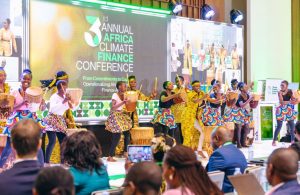
“We are not seeking to create a separate climate economy. We are ensuring that the economy we build is productive, investable and resilient,” she said.
Musherure said government has strengthened Uganda’s climate finance architecture, including the establishment of the Climate Finance Unit in 2023, the Climate Finance Strategy 2025–2030 and the National Green Taxonomy.
Uganda is also developing instruments such as sovereign green bonds, blended finance, guarantees, disaster-risk financing and insurance, while strengthening the environment for carbon markets and carbon finance.
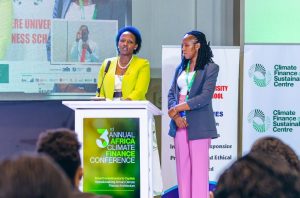
But she warned against confusing policies and institutions with actual results. “We should not confuse architecture with outcomes,” Musherure said. “A strategy is useful if it mobilises capital. A taxonomy is useful only if it influences financing decisions. A pipeline is useful only if projects reach financial close. A tracking system is useful only if it improves decisions and accountability. And an institution is useful only if it delivers.”
She challenged delegates to identify why climate finance continues to struggle to reach projects. “Which projects are investment-ready? What prevents them from reaching financial close? Which risks should government carry, and which should the market carry?” she asked.
Climate finance must reach communities
CFSC Executive Director Dr. Maria Nantongo said the conference was established to bring together government, academia, private-sector players, development partners and civil society to build practical partnerships.
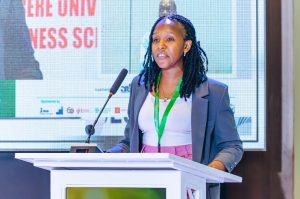
“At the university, we do research and capacity building. That is the partnership that we have built. But we also realised that we have the space, as a neutral voice, to convene people, and that is why we started these conferences,” Nantongo said.
She said climate change has a disproportionate impact on women, particularly through food, water and energy insecurity.
“As a woman, I know that women are among those most affected by the impacts of climate change,” she said. “We are the ones who look for food at home. We are the ones looking for firewood. We are the ones responsible for providing water in our households.”

She argued that the consequences eventually affect consumers far beyond farming communities.
From blueprint to deployment
Conference chair Dr. Colin Agabalinda said Africa has accumulated a “big tank” of climate pledges and frameworks but must now address the blockages preventing money from flowing.
“Let’s turn our commitments into capital that flows on a balance sheet of real green business,” Agabalinda said. “Now, it is about fixing the plumbing, clearing the blockages that keep climate finance from reaching the farmer, entrepreneur and communities who need it most.”
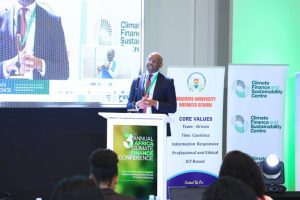
He urged delegates to leave with practical commitments rather than simply exchanging contacts.
Uganda Institute of Banking and Financial Services Chief Executive Officer Goretti Masadde said the continent must make a decisive shift from climate ambition to investment.
“For nearly a decade, global climate discourse has been dominated by commitments, declarations and frameworks. However, intent without an operationalised infrastructure is merely a liability.”
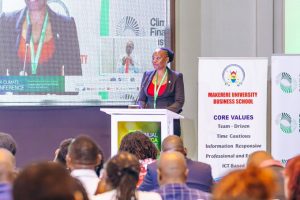
Dr. Akinyi J. Eurallyah, Program Manager at the Africa Science Policy Fellowship at the Africa Research and Impact Network, said Africa’s climate narrative should also recognise its investment potential.
“Africa’s climate story should not be reduced to vulnerability. The continent also possesses extraordinary opportunities for a different development trajectory,” she said.
She said Africa received about US$43.7 billion annually in climate finance in 2021/22, only about two per cent of global flows, while its climate finance needs are estimated at US$2.8 trillion by 2030.
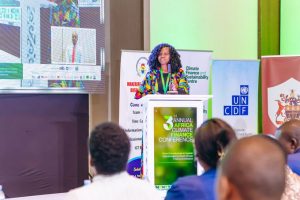
“We need to change the way we talk about Africa’s climate finance gaps. The problem isn’t just one of volume but also a problem of structure, access and allocation,” Eurallyah said.
MUBS Dean Dr. Ronette Atukunda said financial institutions must become central to the climate transition. “We must move from what ought to be done to who does it, whose money does it and by when. Funding the climate transition isn’t an expenditure; it’s an investment,” she said.

Climate Finance Specialist Chavi Meattle warned that more money alone would not solve Africa’s financing problem.
“Africa remains at around 4–5% of global climate finance flows. More money overall does not automatically mean more money where the climate vulnerability is highest,” Meattle said.

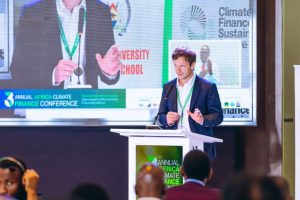
Frankfurt School Senior Programme Manager Michael König said partnerships had helped establish climate finance capacity at MUBS.
“We brainstormed on what is needed to drive capacity building in absorbing, mobilising and accessing climate finance. Within a few months, a centre of excellence was established at Makerere University Business School,” König said.
The conference continues with discussions on blended finance, carbon markets, financial intermediation, local financing, youth innovation and mechanisms for moving climate finance from commitments to actual investment.