


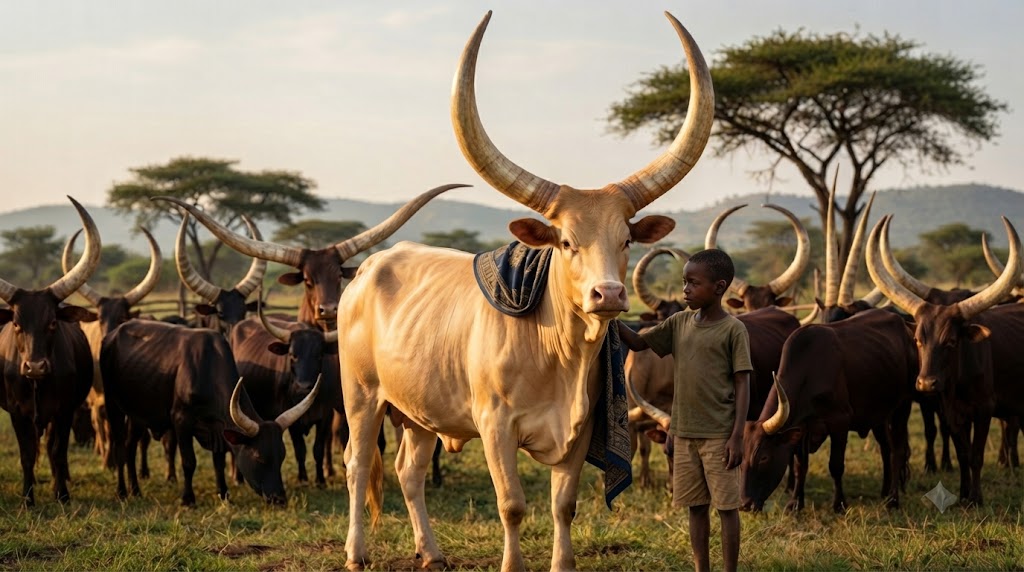
In Part 4 of Guardians of Kikurungo, I introduced you to the world of cattle—the beautiful longhorns that were more than family. There was one unforgettable cow, Kasa, that earned herself a royal title.
This is her story.
Part Five
Kasa: The Princess of the Herd
She was not built for motherhood. She was built for battle. A cow with the spirit of a bull, Kasa ruled the family herd with unmatched confidence, forcing even the strongest bulls to respect her presence.
By Rogers Atukunda
*
Every kingdom has a ruler.
Some inherit crowns.
Some inherit titles.
Some earn respect through wisdom.
And some are simply born with a presence that cannot be ignored.
In the cattle kingdom of my childhood, there was one animal whose authority needed no explanation.
Her name was Kasa.
Kasa was born into a family where cattle were not simply animals but inherited memory.
The Two Rivers of My Heritage
The hills of Kikurungo gave me my first understanding of guardianship.
But they were not the only landscape that raised me.
Just ten kilometres away, in Omukabare Village, present-day Kashangura Sub-county in Ibanda District, stood my parents’ home.
If Kikurungo was where I inherited the philosophy of guardianship from my grandmother, Kashangura was where I learned to practise it.
My parents’ own story had begun in Mbarara Town. My father was working for a government corporation when he met my mother, who was visiting her aunt. They first settled in Rwampara, where my elder siblings were born. I arrived later at Mbarara Hospital, shortly before the family moved permanently to Kashangura.
Looking back now, I realise that I inherited the cattle tradition from both sides of my family.
My father came from the Bahororo of Rujumbura, in what was then Kigezi Region, now Rukungiri District. His family’s history reflected a social transition that President Yoweri Museveni describes in his autobiography: Sowing the Mustard Seed.
Writing about the old social organisation of western Uganda, Museveni explains: “Since the castes were based on job specialisation, a family would shift from one caste to another depending on what it was doing. If an agricultural family acquired cattle, they would become Abambari (cultivators that had taken to cattle keeping) and, eventually, become Abahima (cattle keepers). That is how you hear names like Rwabambari.” (p.7)
My father’s name was Rwabambari.
The passage fascinated me the first time I read it.
It explained something I had grown up hearing without fully understanding.
Rwabambari was not merely a surname or a personal name. It was a historical memory—a reminder of families whose lives had been transformed by cattle. It reflected a society where identity was not fixed by blood alone but could change with livelihood, responsibility and the gradual accumulation of livestock.
My mother’s heritage reached even further back.
Her name is Kugonza, and her pet name is Abwooli.
Her father was a Muhuma, one of the cattle aristocrats of the old Bunyoro-Kitara Empire and Tooro Kingdom. Through him came another pastoral tradition, one rooted in one of East Africa’s oldest cattle cultures.
Without realising it as a child, I stood at the meeting point of two cattle traditions.
Perhaps that is why the kraal always felt less like a workplace than a home.
My parents never owned the vast herds that people often associate with Ankole cattle keepers. Ours was a modest farm with only a few dozen cattle and other livestock.
But greatness is not always measured in numbers.
Sometimes an entire herd is remembered because of a single extraordinary animal.
For us, that animal was Kasa.
The Princess of the Herd
Kasa was born a cow but carried the spirit of a warrior.
She never gave birth, yet she became one of the most unforgettable members of our family herd.
Kasa did not follow the herd — the herd followed her.
My sister Grace later joked that Kasa was like Princess Bagaya of Tooro — a royal figure in Tooro Kingdom.
The joke carried more truth than humour.
Because Kasa had something unusual.
She carried herself like royalty.
She did not seek attention.
She commanded it.

The Cow Who Was Different
When Kasa was young, she was called a kasa — a name traditionally used for a heifer.
Later, when a cow begins breeding and producing calves, it becomes known as a kisa.
But Kasa never followed that path.
She never gave birth.
She was sterile.
At first, this seemed like a disappointment.
In the traditional cattle world, reproduction was part of a cow’s value. A cow that produced calves contributed directly to the continuation of the herd.
But Kasa was different.
She seemed to have been created for another purpose.
She was not built for motherhood.
She was built for battle.
The Cow Who Looked Like a Bull
From a distance, Kasa could easily confuse someone.
Although she was shaped like a cow, there was something masculine about her appearance.
She carried herself like a bull.
Her body was lean and powerful.
Her muscles were visible.
Her posture showed confidence.
But what made her unforgettable were her horns.
Kasa did not possess the enormous royal horns.
Hers were smaller — sharp, upward-pointing and slightly curved inward.
They looked almost modest beside the great horns of some of the bulls.
They were not designed for beauty.
They looked designed for combat.
Anyone who mistook the size of her horns for weakness learned the mistake quickly.
Her coat was equally unique.
It was neither pure white nor light cream.
It existed somewhere in between.
A soft, rare shade that made her stand out among the herd.
Everything about Kasa suggested that she was not ordinary.
The Warrior Princess
Among cattle, hierarchy matters.
Animals establish their place.
Strength is recognised.
Weakness is challenged.
And Kasa refused to be challenged.
She was stronger than many ordinary cows.
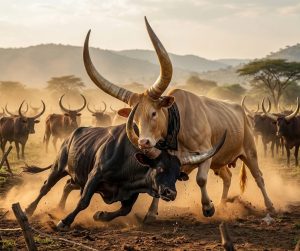
But what surprised everyone was that she could stand against bulls.
Those young, testosterone-filled bullocks that arrived full of confidence quickly learned a lesson when they met Kasa.
They came expecting to dominate.
They left humbled.
Kasa would lower herself, prepare herself and meet them with a strength that seemed impossible for a cow.
The result was always the same.
Respect.
The young bulls discovered that size alone did not determine power.
The Secret We Did Not Understand
Before we understood that Kasa was sterile, many bulls had been brought to mate with her.
But every attempt failed.
Not because she lacked strength.
Because she refused submission.
Instead of accepting their advances, she fought them away.
In some encounters, she even mounted them — a humiliation that seemed to announce:
“You came here thinking you were stronger. You were wrong.”
As children, we did not understand the biology.
We understood the personality.
Kasa was a fighter.
The Wild Classroom of Kashangura
Kashangura had its own geography, as vivid in my memory as Kikurungo.
Our cattle and goats grazed across three hills that formed the landscape of my childhood.
There was Kamuzwara, a small rounded hillock which was owned by a man called Erikanzeru.
There was Karindiriro, a striking conical hill whose steep slopes seemed almost impossible to climb.
And then there was what we simply called The Big Hill, generally associated with its Great Valley — Omukihanga. Even today, I am not certain of its proper name. We knew it through the villages that surrounded it—Nyamiswiga, Nyarubira and Kashangura II—and by the busy Maradona Trading Centre below it, as well as its highest point known as Akatesani.
These landscapes became the stage where our childhood unfolded.
Together with my childhood friends, especially Dickson Atwine, these hills became our playgrounds, our grazing fields and our second university.
Grazing cattle was rarely just grazing cattle.
Once the animals settled into fresh pasture, the children disappeared into their own world.
The Games We Played
There were games whose names I remember more clearly than their rules. And there were others whose rules I could still reconstruct decades later simply by remembering what our hands did.
We played amatatu with worn playing cards until the edges curled.
We played duru, throwing dried seeds at another seed, trying to knock it into a small hole scratched into the earth.
We played choko, aiming stones, shirt buttons or bottle tops into another hole with the concentration of professional athletes.
Another game was Ekyesho. We drew eight squares on the ground, four on one side and four on the other. A player threw a small stone into one of the squares, then hopped on one leg, kicking the stone from one box into the next. The stone could not touch the line. If it did, you were out.
The game continued until someone had completed all eight boxes.
But winning was not the end.
The winner then claimed a square as a house.
Nobody else could step into that house. Only its owner could enter it with both feet. The other players had to kick their stones through the remaining empty squares, carefully avoiding the houses belonging to their opponents.
One by one, the squares became houses.
Until there were no empty spaces left.
Then the game ended.
There was ekyehubo, too: a swing made from a rope tied to two points on a tree branch, forming a rough semicircle. You sat on the rope while someone stood behind you, pushing you higher and higher.
There was no winner.
No loser.
No final whistle.
You simply swung until you were tired.
But the girls had their own games.
One of them was Okwepena. Two girls would stand opposite each other, with another girl in the middle. The two on either side would throw the ball at the girl in the middle, whose job was to dodge it. The longer she survived without being hit, the more points she earned.
There was another version of the game that involved skipping a rope. Two girls would stand opposite each other and swing a rope in a continuous circular motion. The girl in the middle had to jump over it repeatedly, making sure it did not catch her feet or strike her head.
The rope itself was made from whatever the countryside provided: sisal, banana fibre, papyrus reeds or the outer fibres of shrubs that could be peeled, dried and twisted into a cord.
The game looked simple.
It was not.
The girl in the middle had to judge the speed and height of the rope, time her jumps and keep moving with the rhythm of the circle. One mistake and the rope caught her.
Then she was out.
There was another game that belonged to everyone: tapo. One child became the seeker and counted up to one hundred while the rest scattered and hid.
Then the hide-and-seek began.
The seeker searched the compound, the bushes, behind houses, around banana plants and wherever else a child could squeeze themselves into. Once the seeker spotted someone, he or she had to reach them, tap them and shout:
“Tapo!”
The first person found became the next seeker.
And the game began again.
But think about what the child was actually learning: balance, coordination, timing, concentration, spatial awareness, memory and the ability to follow rules while competing against others.
Nobody stood beside us with a textbook explaining any of this.
The ground was the textbook.
The rope was the lesson.
The other children were the examination.
And failure was immediate: you stepped on the line, the rope caught your feet, the ball hit you, or someone found your hiding place.
Then you tried again.
That was the wild classroom of Kashangura.
We were learning without knowing that we were learning.
The Football Wars
While girls played their skipping and dodging games,
We played football using tightly woven banana fibres (akareere) — or simply omupira gw’ebireere (a homemade ball made out of wrapped banana fibres).
Our football was different.
We played in equal numbers, one team against another, trying to score against the opposing side. But when the numbers did not balance, there was always a special player: Ruzanira. The best player could move between the two teams, switching sides whenever necessary to make the game fair.
Even as children, we understood something adults sometimes forget: a game is only enjoyable when the contest is fair.
We played football everywhere.
When we were grazing cattle, we played among ourselves. But football did not end with the boundaries of our grazing fields. It became our way of meeting other villages.
Our training ground was the playground at Kashangura Primary School. From there, we travelled to compete against Mahega, Nyamiswiga and other surrounding villages. Sometimes we went as far as Migyera, where the weekly market was held every Monday.
But our greatest rivalry was Omurwera.
I still cannot explain why.
There was no single incident I can remember that started it. No ancestral dispute. No stolen cow. No broken friendship that I can trace back to its beginning.
Yet whenever Kashangura met Omurwera, football stopped being just football.
We were sworn enemies.
Every tackle seemed personal. There was almost a foul with every step. Players argued. Tempers rose. Sometimes the game stopped altogether because the footballers had become fighters.
One season, however, we dominated them.
The first leg was played at Kashangura. We beat Omurwera 3–1.
And something else happened that made the victory particularly important to me.
My father came to watch.
He had never encouraged my football. As far as he was concerned, going to Kashangura to play football was little more than wasting time that could have been spent doing something useful.
But that day he came.
I could not disappoint him.
I scored.
For a boy whose father had come to watch him do the very thing he usually considered a waste of time, that goal felt bigger than the scoreline.

Then came the return leg.
We had to travel to Kicheche, Omurwera’s home ground.
We knew we were walking into hostile territory.
From the moment we arrived, their players and supporters made it clear that we were not welcome. There was no cheering for us. We were booed, insulted and threatened. They warned us that once the game ended, they would deal with us.
So we played under pressure.
And somehow, we won again.
2–0.
I scored again.
Then the final whistle came.
There was no time to celebrate.
We ran.
The Omurwera supporters and players came after us. We fled down the road towards Kashangura, with the pursuit continuing all the way to Katego, the hill between Omurwera and our home.
That was where we finally regrouped.
We had survived.
Nobody had beaten us.
Nobody had caught us.
And then, after the fear had passed, something remarkable happened.
We began to celebrate.
We chanted victory songs all the way home.
Perhaps this is what football was teaching us before we had words for it: that a village could become a team, a game could become a battle, and victory could turn frightened children into an army returning from war.
I still do not know why we hated Omurwera so much.
Against every other village, we competed.
Against Omurwera, we went to war.
Perhaps that is the strange thing about childhood rivalries.
Sometimes we inherit the hatred before we inherit the reason.
The Price of Fun
But every kind of freedom has its price.
While we played the different games, the cattle continued grazing.
And cattle, unlike children, did not understand that there was a football match to finish or a game of tapo that could not be interrupted.
They followed grass, water and whatever looked edible. Sometimes that meant wandering straight into someone’s garden.
And the consequences were immediate.
The moment we realised the cows had disappeared, the games ended.
We would abandon the football, and start searching the hills, already imagining what awaited us when we found the animals — or, more accurately, what awaited us when the owners of the gardens found us.
Some people were patient.
Others were not.
The consequences always arrived with remarkable speed.
Erikanzeru, who owned Kamuzwara, had three sons, and they operated with military efficiency.
Whenever our cattle or goats entered their gardens, they never shouted from a distance.
They hunted us.
They would quietly track us until we were completely absorbed in our games.
Then, without warning, they descended upon us.
The beating came first.
The explanation came later.
In fact, no explanation was necessary.
The beating itself was enough to tell us that the cows had wandered into somebody’s crops.
Curiously, we never reported these beatings at home.
That would only earn us a second beating for failing to watch the animals in the first place.
There was another farmer-turned hunter called Maleju, whom everyone affectionately called Kanywani— meaning “friend”.
His nickname was wonderfully misleading.
He really was everyone’s friend.
Until your cows or goats entered his garden.
Unlike Elikanzeru’s sons, Maleju employed strategy.
He would stroll over smiling, greet everyone warmly and sometimes offer a meal.
He would then join whatever game we were playing.
Slowly, we relaxed.
We forgot why he had come.
Then, at the exact moment our guard was completely down, he would seize one of us and administer a thorough caning.
Only afterwards would someone think to check the cattle.
Sure enough, they had found his potatoes or maize.
It was justice, village style.
When cattle destroyed gardens, punishment arrived before explanation.
It was the village’s way of teaching that animals were not only wealth; they were responsibility.
So we learned the rules quickly, or rather the hard way.
Play, but watch the cows.
Have fun, but keep one eye on the herd.
The River of a Thousand Cattle
Part of the grazing routine involved taking cows to the river to drink.
This usually happened twice, sometimes thrice: morning, afternoon and evening.
One of my strongest memories of Kasa was at the watering place.
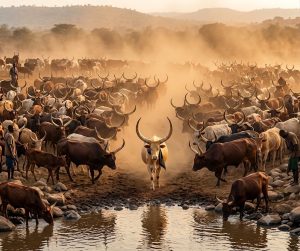
During those days, hundreds — sometimes thousands — of cattle would gather at the river called Omukabare (because the watering place had relatively big stones).
The river was a meeting point.
Different herds arrived together.
The air would fill with movement, dust and the sounds of cattle calling.
In such a crowd, finding a path to the water was not easy.
Animals pushed.
Herds mixed.
The strongest often moved first.
Then Kasa would appear.
Walking slowly.
Confidently.
Leading our family herd.
And something remarkable happened.
The cattle moved.
Not because anyone commanded them.
Not because there was a fight.
Because they recognised authority.
A narrow path would open through the middle of the gathered herds.
Even bulls moved aside.
Kasa walked through like a queen entering her kingdom.
She did not force respect.
She carried it.
The Pride of a Young Boy
As a child, I did not know words like leadership, personality or dominance.
I only knew what I saw.
I saw a cow unlike any other.
I saw an animal that seemed fearless.
I saw strength in a place where people did not expect to find it.
Kasa was the pride of our herd.
She was the animal we spoke about.
The one we admired.
The one whose presence made us feel that our family cattle were special.
Every child has a favourite animal.
The one whose name remains attached to childhood.
For me, that animal was Kasa.
The Pain of Losing a Legend
But childhood memories also carry pain.
Not every story ends the way we wish.
Eventually, Kasa was sold.
And later, she was slaughtered for meat.
Even today, remembering that moment brings conflicting emotions.
There is admiration.
There is longing.
And there is anger.
A part of me still struggles with the idea that such a unique animal — an animal that had become a symbol of our family pride — could simply disappear.
To someone else, Kasa may have been just meat.
To me, she was history.
She was personality.
She was a story.
She was part of the education I received from animals.
The Lesson of Kasa
Years later, I understand that Kasa taught me something important.
Guardianship is not only about protecting things that are useful.
Sometimes, it is about protecting things that are unique.
Every herd has animals that reproduce.
Every farm has animals that generate value.
But some creatures contribute something different.
They become symbols.
They become memories.
They become stories.
Kasa never produced calves.
But she produced something else.
A memory that survived.
A lesson about strength.
A reminder that greatness does not always appear in the form we expect.
The Princess Remains
Today, when I close my eyes, I can still see her.
The unusual coat.
The sharp horns.
The confident walk.
The river parting before her.
The herd making way.
The little boy watching with admiration.
Kasa was not the biggest animal.
She was not the most productive.
She was not the most valuable according to ordinary measures.
But she was unforgettable.
And sometimes, that is the greatest legacy of all.
*
Andy, my family was never short of unforgettable animals.
Other legends among us had no hooves or horns—they had paws and sharp teeth.
Among them were our legendary dogs: Champion, Kadoma, and Simba.
Next Tuesday in The Guardians of Kikurungo
Part Six: The Kingdom of Paws —Legendary Dogs Champion and Kadoma