



KAMPALA — The commencement of commercial petroleum production later this calendar year is expected to usher Uganda into a new phase of accelerated economic expansion, with government projecting a return to double-digit growth underpinned by expanded fiscal space and strategic investment in productive sectors.
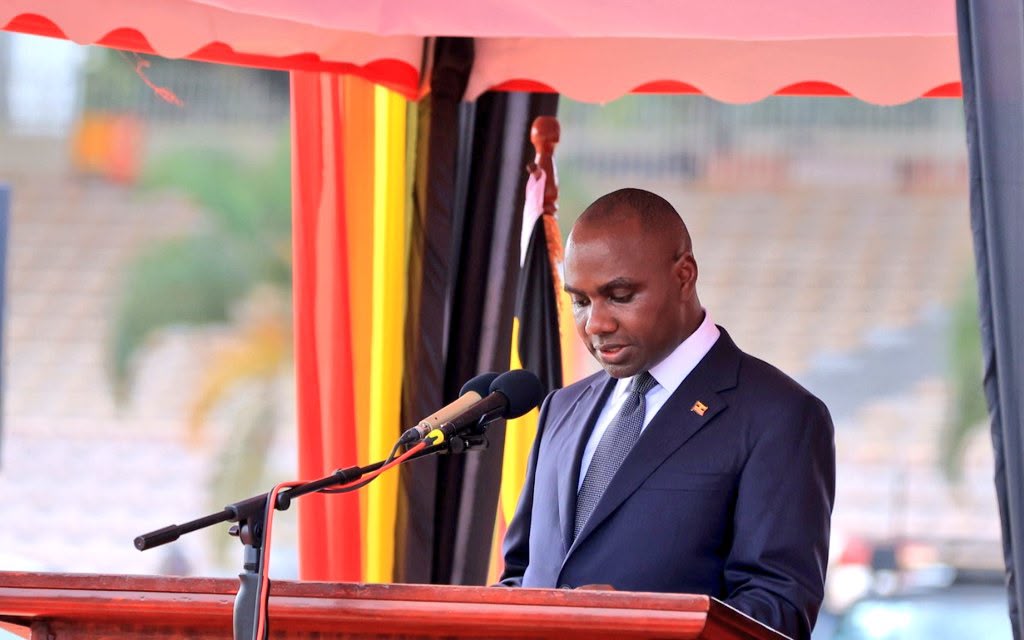
Delivering the FY 2026/2027 National Budget Speech at Kololo Independence Grounds on Thursday, Minister of State for Finance (General Duties) Henry Musasizi announced that the economy is forecast to grow by 10.2 percent in the coming financial year, up from an estimated 6.4 percent in FY 2025/2026.
He described the projected surge as a historic turning point, marking Uganda’s first return to double-digit growth since the structural reforms of the 1990s, with “First Oil” positioned as a key catalyst.
Rather than treating petroleum revenues as a standalone windfall, government has integrated expected oil proceeds into a broader development framework anchored on the ATMS strategy—Agro-Industrialisation, Tourism development, Mineral-based industrial development (including oil and gas), and Science, Technology and Innovation.
Collectively, these priority areas form the backbone of Uganda’s Tenfold Growth Strategy aimed at expanding the economy to USD 500 billion by 2040.
Shs 5.21 Trillion Allocated to ATMS Priorities
In a bid to accelerate structural transformation, government has allocated Shs 5.21 trillion toward wealth creation and ATMS-related interventions in FY 2026/2027.
The allocation is designed to shift Uganda from reliance on raw commodity exports toward high-value production and industrialisation across key sectors:
Agro-Industrialisation (Shs 2.26 trillion)
The sector receives the largest allocation in recent history, with funding directed toward irrigation systems, post-harvest handling infrastructure, agro-processing, and scaling up local innovations such as the anti-tick vaccine. The focus is on strengthening agricultural value chains and climate resilience.
Tourism Development
Following a strong post-pandemic recovery, with tourism earnings reaching USD 1.86 billion in 2025, investment will target infrastructure, conservation, and global marketing of Uganda under the “Explore Uganda” brand.
Science, Technology and Innovation
Funding will support ICT development, start-ups, and the creative economy, building on rising venture capital inflows—particularly in Kampala’s innovation ecosystem. Government also highlighted continued support for youth employment through innovation financing initiatives.
Mineral-Based Industrial Development
Resources will support value addition in mineral processing, expansion of domestic manufacturing linkages, and strengthening of industrial supply chains within the extractives sector.
Oil Revenues to Anchor Infrastructure Expansion
Speaking after the budget presentation, President Yoweri Kaguta Museveni reiterated government’s position that petroleum revenues will be strictly ring-fenced for productive investments, particularly infrastructure development.
“We shall use part of the oil money for infrastructure development such as railways, roads, and oil pipelines,” the President said, noting that reducing transport and energy costs is critical to enhancing the competitiveness of Ugandan industries.
A key highlight of the budget is Uganda National Oil Company’s (UNOC) acquisition of a 20.15 percent stake in the Kenya Pipeline Company. With over 95 percent of Uganda’s refined petroleum imports transiting through the Kenyan corridor, the investment is expected to enhance supply security, reduce logistical risks, and stabilize fuel flows into the domestic market.
“Kisanja No More Sleep” Implementation Phase Launched
The convergence of first oil and expanded ATMS financing marks what government has termed the “Kisanja No More Sleep” implementation phase, signaling intensified focus on economic transformation and accountability.
While acknowledging progress under programmes such as the Parish Development Model (PDM), which has expanded household participation in the money economy, both the President and the Finance Minister emphasised the need to fully transition remaining subsistence households into productive economic activity.
Minister Musasizi said government’s objective is to integrate all Ugandans into the money economy through sustained wealth creation efforts.
“We are targeting the remaining 33 percent of Ugandans still in subsistence to ensure they are fully integrated into the money economy,” he said.
He further emphasized that leadership accountability will be central to budget implementation.
“All Accounting Officers will sign the Budget Discipline and Accountability Charter,” Musasizi said, adding that the framework will introduce sanctions for breaches in planning, budgeting, and execution of public funds.
PDM and Household Transformation
The Minister highlighted the Parish Development Model as a key driver of inclusive growth, noting that Shs 4.4 trillion has so far been disbursed to 10,589 parishes nationwide as revolving funds.
He said the programme is already contributing to higher household incomes, improved food security, and increased participation in income-generating activities among previously subsistence-dependent communities.
Long-Term Growth Vision
Government reaffirmed its commitment to the Tenfold Growth Strategy, which targets expansion of Uganda’s economy to USD 500 billion by 2040, anchored on wealth creation, poverty eradication and job creation.
Why It Matters
Officials say the FY 2026/2027 budget is not only a fiscal plan but also a strategic transition framework linking oil revenues to long-term structural transformation.