



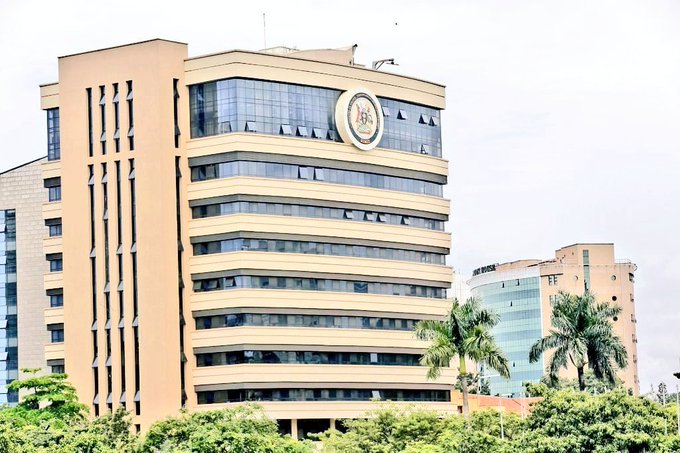
KAMPALA — Uganda recorded gains in employment, environmental sustainability, financial inclusion, and business activity in April 2026, according to the latest Microeconomic Indicator Dashboard (MIND) released by the Ministry of Finance, Planning and Economic Development.
The report paints a generally positive picture of the economy ahead of the national budget reading scheduled for June 11, highlighting improvements in formal employment, cleaner air in Kampala, increased migrant labour opportunities, and growing use of agent banking services.
Formal Employment Increases
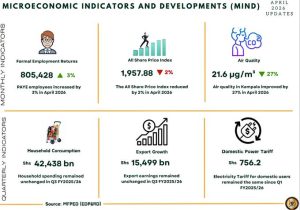
The Ministry reported that formal employment, as captured under the Pay-As-You-Earn (PAYE) register, grew by 3 percent from 782,623 employees in March 2026 to 805,428 employees in April 2026.
The number of Ugandans taking up employment opportunities abroad also rose significantly. According to data from the Immigration Department, migrant workers increased by 35.4 percent, rising from 1,897 in March to 2,569 in April, largely attributed to the resumption of flights.
Kampala Air Quality Improves
The report showed a notable improvement in environmental conditions, with Kampala’s air quality registering a 27 percent improvement.
Particulate matter (PM2.5) levels dropped from 29.6 micrograms per cubic metre in March to 21.6 micrograms per cubic metre in April. The ministry also noted that most parts of the country experienced near-normal rainfall during the month.
Agent Banking Transactions Surge
Financial inclusion indicators continued to strengthen, with agent banking transactions registering substantial growth.
By December 2025, the volume of agent banking transactions had reached 15 million, representing a 55 percent increase from 9.7 million transactions recorded in December 2024.
The value of these transactions also rose sharply by 71 percent, from Shs21 trillion to Shs37.5 trillion over the same period.
More Businesses Registered
The business environment showed signs of expansion, with new business registrations increasing by 14 percent.
A total of 2,679 businesses were registered in April compared to 2,349 in March, reflecting growing entrepreneurial activity.
Meanwhile, Uganda’s monthly trade deficit narrowed by 22 percent, falling from US$61.9 million in February to US$47.7 million in March. The improvement was largely driven by increased gold export earnings, which rose from US$818.16 million to US$851.35 million during the period.
Inflationary Pressures Persist
Despite the positive indicators, the report highlighted rising costs in some sectors.
Food and non-alcoholic beverage inflation increased by 1.1 percent in April after a 0.1 percent decline in March. Energy, Fuel and Utilities (EFU) inflation also rose to 1.8 percent from 1 percent in March, driven by higher fuel prices.
The Ministry attributed part of the increase in fuel costs to logistical disruptions associated with the closure of the Strait of Hormuz, a key global shipping route.
However, electricity tariffs for domestic, medium, large, and extra-large industrial consumers remained unchanged during the April–June 2026 quarter.
Remittances Hit Record Growth
The Ministry also highlighted strong growth in remittance inflows from Ugandans abroad.
Remittances increased by 79 percent from US$1.4 billion in 2024 to US$2.5 billion in 2025, strengthening their contribution to household incomes and economic activity.
To capitalise on this trend, the government has rolled out several initiatives, including the National Migration Policy 2025, the launch of a national remittance dashboard, and the establishment of diaspora engagement units across government institutions.
A National Diaspora Policy is also being developed and is expected to be completed during the 2026/27 financial year.
Government Cites Strong Economic Fundamentals
In its economic outlook, the Ministry maintained that Uganda’s medium-term prospects remain positive.
It cited ongoing government programmes such as the Parish Development Model (PDM), Emyooga, major infrastructure investments, increasing foreign direct investment, growth in exports, and the anticipated commencement of commercial oil production as key drivers of future economic expansion.
The Ministry also pointed to continued peace, security, political stability, and value addition in sectors such as coffee, minerals, fruits, and food processing as factors supporting economic growth.
Officials said upcoming investments in the Standard Gauge Railway, downstream oil infrastructure, and strategic roads, including the Kampala–Jinja Expressway, are expected to further strengthen Uganda’s productive capacity.
However, the report warned that continued conflict in the Middle East and disruptions to global fuel supply routes could contribute to imported inflation and higher fuel prices in the coming months.
The Ministry has encouraged Ugandans to follow the national budget speech on June 11, 2026, to learn about government priorities and opportunities for wealth creation and economic transformation in the new financial year.