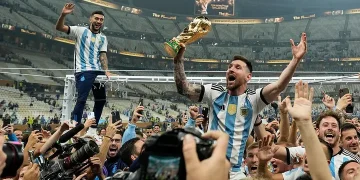



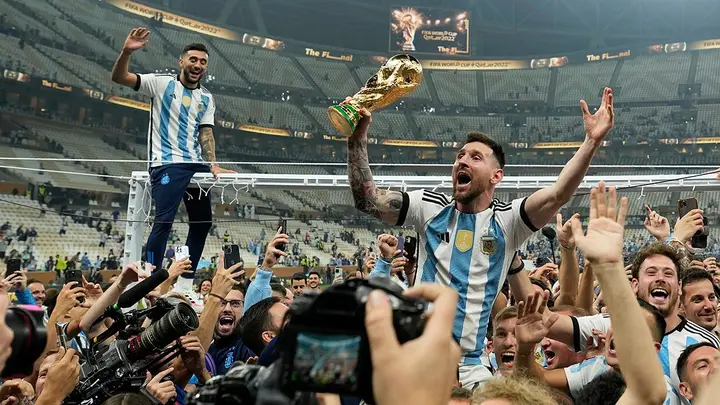
Messi has left the stage
There is something almost cruel about Lionel Messi retiring from international football now.
Not because he has nothing left to prove. Quite the opposite.
At 39, after 207 appearances and 125 goals for Argentina, after finally winning the Copa América in 2021, the World Cup in 2022 and another Copa América in 2024, Messi has walked away from the national team as its most decorated modern footballer.
His final international match was the 2026 World Cup final against Spain. Argentina lost 1–0.
Perhaps that is fitting.
Football rarely gives its gods the ending they want.
Messi had already decided that the time had come. “Time is running short, chapters come to a close,” he wrote, saying he had given everything he had to Argentina and had nothing left to give.
And suddenly, something becomes painfully clear.
The age is ending.
Not football. Not great footballers. There will be others.
But my football age — the age of Ronaldo, Ronaldinho, Zidane, Henry, Beckham, Okocha, Drogba, Eto’o, Weah, Rooney, Kaká, Iniesta, Xavi, Messi and Cristiano Ronaldo — is disappearing into history.
We watched these men become legends.
Now we are watching the legends become old.
And perhaps that is why Messi’s retirement feels larger than one player’s decision.
It feels like a door closing.
Because before football became dominated by numbers, expected goals, pressing data, tracking systems, algorithms and personal brands, there was another way of knowing a footballer.
You knew him by how he moved.
You knew his face.
His haircut.
His celebration.
His particular trick.
The sound of the commentator screaming his name.
You knew that if Ronaldinho received the ball, something ridiculous might happen.
And that brings us to the next group.
The Entertainers
Ronaldinho, Okocha. Denílson. Robinho.
These players made football feel unpredictable, mischievous and human.
Three Brazilian entertainers from slightly different moments of the same football culture.
They did not simply want to beat the defender.
They wanted to embarrass the defender.
Ronaldinho — the man who turned football into mischief
Then came Ronaldinho.
Ronaldo Nazário was a phenomenon.
Messi was a phenomenon.
Cristiano Ronaldo was a phenomenon.
But Ronaldinho was something else: he made football feel like a game again.
The 2005 Champions League night at Stamford Bridge remains one of those moments when football mythology becomes visible.
Chelsea had built a defensive wall around their goal: John Terry, Ricardo Carvalho, Claude Makélélé, Petr Čech.
Then Ronaldinho received the ball.
He faced them.
He danced.
And then, almost without a conventional backswing, he struck the ball through the crowd and into the net.
It was not simply a goal.
It was an act of insolence.
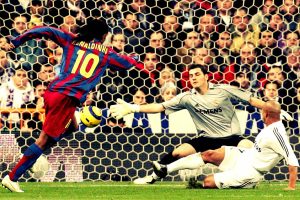
And then came 19 November 2005.
Real Madrid’s Galácticos era: Zidane, Ronaldo Nazário, Luís Figo, Roberto Carlos, Beckham, Casillas.
An empire of football celebrities. It was as if they had lined up the best squad from another galaxy.
Ronaldinho scored twice.
The second goal became mythology. He took the ball, ran at Sergio Ramos, accelerated, cut inside and finished.
Then the extraordinary happened.
The Santiago Bernabéu applauded him.
The enemy applauded.
That is a rare kind of greatness.
A great footballer defeats you.
A magician makes you forget, for a moment, that you are supposed to hate losing.
Ronaldinho smiled while destroying you.
The elastico.
The no-look pass.
The sombrero.
The backheel.
The free kick.
The dance.
The impossible angle.
The smile.
He played as though somebody had forgotten to tell him that professional football was supposed to be serious.
And perhaps that is why his decline felt so painful.
He burned brightly.
Then the flame went down.
He never possessed Messi’s extraordinary statistical longevity or Cristiano Ronaldo’s almost frightening physical discipline.
But perhaps that was never his bargain with football.
Ronaldinho came to remind us of something that professional sport is always in danger of forgetting: football is supposed to be fun.
Denílson — football as street theatre
Denílson was almost pure street football transferred onto the international stage.
The stepovers.
The body feints.
The sudden change of direction.
The defender standing in front of him was not merely an obstacle. He was part of the entertainment.
Brazil paid a world-record transfer fee to Real Betis for him in 1998 — roughly £21.5 million, enormous money at the time. The expectation was enormous too. He became part of Brazil’s 2002 World Cup-winning squad, although he never became the global superstar many expected.
But that does not erase what he represented.
Denílson belonged to that Brazilian tradition in which the footballer seemed to be asking a wonderfully unnecessary question:
If I can go past you, why shouldn’t I make it beautiful?
The stepover was not simply a movement.
It was a provocation.
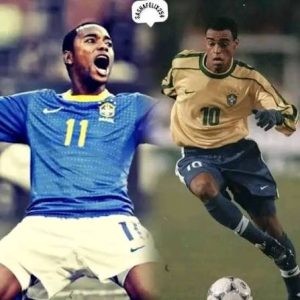
Robinho — the heir who never became the king
And then there was Robinho.
He arrived carrying an enormous burden: the next Pelé.
At Santos, the comparison became almost unavoidable. The tricks, the dribbling, the Brazilian swagger. He looked like another product of the country’s seemingly endless factory of entertainers.
Then came Real Madrid.
Manchester City.
AC Milan.
The talent was obvious.
The expectation was enormous.
But the career never quite reached the height that childhood football mythology had promised.
And yet Robinho belongs here because of what he represented.
The Brazilian factory was still producing magicians.
That is what fascinated us.
Every few years, another Brazilian appeared and seemed to announce that the old rules still did not apply.
Denílson entertained the defender.
Ronaldinho entertained the entire stadium.
Robinho carried the expectation of an entire football culture.
And somewhere between them was the strange Brazilian idea that football does not have to be merely efficient.
If you are going to win, why not make people remember how you did it?
Jay-Jay Okocha — when football became laughter
And then there was Jay-Jay Okocha.
If Ronaldinho made football mischievous, Okocha made it playful.
I have already mentioned him among the midfield magicians, but he belongs here too because Okocha was not simply trying to control a football match. He was trying to entertain the people watching it.
A defender stood in front of him.
Okocha saw an opportunity.
Not necessarily to pass.
Not necessarily to score.
To do something.
A stepover. A feint. A drag-back. A sudden turn. A body movement that sent the defender in one direction while the ball went somewhere else.
The Ugandan commentators who claimed that Okocha shot a 45kg missile was not giving us physics. He was giving us mythology.

Because for African children watching European football, there was something psychologically powerful about seeing Okocha command attention through skill and imagination.
George Weah had shown that an African could become the world’s best footballer.
Okocha showed that an African could become the entertainer.
The magician.
The man people paid to watch.
And perhaps that is why his name was repeated twice.
Jay-Jay.
As though one Jay was insufficient.
Ronaldo Nazário — when the entertainer became a weapon
Ronaldo Nazário belongs here for a different reason.
He was not an entertainer in the same way as Ronaldinho or Okocha. His tricks were not performed simply for the pleasure of humiliating a defender.
They were weapons.
The stepovers had a destination.
The acceleration had a purpose.
The body feint was followed by destruction.
Ronaldo could receive the ball and suddenly turn a football pitch into open countryside.
One second there were defenders.
The next second there was Ronaldo running away from them.
That is why his 1996–97 Barcelona season became so mythological. The famous goal against Compostela is almost impossible to describe without sounding like an exaggeration: Ronaldo receives the ball, accelerates through challenges, survives tackles, keeps going and finishes.
The defender thinks he has stopped him.
He hasn’t.
Another arrives.
Still not enough.
And suddenly the Brazilian is in front of the goalkeeper.
This was not simply dribbling.
It was physical impossibility.
Ronaldo seemed to possess a temporary exemption from the laws governing ordinary footballers.
Then jump to 2002.
The boy with the strange haircut had become a world champion.
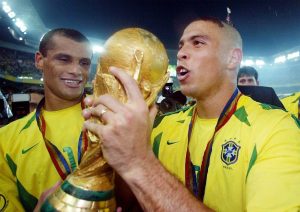
And somewhere in Uganda, schoolboys were cutting their hair like him.
That is when you realise football is not merely sport.
It is culture crossing oceans.
Lionel Messi — when the magician became a system
Then came Lionel Messi.
Messi complicates my argument because he belongs simultaneously to almost every category.
Midfielder.
Forward.
Entertainer.
Goal machine.
Playmaker.
And eventually, something even stranger: an entire football system concentrated inside one human being.
Messi could dribble.
Pass.
Score.
Assist.
Control.
Accelerate.
Stop.
Start again.
He could receive the ball in the middle of a crowd and somehow emerge with it still attached to his feet.
But what made Messi extraordinary was not merely that he could do spectacular things.
It was the frequency.
The impossible became routine.
A hat-trick stopped being shocking.
A solo goal stopped being shocking.
A 30-goal season stopped being shocking.
Then 40.
Then 50.
Then another season.
And another.
This is where the mythology of my generation begins to change.
With Ronaldinho, we waited because something might happen.
With Ronaldo Nazário, we waited because the defence might disappear.
With Okocha, we waited because someone might be embarrassed.
With Messi, we eventually reached a strange place where we almost expected the impossible.
And perhaps that is one reason Messi and Cristiano Ronaldo mark the end of this era.
They did not merely become legends.
They industrialised greatness.
Cristiano Ronaldo — when the footballer became a machine
And then there was Cristiano Ronaldo.
If Messi was the magician who made impossible things look natural, Cristiano became something different: the human being who tried to turn himself into an instrument of perfection.
Speed.
Strength.
Jumping.
Heading.
Finishing.
Training.
Diet.
Recovery.
Repetition.
Discipline.
Where Ronaldinho seemed to ask, “What can I do with this ball?”
Cristiano seemed to ask:
“What can I turn myself into?”
And he kept improving the answer.
That is why Cristiano is central to the argument about the end of organic football.
Because he was perhaps the first great football superstar of my generation whose mythology increasingly existed alongside measurement.
Goals.
Assists.
Champions League records.
Sprint speeds.
Minutes.
Fitness.
Longevity.
Records upon records.
He became both footballer and statistic.
And yet, strangely, millions of children still copied his celebration.
They did not need an algorithm to tell them that Cristiano was special.
They saw him.
They knew.
The African footballer stopped asking for permission
There is something almost invisible that happened between Roger Milla and Mohamed Salah.
We rarely talk about it because revolutions become ordinary once they succeed.
Milla arrived on the world stage and made people look twice.
Weah arrived and made them reconsider.
Eto’o and Drogba arrived and made African football impossible to ignore.
Then Salah and Mané arrived, and something even more profound happened:
Nobody was surprised.
That may be the greatest victory of all.
When Salah scored, season after season, Liverpool supporters were not talking about whether an African could carry a European giant. They were talking about goals. Assists. Records. Champions League nights. Premier League titles.

The question had changed.
That is what progress looks like.
Not applause.
Expectation.
We no longer needed the European football establishment to tell us that Salah was exceptional before we believed it. We had already inherited the memory of Weah, Okocha, Kanu, Drogba, Eto’o, Yeboah, Milla, Abedi Pele and the others.
The psychological wall had been breached.
And perhaps this is why African football occupies such a strange place in the story of my generation.
We grew up watching European football through television screens while living thousands of kilometres away from the stadiums where these men played. We had never touched Old Trafford. We had never stood inside San Siro. We had never walked through the Santiago Bernabéu.
Yet somehow those places became part of our childhood geography.
A boy in Bushenyi could know the streets of Manchester better than the streets of some Ugandan towns.
He could pronounce Pernambucano before he could explain where Pernambuco was.
He could identify a Nigerian defender from his hairstyle before he knew the name of the Nigerian state he came from.
He could argue about whether Ronaldo was better than Henry while having no realistic possibility of ever seeing either man in person.
That was the power of television.
But there was something else.
The football card.
The bubble gum.
The sweets.
The little pieces of paper that carried European football into African classrooms.
You opened the wrapper, and there was a face.
Oliseh.
McCarthy.
Okocha.
Kanu.
Uche Okechukwu.
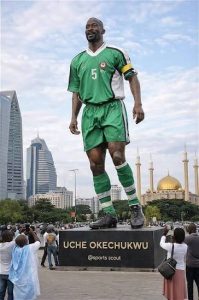
Sometimes the card was worth more than the sweet.
We studied those photographs.
The hair.
The muscles.
The boots.
The shirt.
The expression.
Football statistics were not yet the dominant language of fandom. We had no xG charts to tell us whether a striker had exceeded expectations. We did not have heat maps showing where a midfielder had moved. We did not have algorithms explaining why a player was valuable.
We had memory.
And memory is a dangerous statistic.
It does not always remember the best player.
It remembers the player who made us feel something.
That is why Uche Okechukwu’s thighs survive in my memory.
Why Taribo West’s green beads remain.
Why Oliseh’s long-range shot against Spain still feels louder than many goals scored by players with greater statistical careers.
Why Okocha remains Okocha.
Why Ronaldinho can disappear from the summit of football and still remain one of the first names a child mentions when asked what football looked like when it was beautiful.
And why Ronaldo Nazário’s haircut got a Ugandan schoolboy into trouble.
These are not footnotes.
They are the real archive.
We were watching ourselves
Perhaps the deepest thing African football gave my generation was not entertainment.
It was permission.
Permission to imagine.
The colonial imagination had spent generations organising the world into centres and margins: Europe was modern; Africa was catching up. Europe produced the institutions; Africa consumed them. Europe produced the great footballers; Africa occasionally produced an extraordinary exception.
Then a Liberian won the Ballon d’Or.
A Ghanaian became the creative heart of a Champions League-winning Marseille.
A Nigerian became an Olympic champion after helping defeat Brazil and Argentina.
A Cameroonian became the face of the World Cup’s African revolution.
An Ivorian striker became the emotional centre of Chelsea.
A Senegalese forward defeated the reigning world champions.
A Nigerian playmaker made defenders dance.
A South African scored against Manchester United in the Champions League.
And eventually an Egyptian and a Senegalese forward became central figures in one of England’s greatest modern clubs.
Something had changed.
The African footballer was no longer merely entering European football.
He was helping define it.
And perhaps this is why those names felt so large to us.
They were not simply footballers.
They were arguments.
Weah was an argument.
Okocha was an argument.
Drogba was an argument.
Eto’o was an argument.
Milla was an argument.
Sadio Mané is an argument.
Salah is an argument.
Every time one of them walked onto a European pitch, something larger than ninety minutes was being negotiated.
Who gets to be brilliant?
Who gets to be beautiful?
Who gets to be the protagonist?
Who gets to be remembered?
For centuries, Africa was accustomed to being described by other people. Our landscapes were named. Our histories were classified. Our cultures were interpreted. Even our bodies were turned into objects of European fascination and control.
Then an African footballer walked into the world’s most watched stadiums and said something without saying it:
Watch me.
And the world did.
But then something changed
This is where the story becomes uncomfortable.
Because perhaps the golden age I am mourning was not simply a golden age of football.
Perhaps it was a golden age of attention.
There were fewer global stars.
So the stars felt larger.
There were fewer television channels.
So the match felt like an event.
There was no social media algorithm continuously feeding us thousands of clips.
So when Ronaldinho did an elastico, we waited for the replay.
When Roberto Carlos bent a free kick, we talked about it at school the following morning.
When Okocha humiliated a defender, the story travelled by word of mouth, radio, television and playground.
Scarcity created mythology.
Today, there is no scarcity.
There is abundance.
Every player has highlights.
Every match has clips.
Every touch can become a statistic.
Every teenager with a spectacular goal can become a viral sensation before he has played ten senior matches.
The gods have multiplied.
And strangely, when there are too many gods, none of them feels quite divine.
That may be the contradiction at the heart of modern football.
The game has become technically richer. Players are fitter. Faster. More tactically disciplined. Nutrition is better. Sports science is better. Recovery is better. Analysis is better.
So why does it sometimes feel poorer?
Why can I watch a football match containing extraordinary athletes and still miss the feeling produced by one man standing over a free kick?
Why do I sometimes know a player’s statistics without knowing his personality?
Why can a footballer have millions of followers and leave almost no cultural imprint?
Maybe the problem is not that football stopped producing great players.
Maybe football stopped giving us enough time to turn players into myths.
And that brings us back to Manchester United.
Because if I am honest, Manchester United was not merely the club I supported.
It was the place where many of these gods appeared to gather.
And for a boy watching from Uganda, Old Trafford became something almost mythological.
The football world seemed impossibly crowded with giants.
Which raises the question I have been avoiding.
What happened to them?
Where did the gods go?
Or perhaps the more uncomfortable question is this:
Did the gods disappear — or did we simply grow old?
The football map in our heads
And so, as children, we were not simply watching matches.
We were building a mental map of the world.
Brazil meant magic.
Argentina meant rebellion.
Italy meant defence.
Germany meant discipline.
France meant power and technique.
Spain meant possession.
Netherlands meant ideas.
England meant drama.
Portugal meant craft.
Nigeria meant swagger.
Cameroon meant defiance.
Ghana meant possibility.
Ivory Coast meant power.
Croatia meant midfield intelligence.
And these identities were not invented in classrooms.
They were learned through faces.
Through commentary.
Through shirts.
Through hairstyles.
Through World Cups.
Through Champions League nights.
Through arguments at school.
Through radio broadcasts hidden from teachers.
Through bubble-gum cards.
Through the little football pitches where one child became Ronaldo and another became Okocha and somebody unfortunate was always forced to play goalkeeper.
We were children in Uganda.
But our football imagination had no borders.
That was the extraordinary contradiction.
Our bodies were local.
Our football imagination was global.
And perhaps that is why the football of the 1990s and 2000s feels, in retrospect, like a collection of civilisations rather than merely leagues and tournaments.
Every nation seemed to bring a philosophy.
Every philosophy produced characters.
Every character carried a story.
And every story gave a child somewhere in Africa another possibility for imagining himself.
Then something happened.
The national identities did not disappear.
The players did not disappear.
The football became faster, richer, more scientific, more connected.
But the boundaries between the civilisations began to blur.
Brazil became less recognisably Brazilian.
England became more tactically European.
Spain’s possession became a global coaching language.
African players became completely normal at Europe’s biggest clubs.
And the global game began producing something new:
not football civilisations, but a football civilisation.
One system.
One market.
One language.
One enormous machine.
Which brings us back to the question that has been haunting this whole memory:
Where did the gods go?
Maybe they did not disappear.
Maybe we built a world in which there was no longer enough distance between them and us for them to look like gods.
The Ronaldo–Messi Age: The Last Giants
There is something almost unfair about the Ronaldo–Messi era.
We did not merely watch two great footballers. We watched two competing definitions of greatness develop in real time.
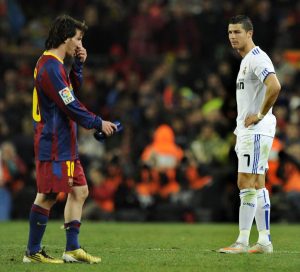
Cristiano Ronaldo arrived as a skinny, extravagant winger at Manchester United; stepovers, tricks, long hair, vanity. Then he became something else: a footballing machine that seemed to understand his own body as an instrument. Speed became strength. Strength became elevation. Elevation became goals. Goals became records.
Messi arrived differently.
He seemed almost too small.
And then he touched the ball.
Suddenly the defender’s body, the pitch, the angle of the goal, the distance between two players — all these things seemed to lose their solidity. Messi did not overpower space. He rearranged it.
Ronaldo attacked the goal.
Messi attacked the geometry between people.
But perhaps the extraordinary thing was not either man individually.
It was that history placed them together.
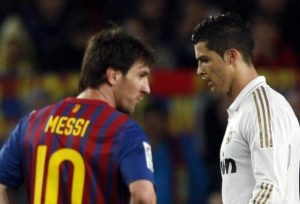
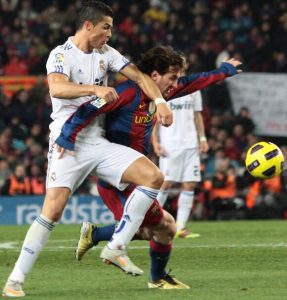
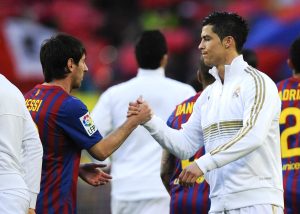
Barcelona and Real Madrid. Spain. El Clásico. Ballon d’Ors. Champions League nights. Records. Arguments. Children choosing sides.
Messi or Ronaldo?
The question became almost religious.
You were not simply choosing a footballer. You were choosing a philosophy.
Was greatness natural genius or manufactured discipline? Was the perfect footballer the one who seemed to discover solutions nobody else could see, or the one who transformed himself through obsession into the most complete physical specimen the game had ever seen?
And the maddening thing was that both arguments kept producing evidence.
Messi could score four.
Ronaldo could score four.
Messi could dribble through half a team.
Ronaldo could leap above a defensive line and appear to hang in the air.
Messi could make a football match look like a mathematical problem solved by instinct.
Ronaldo could make the penalty box look like a laboratory in which every weakness had already been identified.
They were not opposites.
They were two different answers to the same question.
What can a human being become with a football?
And then came the records.
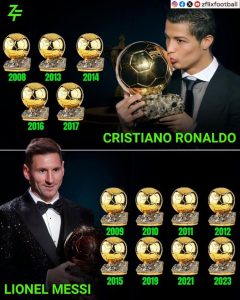
At first, records still felt like records. Someone scored 30 goals, and we were impressed. Someone scored 40, and the number became extraordinary. Someone reached another Champions League milestone, and commentators talked about history.
Then Messi and Ronaldo began breaking records so frequently that the language itself became exhausted.
He broke the record.
Then broke another.
Then broke the record he had just broken.
A hat-trick became normal.
A 50-goal league season became something we could actually imagine.
Champions League knockout stages became laboratories for impossible numbers.
And this is where something strange happened.
They made the extraordinary ordinary.
That may be their greatest statistical achievement — and perhaps their greatest cultural tragedy.
Because when the impossible becomes routine, does it remain impossible?
We watched them produce numbers that would have sounded like video-game statistics to an earlier generation. But because we saw it happen every week, the numbers gradually lost some of their magic.
The machine had begun measuring the magician.
And then there was the rivalry.
For years we were invited into the argument: Messi or Ronaldo?
But why did we need to choose?
Perhaps because football had never given us such a convenient historical duel. Two men. Two clubs. Two bodies. Two personalities. Two styles. Two enormous statistical records.
And the rivalry fed itself.
Every goal became evidence.
Every trophy became evidence.
Every Ballon d’Or became evidence.
Every failure became ammunition.
The mountain became enormous because there were two climbers standing at the summit at the same time.
Ronaldo needed Messi.
Messi needed Ronaldo.
Not because either man was incomplete without the other, but because greatness requires resistance. A solitary genius can become a legend. Two geniuses competing across the same historical landscape become mythology.
And then came the question that had followed them for years:
What about the World Cup?
For Messi, the answer finally arrived in 2022.
Argentina. France. Lusail.
Three goals in the final. Penalties. World champions.
And suddenly the photograph existed.
Messi holding the World Cup.
The boy from Rosario who had spent so much of his career being measured against Maradona had finally acquired his own image of Argentine immortality.
There is something almost primitive about the power of that photograph.
The ball disappears.
The statistics disappear.
The sponsorships disappear.
What remains is a man holding a trophy.
A nation looking at him.
History looking back.
Ronaldo’s story remained different.
Portugal won Euro 2016, but Ronaldo was injured during the final and spent much of the match watching from the touchline. His international career became enormous in another way: goals, longevity, records, tournaments, leadership, the extraordinary persistence of a player refusing to become old.
But the World Cup remained beyond him.
And perhaps this is where mythology becomes more interesting than statistics.
Because legends are not always built from complete stories.
Sometimes they are built from what remained just beyond reach.
Achilles has his heel.
Icarus has the sun.
Maradona has his contradictions.
Ronaldo has the World Cup that never came.
The missing piece does not necessarily destroy the myth.
Sometimes it gives the myth its wound.
And wounds are memorable.
The Last Bridge
This is why I think the Ronaldo–Messi era was different from what came before and what came after.
They became global myths during a peculiar historical window.
Television was still powerful enough to give millions of people the same images.
The internet had become powerful enough to make those images global.
Social media existed, but had not yet completely atomised attention.
A footballer could still become a common reference point across continents.
A child in Kampala could know exactly what Ronaldo’s haircut looked like.
A child in Lagos could imitate Ronaldinho.
A child in Buenos Aires could argue about Messi.
A child in Manchester could hate both Barcelona and Ronaldo for completely different reasons.
The world was becoming digital without yet becoming completely fragmented.
Ronaldo and Messi were the bridge.
They connected the old football mythology to the new digital football culture.
And perhaps that is why their departure feels larger than the retirement of two footballers.
When they left the central stage, something else disappeared with them.
Not greatness.
Not talent.
Something harder to define.
Shared recognition.
And Then the Game Became Organic
Before we had dashboards, we had faces.
Before expected goals, we had expectation.
Before tracking data, we had memory.
Before algorithms told us where a winger should stand, we watched Ronaldinho stand somewhere completely irrational and waited.
Before analysts calculated the probability of a free kick, Juninho placed the ball thirty-five metres from the goal and made an entire stadium believe.
Before databases classified players, we classified them ourselves.
Beckham bends it.
Carlos destroys it.
Okocha entertains.
Henry runs.
Drogba rises.
Raúl appears.
Inzaghi is always offside.
Ronaldinho smiles.
Ronaldo explodes.
Messi dribbles.
You did not need a spreadsheet.
You had memory.
And this is what I mean by organic football.
Not football without tactics. Not football without training. Not some imaginary golden age in which players wandered onto the pitch and invented the game spontaneously.
Organic football means something more human: the player was still larger than the system used to measure him.
The footballer had a signature.
A movement.
A weakness.
A strange habit.
A particular kind of arrogance.
A celebration.
A haircut.
A relationship with the ball that could not be completely replicated.
The modern player may be better prepared than almost anyone who came before him.
Better nutrition.
Better recovery.
Better biomechanics.
Better tactical education.
Better medical support.
Better data.
Better everything.
And yet I sometimes wonder whether football has become better at producing elite athletes than it is at producing mythological characters.
That is a dangerous distinction.
Because mythology does not emerge from perfection.
It emerges from strangeness.
Maradona was strange.
Ronaldinho was strange.
Okocha was strange.
Zidane was strange.
Ronaldo Nazário was strange.
George Weah was strange.
They did not look like products from the same factory.
They looked like accidents of history.
One had a particular body.
Another had a particular walk.
Another had an impossible hairstyle.
Another moved as though gravity had been negotiated in advance.
Their imperfections were not always weaknesses.
Sometimes the imperfection was the identity.
And perhaps that is what professional football has gradually become uncomfortable with.
The modern footballer is optimised.
The old footballer was recognisable.
Those are not necessarily the same thing.
From Footballers to Data Points
The transformation becomes obvious when we look at what we now ask about a player.
How many goals?
How many assists?
Expected goals?
Progressive carries?
Pressing intensity?
Pass completion?
Shot-creating actions?
Distance covered?
Sprint speed?
Possession value?
Heat maps?
Every question produces another number.
And numbers are useful.
Of course they are.
They can reveal things the eye misses. They can expose our prejudices. They can show that a player we thought was brilliant was actually inefficient, or that a player we barely noticed was quietly controlling matches.
But measurement has a strange appetite.
Once we can measure something, we begin to treat the measurement as the thing itself.
A footballer becomes a profile.
Then a rating.
Then a transfer value.
Then a statistical comparison.
Then an asset.
Then a market opportunity.
The person disappears beneath the spreadsheet.
And perhaps this is where the footballer begins to resemble the modern worker.
We have become obsessed with optimisation.
Measure the body.
Measure the productivity.
Measure the output.
Measure the recovery.
Measure the risk.
Measure the market value.
Measure the attention.
Measure everything.
But what happens to the thing that cannot be measured?
The gasp.
The anticipation.
The ridiculousness.
The feeling that something might happen because this particular man has the ball.
And Then Came Betting
Football was once a spectacle.
Then it became content.
Then it became data.
And somewhere along the way, it became a giant prediction machine.

Who scores first?
How many corners?
How many cards?
Over or under?
Both teams to score?
Correct score?
First goalscorer?
The football match becomes thousands of possible transactions.
A goal is no longer merely a goal.
It changes odds.
A corner is no longer merely a corner.
It changes odds.
A yellow card becomes information.
A substitution becomes information.
The match itself becomes a market moving in real time.
And the fan is transformed into something else.
Not merely a spectator.
A participant in the financial interpretation of the game.
This matters because anticipation changes when money enters it.
The question is no longer only:
What will happen?
It becomes:
What will happen, and what will happen to my money if it does?
That is a different psychological relationship with football.
And perhaps this is one reason modern football can feel strangely less innocent.
The old child waited for Ronaldinho to do something absurd.
The modern spectator may be watching the same player — while simultaneously watching a probability.
The magician has become an event inside a market.
Then the Machine Learned to Watch
And now we have AI.
Artificial intelligence can watch thousands of hours of football.
It can identify patterns humans miss.
It can analyse player positioning, movement, passing networks, defensive structures.
It can predict.
It can compare.
It can recommend.
Soon enough, perhaps, a system will be able to tell us that a player is 87.4% likely to cut inside from a particular position, that a particular defender is 63% likely to step forward, that a particular free kick has a measurable probability of entering a particular area of the goal.
Wonderful.
Terrifying.
Because football’s deepest attraction was never simply that we didn’t know what would happen.
It was that we didn’t know what a particular human being might invent.
AI is extraordinarily good at identifying patterns.
But mythology begins where pattern becomes surprise.
The system says:
This is the optimal decision.
The magician says:
Watch this.
And perhaps the future of football will be a struggle between those two sentences.
What Did Measurement Do to Mythology?
This is the question I keep returning to.
Did statistics destroy football mythology?
No.
That would be too easy.
Statistics did something more complicated.
They changed the language through which we experience greatness.
The old language was sensory.
Look at his movement.
Look at his body.
Look at his touch.
Look at his face.
Listen to the commentator.
Remember that goal.
The new language is comparative.
His expected goals are higher.
His progressive carries are lower.
His pressing numbers are elite.
His output is declining.
His market value is rising.
And perhaps neither language is false.
But they produce different kinds of memory.
The old memory says:
I remember what he made me feel.
The new memory says:
I remember what his numbers were.
One produces stories.
The other produces rankings.
And rankings are useful.
But they are terrible places to bury childhood.
What Did We Lose?
Maybe we lost slowness.
Not the slowness of football itself.
The slowness of attention.
We once waited.
We waited for the free kick.
We waited for the striker to appear.
We waited for the commentator to scream.
We waited for Sunday.
We waited for the match.
We waited for the replay.
We waited for the newspaper the following morning.
Now everything arrives immediately.
The goal arrives on your phone before the television commentator has finished describing it.
The clip is edited before the celebration ends.
The reaction is online before the players have returned to the centre circle.
The argument begins before the referee has blown for full time.
Football has become almost permanently present.
And perhaps something becomes less precious when it is permanently available.
There is another loss.
Mystery.
When I was young, I did not know everything about a footballer.
I knew what I saw.
I knew the face.
The boots.
The movement.
The celebration.
Perhaps I knew the club.
Maybe the country.
That was enough.
Today we can know almost everything.
Age.
Weight.
Salary.
Contract.
Training data.
Injury history.
Social media posts.
Private opinions.
Family photographs.
Fitness statistics.
Transfer rumours.
The footballer is no longer simply seen.
He is continuously documented.
And perhaps myth requires distance.
You cannot worship what you can inspect every five minutes.
And Then There Is Grief
Perhaps this is where Manchester United enters the story.
Not as an argument about whether United are good or bad.
Not even as a tactical discussion.
Something more personal is happening.
When I watched Manchester United lose 2–0 to newly promoted Hull City on the opening day of the 2026/27 Premier League season, the embarrassment was real.
But beneath the embarrassment was something else.
Recognition.
I was looking at a football institution that belonged to the world in which my childhood football mythology had been constructed.
Ferguson.
Old Trafford.
Scholes.
Keane.
Giggs.
Beckham.
Van Nistelrooy.
Rooney.
Ronaldo.
The names were not merely players.
They were coordinates on a map of memory.
So when the institution struggles, something inside the former child also struggles.
Perhaps that is why football defeats can feel irrationally painful.
We are not only watching eleven men lose a match.
We are watching time defeat us.
The child who once moved closer to the television because Raúl had the ball is still somewhere inside the adult watching the match.
The boy who copied Ronaldo’s haircut is still there.
The child who opened bubble gum hoping to find Sunday Oliseh or Benni McCarthy is still there.
The young Manchester United supporter who feared Henry, admired Bergkamp, waited for Rooney and worshipped Ronaldo is still there.
But the football world that created those memories is gone.
And no amount of data can bring it back.
The Last Question
Maybe this is why I hesitate to say that football has lost its legends.
It hasn’t.
Mbappé is extraordinary.
Haaland is extraordinary.
Vinícius Júnior is extraordinary.
Lamine Yamal is extraordinary.
Others will come.
Perhaps one of them will become something greater than anything we have imagined.
But the question is not whether football still produces great players.
The question is whether it still produces the conditions under which greatness becomes mythology.
Can a player become mysterious when every movement is tracked?
Can a footballer become a childhood god when his every mistake is instantly dissected?
Can a player remain strange when an entire industry exists to optimise him?
Can a boy in Kampala still see a player on television, copy his hairstyle, run outside and spend the afternoon trying to reproduce his goal?
Or has football become too efficient to allow that kind of irrational love?
These are uncomfortable questions because they force us to separate progress from improvement.
Football is faster.
Football is richer.
Football is more scientific.
Football is more tactically sophisticated.
Football is more measurable.
But is it more memorable?
That is the question.
And perhaps the answer cannot be found in the Champions League statistics or the latest player-rating algorithm.
Perhaps it is found somewhere much smaller.
In a child sitting before a television.
In a sweet wrapper.
In a football card.
In a haircut.
In a commentator suddenly screaming a name.
In the silence before Juninho strikes the ball.
In the moment Ronaldinho smiles.
In the instant Ronaldo begins running.
In the second Messi receives the ball and three defenders realise they have made a mistake.
That is where football mythology lived.
Not inside the numbers.
Inside us.
And perhaps that is why I am grieving.
Not the death of football.
Not even the death of legends.
I am grieving the disappearance of a particular way of believing in football.
The world I grew up in allowed a footballer to become larger than his statistics.
It allowed him to become a character.
A hero.
A villain.
A magician.
A nightmare.
A prince.
A warrior.
A god.
And then, one day, we grew older.
The gods grew older with us.
Ronaldo and Messi left the centre of the stage.
The next generation arrived.
And the child remained seated before the television, waiting.

Still waiting.
Because perhaps this is the secret football has always known:
Every generation believes its legends are the last ones.
And every generation is wrong.
Or perhaps we are witnessing something genuinely different.
Perhaps the legends are not disappearing.
Perhaps we are losing the cultural conditions that allow us to recognise them as legends.
That distinction matters.
Because the question is no longer simply:
Who will be the next Messi?
It is: Will the next Messi ever be allowed to become a Messi?