



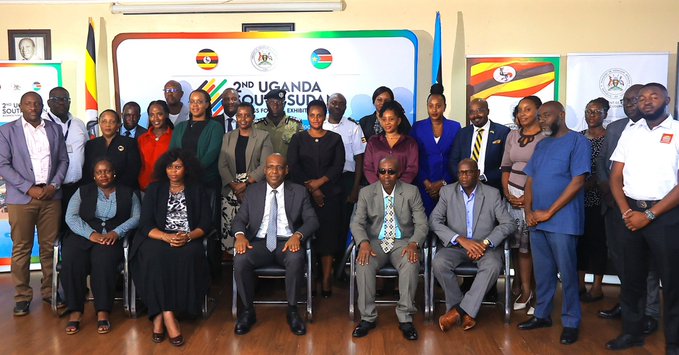
Uganda and South Sudan are seeking to deepen trade and investment ties as the two countries prepare to hold the second Uganda–South Sudan Business Forum in Kampala from October 13–15.
The forum, organised under the theme, “Easing the Cost of Doing Business and Unlocking Regional Market Opportunities for Uganda and South Sudan,” will bring together government officials, private-sector players and business communities from the two countries at Mestil Hotel.
Speaking at the launch of the forum in Kampala, Ambassador Charles Ssentongo, Director of Protocol Services at the Ministry of Foreign Affairs, said bilateral trade between Uganda and South Sudan has grown significantly, but more needs to be done to remove barriers affecting businesses.
Ssentongo, who spoke on behalf of the Ministry’s Permanent Secretary, said available data indicates that trade between the two countries has risen from about $490 million in 2024 to approximately $700 million, although the figures are still being finalised.
“We estimate that right now we are trading at around $700 million in terms of exports to South Sudan, which is a big leap from $495 million by 2024,” Ssentongo said.
He said the two countries would use the forum to identify specific measures for increasing trade, with targets expected to be announced at the end of the meeting.
“At this stage I wouldn’t want to preempt that to NTV, to be fake news, so you wait at the end of the forum and you get the figures,” he said.
Ssentongo said Uganda and South Sudan should address both regulatory and infrastructure challenges that continue to affect cross-border trade, including non-tariff barriers, taxation and customs procedures.
He cited cooperation between the Uganda Revenue Authority (URA) and South Sudan’s revenue authorities as one area that has helped improve the clearance of goods and address smuggling.
“We need to build on such efforts to be able to be visible and relevant to the cooperation,” he said.
Ssentongo also urged Ugandan traders to understand and comply with South Sudanese regulations instead of assuming that trade across the border involves simply “walking across.”
“There are stringent and sovereign regulations which have been put in place by the government of South Sudan, which have to be observed,” he said.
He said Uganda must similarly ensure that its regulations are clearly understood and that non-tariff barriers on its side are addressed.
The forum will also place bilateral trade within the wider East African Community market, with Ssentongo saying Uganda and South Sudan should exploit opportunities presented by their membership in the regional bloc.
“We also have to look at it in the wider context of the East African Community. Both our countries are leading and important members of the East African Community,” he said.
Ssentongo said the two governments were not starting from scratch, pointing to previous agreements and commitments made by their leaders to improve trade relations. “We are not starting from zero. Let us see where we are,” he said.
Brig Gen Bonny Bamwiseki, Defence Attaché and Head of Mission at the Uganda Embassy in Juba, said Uganda and South Sudan share historical ties that should be strengthened through increased business cooperation.
He said Uganda has significant commercial interests in South Sudan in agriculture, manufacturing, construction materials and services, particularly education and healthcare.
The embassy, he said, has intervened on several occasions to facilitate trade, including during a maize crisis when Ugandan maize was temporarily barred from entering South Sudan and in recent discussions concerning scrap materials.
Bamwiseki also cited the joint Uganda–South Sudan border meeting held in Arua and Gulu in July 2026, which focused on trade, customs, security, migration and social affairs.
Akuol Abijok Deng, Chargé d’Affaires and representative of the South Sudan Embassy in Kampala, said the relationship between the two countries was built on shared borders, history and economic interests.
She said reducing the cost of doing business required addressing delays at borders and limited access to finance.
“High costs, delays at the border and limited access to finance. Addressing them is not only an economic task; it is how we build resilience, create jobs and strengthen our regional integration,” Deng said.
She urged the two governments to simplify procedures, improve transparency and strengthen cross-border systems, while calling on the private sector to invest, innovate and form partnerships.
The forum is expected to provide businesses from both countries with an opportunity to explore investment opportunities, establish partnerships and discuss measures for increasing bilateral trade.
The organisers have invited businesses from Uganda and South Sudan to participate in the three-day forum and present proposals on challenges affecting cross-border commerce and opportunities for investment.