



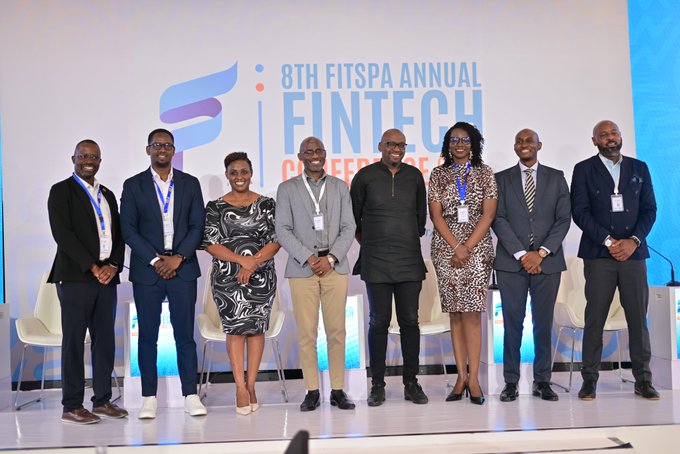
KAMPALA — Uganda’s financial technology sector has called for stronger collaboration, shared digital infrastructure, interoperable systems and increased investment in talent and innovation as the industry seeks to expand access to digital financial services and support economic growth.
The call was made during the 8th FITSPA Annual Fintech Conference, which opened Tuesday at Sheraton Kampala Hotel under the theme, “Scaling Fintech Innovation for Inclusive Growth and a Resilient Digital Economy.”
The two-day conference brings together fintech founders, financial institutions, technology companies, investors, regulators, policymakers and development partners to discuss the future of Uganda’s digital financial ecosystem.
Opening the conference, Vincent Tumwijukye, Chairperson of the Financial Technology Service Providers’ Association (FITSPA) and Co-Founder and CEO of FutureLink Technologies, said Uganda’s ambition to achieve a tenfold expansion of its economy would require more than incremental improvements.
He identified talent, high-risk capital and informed media as three areas requiring greater attention if the fintech sector is to support the country’s growth ambitions.

Tumwijukye also called for stronger regional integration, saying fintech businesses should look beyond Uganda’s borders and take advantage of opportunities in East African markets.
“Uganda cannot make this journey alone,” he said, urging stakeholders to collaborate, invest in talent and create an environment where innovation can thrive.
He said Uganda’s fintech ecosystem had already demonstrated its ability to innovate but needed stronger support systems to help businesses connect with customers, access finance and expand.
“The future is bigger than any one market, institution or sector,” Tumwijukye said.
Albert Gitta, Chief Technology Officer at MTN Uganda, said Uganda’s digital financial ecosystem had evolved significantly from predominantly cash-based transactions to a system where people can use mobile phones to receive payments, pay suppliers and meet household expenses.
However, Gitta said the next stage of growth would depend on building trust, resilience and partnerships rather than simply increasing transaction volumes.
“Trust is the first product; it takes years to build but only moments to damage,” he said, pointing to security, reliable infrastructure, consumer education and strong agent networks as critical to the sector.
“The future of fintech will not be built by one bank, one fintech, one telecom operator, one technology company, or one regulator. It will be built together,” Gitta said.
Delivering the keynote address, Kenyan technology entrepreneur, investor and PANI Africa CEO Ken Njoroge reflected on his experience building Cellulant and navigating difficult periods, including the collapse of Chase Bank and a severe cash-flow crisis.
“Challenges are inevitable. What matters is how leaders and teams respond,” Njoroge said.
He also highlighted the importance of execution, recalling a project in which his team was challenged to deploy a digital platform across 35 countries within 90 days. “Any project that doesn’t deliver in 90 days becomes doubtful,” he said, noting that his team ultimately completed the deployment in 40 days.
Njoroge urged African entrepreneurs to focus on solving real problems and creating sustainable value rather than treating scale as the primary objective. “Scale is not the starting point; it is the result of building businesses that create value, solve real problems and are sustainable to stand the test of time,” he said.
He also argued that Africa’s challenge is not simply a shortage of capital but how available capital is allocated. “Africa does not have a capital problem; it has a capital-allocation problem,” Njoroge said.
The conference also focused on the infrastructure required to support a more connected digital financial ecosystem.
Diana Akullu Wanyama, Acting Digital Economy Lead at Financial Sector Deepening Uganda, said digital infrastructure would be central to Uganda’s economic ambitions.

“Digital financial infrastructure is foundational. It is the technology and framework that allow interconnectivity and are key drivers of the Tenfold Growth Strategy,” she said.
Akullu said Uganda did not need to build separate infrastructure for every financial service but should make better use of existing systems and establish governance structures that allow different players to connect.
“We do not have to reinvent the wheel. We need to leverage the infrastructure that already exists and put in place the appropriate governance structures to ensure that it works effectively for all participants,” she said.
Japhet Aritho, Managing Director of Airtel Money Uganda, called for the sector to scale access, innovation and resilience.

He said fintech businesses should develop solutions around sectors such as agriculture, tourism, minerals and science and technology while strengthening cybersecurity and interoperability.
“Most of our fintechs are just one fraud away from coming down,” Aritho said, calling on companies to build, integrate and scale.
Dennis Kahindi, Broadband Director at Airtel Uganda, also highlighted the importance of reliable infrastructure, noting that 99.9 percent uptime still translates into approximately 8.76 hours of downtime annually.
“The data centre is becoming part of the financial product itself,” Kahindi said.

During a panel on building a digital financial ecosystem that works for everyone, Airtel Money Head of Operations Ekudu Hope said the next phase of mobile-money growth would require simpler and more reliable merchant payments.
Patience Kikoni, Director of Products at Financial Sector Deepening Uganda, called for greater consumer education and trust, as well as incentives that provide tangible value to merchants.
Arwakatungu, Founder and CEO of Intelligent Tyms, said fintech companies should look beyond payments and focus on helping small businesses generate income.
“For SMEs and micro-SMEs, payments are not the problem. Their problem is they want to make money,” he said.

The discussions also highlighted the need for common technical standards, interoperable payment systems, data-sharing capabilities and shared infrastructure, alongside stronger cybersecurity and appropriate regulation.
FITSPA said the conference is intended to provide a platform for industry players and regulators to identify practical ways of strengthening Uganda’s digital financial ecosystem and ensuring that fintech growth contributes to wider economic participation.