



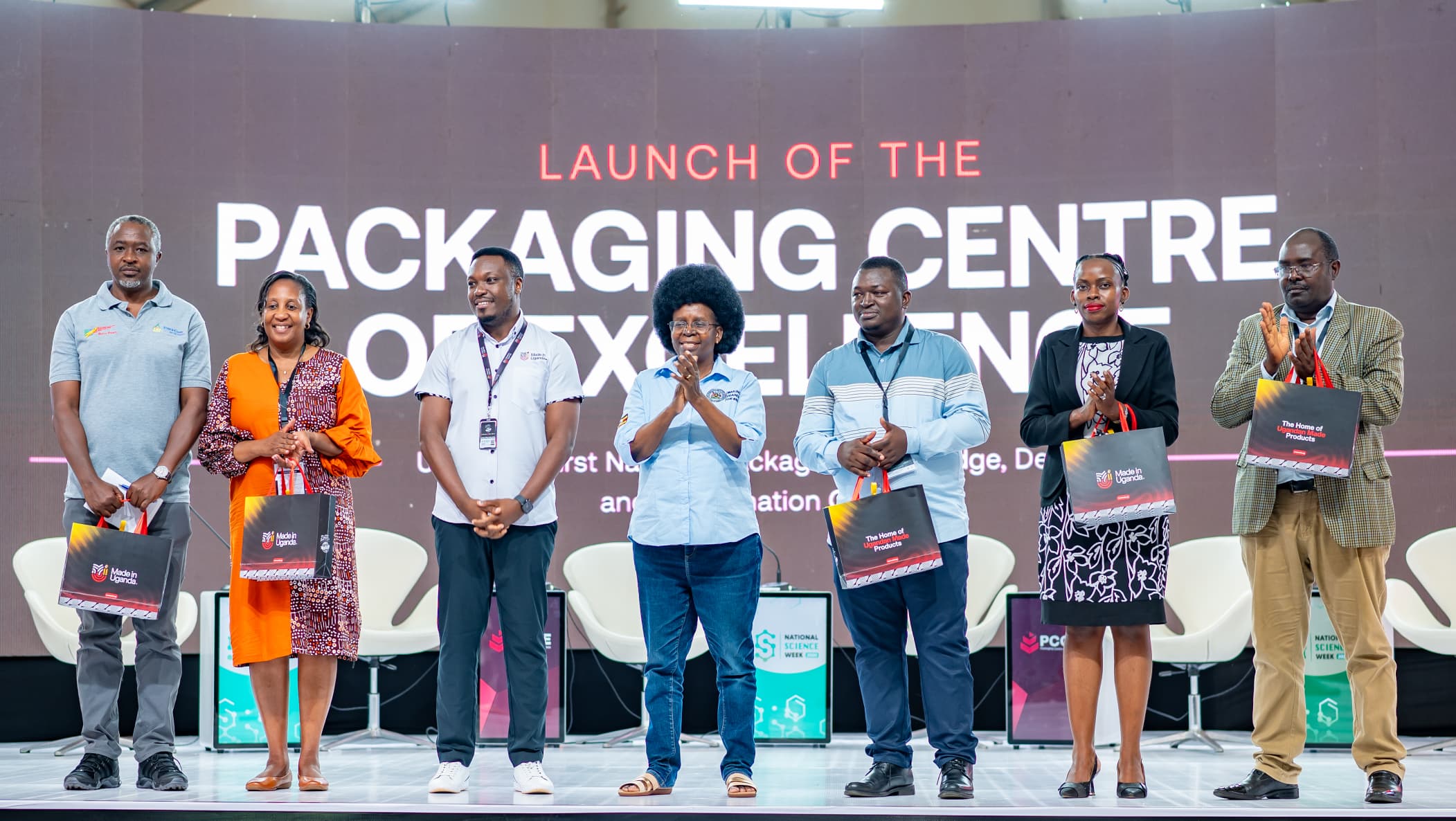
Kampala — Uganda has officially launched the Packaging Centre of Excellence (PCOE), a new national facility aimed at improving product branding, packaging standards, and market readiness for locally made goods, with government officials describing it as a pioneering step for Africa’s innovation ecosystem.
The launch, held at Kololo Independence Grounds during the National Science Week on May 2, 2026, was presided over by the Minister for Science, Technology and Innovation, Dr Monica Musenero, alongside innovators, manufacturers, regulators, and industry stakeholders.
Officials at the event described the facility as the first structured packaging-focused centre of its kind on the African continent, designed to bridge the gap between product development and market competitiveness.

Dr Musenero said the initiative emerged after government analysis showed that innovation alone was not enough without strong market readiness systems.
“When we were beginning, we thought it was destined to be about research, about product development… but now we have taken a lot of analysis to see the scope of work it takes to take an innovative product to the market,” said Dr Musenero.
She emphasised that packaging had become a decisive factor in commercial success. “We have discovered that packaging is very, very important to market success and also market prosperity,” she added.

Dr Musenero noted that weak packaging had continued to limit Uganda’s ability to fully benefit from its innovation and manufacturing base, despite strong product development capacity. “This centre of excellence is a great innovation for us,” she said, officially launching the centre.
She further assured innovators that the centre would work closely with the Uganda National Bureau of Standards (UNBS) to align products with regulatory and market requirements.
Branding and Market Perception
Ms Cathy Muwumuza, Superintendent of Support Services at the Science, Technology and Innovation Secretariat in the Office of the President, said poor packaging remains one of the biggest barriers to Ugandan products competing globally.

“What breaks my heart is the fact that a brilliant product is packed as if it should go to trash, not to the shelf,” said Ms Muwumuza.
She stressed that packaging should be treated as part of the product itself. “Packaging is the product in whatever form—be it the material, be it the branding. Packaging is the product,” she said.
Ms Muwumuza warned that Uganda continues to lose market value due to presentation gaps rather than production quality. “We have world-class products… but because they are not packaged well, they are treated as substandard products,” she noted.

She also highlighted global consumer behaviour research showing that purchase decisions are made within seconds. “Research shows that seven seconds is when a client makes a decision whether to buy your product or not,” she said.
Industry Panel: Standards, Safety and Consumer Trust
During a technical panel discussion, experts from manufacturing, standards regulation, academia, and industry stressed that packaging plays a critical role in product safety, branding, and consumer trust.
Dr Ezra Muhumuza, an economist and Executive Director of the Uganda Manufacturers Association (UMA), said packaging must be designed with the consumer in mind. “When packaging, we need to consider what will be in the mind of the consumer as they receive the package,” said Dr Muhumuza.

Dr Frankline Mucunguzi, Senior Legal Metrologist at Uganda National Bureau of Standards (UNBS), emphasised compliance and accurate labelling. “The most important information to include on your packaging is the manufacturing date and the expiry date,” said Dr Mucunguzi.
He also cautioned against brand confusion. “Some people confuse their brand with the brand of the product. It’s important to differentiate the two when packaging your product,” he added.

Dr Julia Kigozi, Dean of the School of Food Technology, Nutrition and Bio-Engineering at Makerere University, warned about product contamination risks after processing. “Once a product is processed, it’s delicate. Every touchpoint after that risks contamination—that is why the right packaging is crucial,” said Dr Kigozi.
She added that environmental exposure can degrade quality. “Moisture, light, or gases can compromise the quality of a product if the packaging is inadequate,” she said.

Industry Voices and Market Readiness
Rosemary Kezaabu, Head of Sales and Marketing at Luuka Plastics Limited, urged producers to design packaging for end users and regulatory compliance. “Consider the product shelf life. Will your packaging preserve the product’s quality?” said Ms Kezaabu.
She added, “Always design the product packaging for the end user. Choose packaging that serves them.”

Mr Hillary Bainemigisha, Director of Forna Health Foods Limited, said packaging challenges are already affecting local companies’ competitiveness. “At Aunt Porridge, we’ve received five white-label offers. That’s a clear sign our packaging needs to improve,” said Mr Bainemigisha.
He welcomed the new centre, describing it as a long-awaited intervention. “The Packaging Centre of Excellence gives us an opportunity we didn’t have before in Uganda,” he said.

Access and Next Steps
Moses Byaruhanga, Venture Lead at Made in Uganda, said the centre, which will be based at UMA Showgrounds in Lugogo, will also provide product testing and advisory services.
“How to access the Packaging Centre of Excellence: have a Ugandan product, and we run a product test to assess the standard,” said Mr Byaruhanga.

He added that the platform will help address structural challenges facing Ugandan manufacturers and innovators.
The centre will support research-based packaging design, consumer testing, regulatory alignment, and material selection to help Ugandan products compete in regional and global markets.