


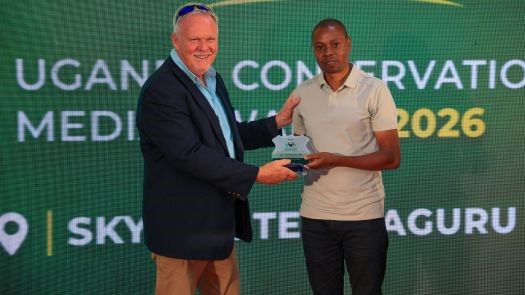
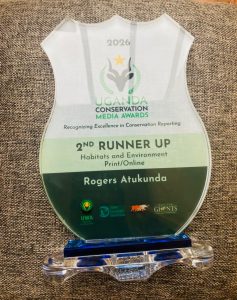
SoftPower News journalist Rogers Atukunda has been recognised as second runner-up in the Habitats and Environment category under the Print/Online category at the 2026 Uganda Conservation Media Awards.
Atukunda received the recognition for his feature story, Mabamba: Waiting in Silence with the Shoebill, which examines the conservation challenges facing the Mabamba Bay Wetland in Kasanje, Wakiso District, through the search for the elusive shoebill stork and the competing interests of wildlife protection and community livelihoods.
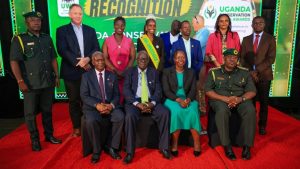
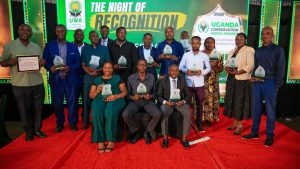
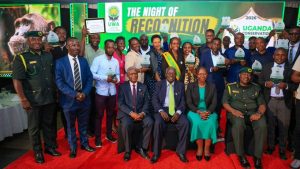
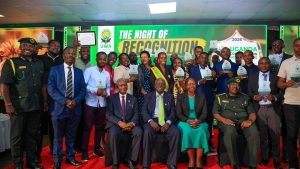
The fourth edition of the awards was organised by the Uganda Wildlife Authority (UWA) on November 26, 2026, at Skyz Hotel in Naguru, Kampala. It attracted 189 entries, with 23 journalists, photographers and digital content creators recognised for their work in conservation reporting.
The awards were presented by State Minister for Tourism, Wildlife and Antiquities Susan Nakawuki Nsambu, alongside senior government officials and UWA leaders.
Atukunda’s recognition came in a category that highlights reporting on ecosystems, biodiversity, environmental protection and the pressures affecting natural habitats.
His feature follows a search for the shoebill, one of Uganda’s most distinctive bird species, in Mabamba Bay Wetland, a Ramsar-listed site on the northern shores of Lake Victoria. Beyond the bird’s appeal to tourists and birdwatchers, the story examines the pressures on the wetland and the difficult relationship between conservation efforts and the livelihoods of communities that depend on its resources.
In her remarks at the ceremony, Minister Nakawuki said the media played an important role in shaping public attitudes towards wildlife and Uganda’s natural heritage.
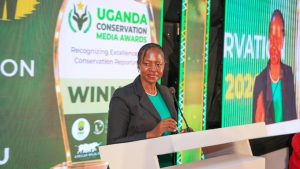
“Conservation journalism must go beyond promoting Uganda’s tourism attractions. It must get the threats facing our wildlife, including poaching, illegal wildlife trade, habitat degradation, climate change,” she said.
UWA Executive Director Dr James Musinguzi said wildlife conservation could not succeed without an informed and supportive public, describing the media as an important partner in building public understanding.
He commended journalists whose reporting had helped audiences appreciate the value of protected areas, the work of wildlife rangers, the contribution of wildlife to livelihoods and the national economy, as well as the challenges facing conservation institutions.
UWA Assistant Commissioner for Communications Bashir Hangi said the awards were established to recognise excellence in conservation journalism and encourage more journalists to report on wildlife and environmental issues.
“As UWA, we are committed to strengthening our relationship with the media through timely provision of information, facilitating field engagements and making our technical officers available to support accurate and informed reporting,” Hangi said.
He added that conservation reporting should not be limited to stories that portray institutions positively, saying investigative journalism and constructive criticism were necessary to strengthen accountability.
“Good journalism does not always tell the stories that institutions want to hear,” he said.
The awards recognised work in five categories: Wildlife Protection, Habitats and Environment, Wildlife Crime and Community Conservation, across print, online and broadcast platforms, as well as Wildlife Photograph of the Year.
Other journalists recognised included Trevor Lutalo of Daily Monitor, who won the Wildlife Protection Print/Online category, while veteran journalist Gerald Tenywa of New Vision received special recognition for his investigative reporting on Bugoma Forest.
Tenywa’s three-part investigation examined forest habitat destruction, threats to chimpanzees and concerns among communities living around the forest. The series highlighted the consequences of environmental degradation and raised questions about accountability in the management of natural resources.
Atim Eunice Brenda received recognition under the New Media category for using TikTok to take audiences beyond the scenic appeal of Entebbe Botanical Gardens and highlight conservation activities at the site.
The awards were supported by the Jane Goodall Institute, African Wildlife Foundation and Space for Giants.
Winners received Shs5 million, first runners-up Shs2 million and second runners-up Shs1 million, in addition to plaques.
Atukunda’s recognition adds to his recent journalism awards. In May 2026, he received a Digital Journalism Award from Inspire Africa Group for reporting on Uganda’s coffee value chain, exports and regional market expansion. He was also listed among the nominees for the Outstanding Business Reporter of the Year at the National Quality Awards 2026.
The Uganda Conservation Media Awards are part of UWA’s efforts to encourage media coverage of conservation, environmental protection and the challenges facing Uganda’s wildlife and natural habitats.