


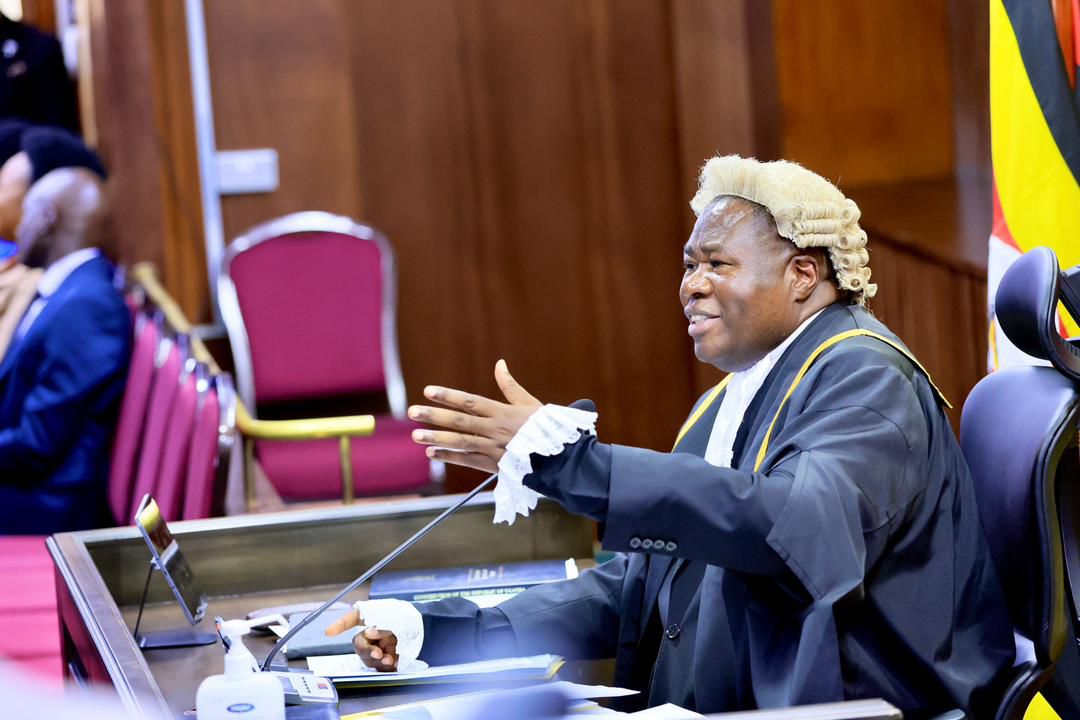
KAMPALA — Speaker Jacob Oboth-Oboth has announced a sweeping overhaul of Parliament’s internal spending structure, slashing funds previously controlled by the Speaker’s Office from more than Shs24 billion to Shs3.9 billion and redirecting the money to parliamentary committees in what he described as a “reset” aimed at strengthening oversight and fighting corruption.
Addressing Members of Parliament, Oboth-Oboth said the decision was intended to ensure committees have adequate resources to execute their constitutional oversight responsibilities without having to seek facilitation from the Speaker’s Office or from the government institutions they are mandated to scrutinize.
“The money that was being in the Office of the Speaker, Shs24 point something billion, we are resetting it back. That money is going to the committees,” Oboth-Oboth said.
He added that under the new arrangement, every parliamentary committee will be required to prepare a costed work plan, which will then be funded through the parliamentary budget.
“From this financial year, no committee of Parliament should lack money for its work,” he said.
The move marks one of the most significant administrative changes since Oboth-Oboth assumed the Speakership and effectively dismantles a discretionary funding structure that had been associated with the previous leadership of former Speaker Anita Annet Among.
Oboth-Oboth framed the changes as part of a broader campaign to restore Parliament’s independence and credibility, arguing that poorly facilitated committees are more vulnerable to influence from ministries, departments and agencies appearing before them.
“There is nothing demeaning as asking for kitu kidogo from those who are supposed to supervise,” he said.
According to the Speaker, Parliament cannot effectively hold public institutions accountable if legislators themselves are financially dependent on the entities they oversee.
“Parliament is the only place where accountability makes sense, and it starts with us,” he said.
The Speaker also issued a warning to accounting officers across government, saying Parliament would take Auditor General reports and Public Accounts Committee findings more seriously under his leadership.
“If you are a CAO, change your prayers. Be honest in what you do. You will come and go well,” he said.
“Factory Reset” for Parliament
Oboth-Oboth repeatedly described the reforms as a return to Parliament’s core constitutional role, saying the institution had drifted away from its primary mandate.
“We are resetting Parliament back to the factory default,” he said.
He told legislators that his office would no longer function as a center for donations and personal financial assistance.
“My office is not going to be a donation centre,” he said, adding that individuals seeking personal support should instead approach President Yoweri Kaguta Museveni, whom he jokingly described as “the chief donor of government.”
The Speaker emphasized that the new approach would prioritize institutional effectiveness over personal patronage, arguing that resources should be directed toward committee work rather than discretionary expenditures.
Questions Over Delayed Parliamentary Chamber
Oboth-Oboth also raised concerns about the prolonged delay in constructing Parliament’s new chamber, questioning why the project has remained unfinished more than a decade after it was initiated.
“A chamber taking from 2014 to date, unless you are building something else, but not that small Parliament,” he remarked.
The Speaker suggested that financial constraints were not responsible for the delays, noting that funds had already been appropriated through previous budgets and that some resources were reportedly still held on Parliament’s account at the Bank of Uganda.
He alleged that vested interests seeking kickbacks may have contributed to the slow progress.
“Me, a son of a peasant whom God has blessed to be a Speaker, what else can you do to me?” he said.
Setting the Tone
Oboth-Oboth said he had assumed office in good faith and intended to focus on restoring order, accountability and adherence to parliamentary procedures rather than exercising personal influence.
“We’ve done some resetting, so fear not. I have come in good faith,” he told MPs.
He emphasized that the Prime Minister, as Leader of Government Business, should be accorded the necessary support to steer government priorities through Parliament while maintaining respect for parliamentary rules and procedures.
The changes signal a significant shift in the management of Parliament’s finances and could reshape how committees conduct oversight in the coming years. By directing billions of shillings away from discretionary spending and into committee operations, Oboth-Oboth is betting that stronger institutional funding will reduce opportunities for corruption and restore public confidence in Parliament’s accountability role.