


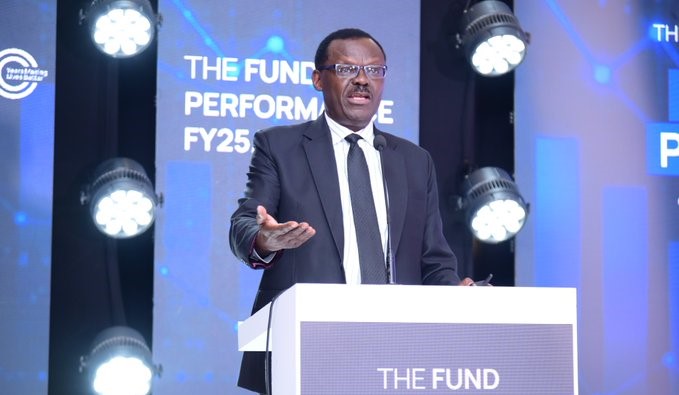
The National Social Security Fund (NSSF) assets under management rose by 26 percent to Shs32.8 trillion in the financial year 2025/26, up from Shs26 trillion the previous year, Managing Director Patrick Ayota has said.
Ayota said the Fund’s total income also increased by 85 percent, from Shs3.5 trillion in financial year 2024/25 to Shs6.51 trillion in 2025/26.
The figures were presented ahead of the Fund’s 14th Annual Members’ Meeting scheduled for next week. NSSF’s previous financial-year results showed assets under management rising from Shs22.13 trillion in 2023/24 to Shs26 trillion in 2024/25.
Ayota attributed the latest performance to the Fund’s investment strategy, with its portfolio at the end of the financial year comprising 76.5 percent fixed income, 18.4 percent equities and 5.1 percent real estate.
Of the Shs6.51 trillion income recorded during the year, Shs3.88 trillion was realised income, according to figures reported by Daily Monitor. Interest from government bonds accounted for Shs3.49 trillion, while dividends from listed companies contributed Shs369 billion.
Contributions increase
Member contributions increased by 13 percent, from Shs2.13 trillion in 2024/25 to Shs2.42 trillion in 2025/26.
At the same time, benefits paid to eligible members increased by 17 percent to Shs1.549 trillion. The Fund said it nevertheless reduced the average benefits-payment turnaround time to 4.5 days, from nearly two weeks in 2021/22.
Ayota said operational efficiency improved by 20 percent during the year, which he attributed to investments in systems and streamlined processes.
Customer satisfaction also improved marginally, from 88 percent to 89 percent.
The Fund has been seeking to expand its membership beyond Uganda’s formal workforce. In March, Ayota said NSSF was targeting 15 million active savers by 2030, compared with about 2.5 million contributors at the time.
Administration costs
NSSF also reported improvements in its cost structure.
Ayota said the Fund’s cost-to-income ratio declined from 7.9 percent to 7.7 percent, while the cost of administration fell from 0.88 percent to 0.84 percent of total assets.
The Fund said it generated Shs27 in value for every shilling spent, although another version of Ayota’s remarks circulated by NSSF put the figure at Shs29.
NSSF also contributed Shs301.5 billion in taxes to the government during the financial year.
The Fund’s voluntary savings product, Smartlife Flexi, accumulated more than Shs180 billion in contributions within its first 20 months, according to Ayota. The product is designed to allow workers outside the traditional formal employment system to save voluntarily. NSSF previously said Smartlife Flexi had surpassed Shs5 billion only three months after its launch in 2024.
Assets and investment scrutiny
NSSF’s latest growth comes as the Fund increasingly occupies a significant position in Uganda’s financial system. Its assets grew from just over Shs22 trillion in 2023/24 to Shs26 trillion in 2024/25 before reaching Shs32.8 trillion in the latest financial year.
The scale of the Fund’s investments has also generated debate over how pension savings should be deployed, particularly in infrastructure and other domestic investments.
Ayota has previously argued that pension funds can provide long-term domestic capital for productive investments, provided such investments meet the Fund’s return and risk requirements.
The Fund’s latest performance will be presented to members at the 14th Annual Members’ Meeting, where the interest rate to be credited to members’ accounts for the 2025/26 financial year is also expected to be announced.
The figures leave NSSF managing a substantially larger pool of members’ savings while also facing the corresponding challenge of maintaining investment returns, liquidity for benefits payments and cost control as the Fund expands its coverage.