


Nile Breweries Limited (NBL) has announced a training initiative to equip over 1,500 local retailers with business, digital and financial skills across the country.
The programme, code-named GRIT – Growing Retailers Innovatively Together – is designed to help retailers build more sustainable and resilient businesses by improving how they manage money, control stock, grow sales, adopt digital tools, trade responsibly and plan for the future.
The retailers, including bar owners, managers and stockists, will be equipped with skills in financial management, stock control, sales and marketing, responsible retailing, digital adoption and long-term business planning.
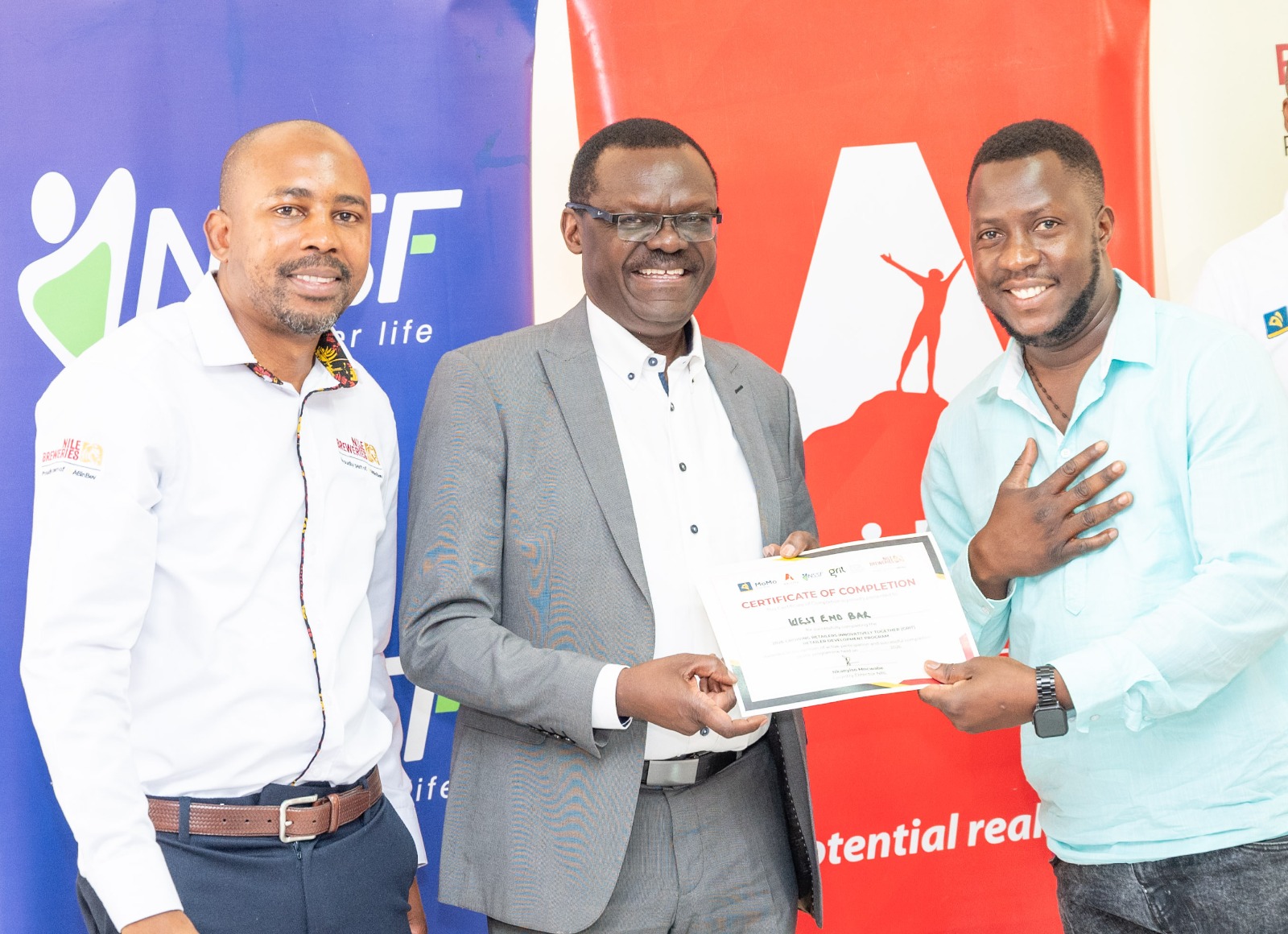
Speaking during the inaugural training in Makindye Division, where the first cohort of over 300 retailers was trained, Nkanyiso Mncwabe, Managing Director, NBL, noted that the training is expected to support business growth, strengthen retailer resilience and deepen financial inclusion among the business owners.
“Retailers are a critical part of our business and of Uganda’s wider economy. Our goal is to ensure that the retailers we work with are not only selling more, but building stronger, more sustainable businesses,” he noted.
“Through GRIT, we are empowering them with practical skills that help them manage money better, control stock, improve sales, trade responsibly and plan for growth to run their business successfully.”
The 2026 rollout builds on the success of previous GRIT cohorts, where over 1,560 retailers were trained in 2024 and 2025. This year’s training introduces a strengthened financial inclusion component through the integration of National Social Security Fund (NSSF) SmartLife Flexi, a flexible voluntary savings solution that allows individuals in the informal and semi-formal sectors to save for the future in a practical and accessible way.
Through this partnership, participating retailers will receive sensitisation on social security, long-term savings and financial resilience, with support to register and begin contributing to NSSF SmartLife Flexi. The integration is designed to help retailers build savings discipline while continuing to manage and run their businesses.
Patrick Ayota, the Managing Director of NSSF, said the partnership with NBL is an important step in extending social security to more Ugandans working outside traditional formal employment structures.
He noted that in the last 13 months since the introduction of NSSF Smartlife Flexi, over 81,000 Ugandans have signed up and have saved over UGX126 billion.
He further encouraged retailers to embrace a long-term savings culture, noting that the power of compound interest, often referred to as the “eighth wonder of the world,” can help small and consistent savings grow significantly over time.
He said this makes it important for business owners to start saving early and consistently, however modest the amount may be.
“Many small business owners and entrepreneurs contribute significantly to Uganda’s economy, yet they often operate without structured social security or long-term savings support. NSSF Smartlife Flexi was created to give such individuals a flexible way to save for the future. By integrating this solution into the GRIT programme, we are making social security more accessible to retailers and helping them build financial resilience beyond day-to-day business income.” Ayota said.
The programme will also continue to promote digital adoption and cashless transactions through MTN MoMo, enabling retailers to access mobile money solutions that support safer, faster and more transparent business transactions.
John Isabirye, Corporate Sales Manager, MTN MoMo, said MTN’s involvement in the programme aligns with its commitment to supporting small businesses with digital financial tools.
“Digital financial services are essential for small business growth. Through MTN MoMo, retailers can receive payments, make transactions, reduce cash-handling risks and improve visibility in their business operations. We are proud to support the GRIT programme because it gives retailers not only the knowledge to grow, but also the tools to participate more confidently in Uganda’s digital economy.”
According to the Uganda Bureau of Statistics, the Small and Medium sector accounts for 90% of the business sector in Uganda and employs over 2.5 million people, contributing approximately 20% of the country’s Gross Domestic Product (GDP).
For many retailers, the programme provides practical knowledge that can be applied in their businesses, from separating business and personal finances, tracking daily sales and stock, managing cash flow, improving customer service and planning for expansion.
A retailer who participated in a previous GRIT cohort noted that the training helped them better understand how to manage business finances and keep proper records.
“The training helped me understand how to separate business money from personal money, track my stock and plan better for my business. These are things we deal with every day, but many of us had never received formal training on how to manage them properly.”
Mncwabe added that the programme is not a one-off training activity, but part of a long-term commitment to retailer development.
“We want our retailers to grow with us, to become more resilient, more digitally enabled and more financially secure. As we scale the programme in 2026, we are also strengthening partnerships that bring real value to retailers beyond training, including access to digital payment solutions and social security through NSSF SmartLife Flexi,” he noted.
“Responsible retailing means reinvesting in their business; being able to manage and save money is important. The retailers are educated and exposed to a saving and investment culture to increase their sustainability.”
Through GRIT, NBL continues to position retailer empowerment as a core part of sustainable business growth, demonstrating how private sector partnerships can support entrepreneurship, financial inclusion, responsible retailing and community resilience across Uganda.